


Ball Python
Python regius

Snake
Key numbers
The figures below are a working snapshot of what a typical captive ball python needs, rather than a guarantee that every individual will fit them exactly. The rest of this guide explains the reasoning behind each number, so you can adjust sensibly when your own snake or your own house behaves a little differently.
- Adult size: Adults commonly reach 3 to 5 feet, and females are often the larger of the two.
- Lifespan: They often live 20 to 30 years, sometimes longer, which makes them a real commitment.
- Adult enclosure: An enclosure about 4 feet long by 2 feet deep by 2 feet tall is a practical minimum for one adult.
- Start size / grow-out: A hatchling can begin in something closer to 24 to 36 inches long, or in a well-set-up 20-gallon, before moving to the adult footprint.
- Housing: Keep one snake per enclosure.
- Warm hide: The surface the snake actually sits on in the warm hide should read about 88 to 92 F.
- Cool hide: The cool hide should sit around 75 to 80 F.
- Humidity: Keep humidity around 50 to 60 percent most of the time, and let it rise into the 70s when the snake is in shed.
- Hides: Provide at least one hide on the warm end and one on the cool end, both snug enough that the snake can touch the sides, plus a humid hide it can enter and leave.
- Diet: Feed a single appropriately sized rodent, usually frozen-thawed, on a schedule that matches the animal’s age and body condition.
Do’s and don’ts
This list is the short version of the husbandry covered in detail further down the page. If a line here and a paragraph later on ever seem to pull in different directions, trust the longer explanation, because it carries the context that a one-line rule cannot.
Do
- Give an adult an enclosure about 4 feet long by 2 feet deep (a 4x2), or larger, with a warm hide and a cool hide that actually differ.
- Measure the hide floors themselves, not a sticker on the glass.
- Keep humidity in a range the skin can shed in one piece, and raise it when the eyes go cloudy (in blue).
- Offer prey that is about as wide as the snake at mid-body, thawed thoroughly and offered with tongs.
- Leave a newly arrived snake alone for a week or more before the first handle, and longer if it has not eaten yet.
- Quarantine a new animal for at least 60 to 90 days in its own enclosure, with its own tools, before it shares air or equipment with a collection.
- Learn that individual’s ordinary patterns so a missed meal or a week of hiding can be read against a baseline.
- See a veterinarian who regularly treats reptiles when breathing, body condition, or shed quality leaves that baseline (local herp groups and exotic-vet directories help you find one before you need them).
Don’t
- Do not leave an adult in a 10- or 20-gallon “starter” tub as a finished home, or in a 36-inch grow-out box because the snake still coils inside it.
- Do not house two ball pythons together.
- Do not use a hot rock or an unregulated under-tank pad as the main heat.
- Do not keep the whole enclosure soaking wet, or bone dry, and call either one humidity control.
- Do not feed live rodents if a frozen-thawed animal will be taken; live prey can injure a snake that is not hungry.
- Do not handle for a couple of days after a meal, or while the snake is in blue (cloudy eyes before a shed).
- Do not read sitting in a water bowl, or wrapping around a person, as a human mood.
- Do not assume a winter appetite drop is brumation (a winter slowdown some keepers induce by cooling) you should force by cooling a thin animal.
- Do not buy a spider or other wobble-linked morph hoping husbandry will erase the neurology.
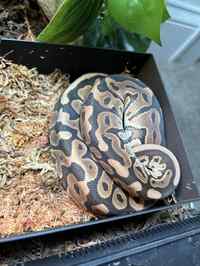
Wild-type ball python coiled in damp sphagnum, classic alien-head blotches.
A bit of background
The ball python, Python regius, is a small African python from the grasslands and forest edges of West and Central Africa. In the field they spend a lot of time in mammal burrows and other tight spaces, coming out more at night. That preference for a dark, snug cavity is the thing most captive setups are trying to recreate. A glass box with a thin hide in the middle of an open floor is the opposite of that picture.
They are marketed as beginner snakes because they stay a manageable size and because many of them sit still in a hand. Those traits can make them look easier than they are. A ball python that refuses food for weeks, or that spends the winter in a water bowl, is a common animal in this species, and both of those pictures have husbandry underneath them. They are also a twenty-year animal. The person who buys a hatchling is signing up for a long stretch of consistent heat, humidity, and rodent supply.
Adults commonly reach 3 to 5 feet, and females are often heavier and longer than males. Some designer morphs, most notably spider and other “wobble” lines, carry a well-documented neurological defect that shows up as a head wobble, corkscrewing of the neck, or trouble striking accurately. Good husbandry does not erase that defect, which makes it a purchase decision rather than a problem you can fix with a better temperature gradient. We return to morphs in more detail later in this guide, because the sales photos usually do not mention it.
This guide is general husbandry for Python regius. Individual animals vary, and nothing here replaces an exam by a veterinarian who regularly sees reptiles.
Whether they are a good fit
A ball python is a long-lived, humidity- and hide-dependent snake that needs a large footprint as an adult and a reliable source of frozen rodents. They do best in a household that can keep a stable day and night cycle, afford a thermostat on the heat, and leave the animal alone often enough that it will eat. They are a poor fit for anyone who wants a snake that is out and moving every evening, or for a first snake whose keeper is not prepared for a six-week hunger strike in winter.
We genuinely like ball pythons, but we also tell people that the quiet-in-the-hand part is the easy part. The harder parts are leaving the snake alone often enough, keeping two hides at two genuinely different temperatures, and not panicking the first time a perfectly healthy male skips meals from November to January.
Enclosure and space
Floor space matters because an adult needs a warm hide and a cool hide with real distance between them. If those two hides sit six inches apart in a 20-gallon, the “gradient” is a wish. A practical minimum for a single adult is about 4 feet long, 2 feet deep, and about 2 feet tall. Height matters less than footprint for this species. They are not arboreal, though some individuals will use a low branch. What they will not do, reliably, is thrive on an open floor with one decoration in the middle.
The adult enclosure we can actually point to on Amazon is the New Age Pet ECOFLEX 48-inch Mojave Reptile Lounge. Its exterior measures 48 inches long by 24 inches deep by 22.8 inches tall, and its interior is about 46.5 by 22.3 by 21.3 inches, which gives a true footprint of roughly 4 by 2 feet. That is about an inch short of the 24-inch height a “4x2x2” is usually marketed at, but for a terrestrial python that lives in its hides, the missing inch is no reason to choose a different brand. The part that does need a plan is the mesh top and side vents, because they let humidity escape quickly. Most keepers cover a good share of the cool-end screen with acrylic, glass, or even foil while leaving the warm-end mesh open for a lamp, and that is how they get this box to hold 50 to 60 percent humidity without turning the floor into mud. Keep in mind that the composite material is moisture-resistant rather than waterproof, so it is the wrong box for standing water. With the hides, the thermostat, and that screen cover in place, it is a reasonable adult home for one ball python.
A hatchling does not need that full footprint on its first day, and a frightened baby in a 4-foot open box will often sit in one hide and refuse food. An enclosure closer to 24 to 36 inches long, or a well-set-up 20-gallon tank, with the same two hides and a genuine gradient, is a kinder start. The ECOFLEX 36-inch Mojave, which measures about 36 by 18 by 18 inches outside with an interior closer to 34.6 by 16.4 by 15.8 inches, is a grow-out enclosure we will stand behind for a young animal, although it is not a finished adult home. Move the snake toward the 4x2 as it approaches adult length over its first couple of years, rather than years later on the grounds that “it still fits coiled,” because a snake that can coil up in a shoebox still has no room for a gradient there.
Tubs and rack systems can hold temperature and humidity well, and they are widely used by people who keep many animals, but they still need the same gradient and the same two hides. A rack tub with a single hide and a heat cable regulated only by a stick-on thermometer is a production shelf rather than a finished habitat.
Keeping one snake per enclosure avoids most social problems, and ball pythons are not a species that needs a companion. When two animals share one gradient, one of them usually claims the better hide, and feeding two snakes in the same box is a reliable way for a keeper to get bitten by the wrong one.
A tight hide at each end matters far more than a pile of decoration, and the snake should be able to coil up inside and feel the walls on all sides. A hide that is too large feels like open ground, so many ball pythons will ignore it and wedge themselves under the water bowl instead. That behavior is useful information, because it tells you the hide on offer is not snug enough, not that the snake “likes the water.” A third hide packed with damp sphagnum moss, known as a humid hide, which the snake can enter and leave as it pleases, is the shedding tool that lets you raise humidity for the animal without soaking the whole floor.
Some individuals will use climbing branches, but artificial plants, cork flats, and leaf litter that break up the sight lines matter more, because a ball python crossing open ground feels exposed. A water bowl that is heavy enough not to tip, and large enough for the snake to soak in if it chooses, belongs in the enclosure at all times. Front-opening doors are easier on many animals than a lid lifted off from above, and the sliding doors should always be locked. A ball python is no champion escape artist compared with a kingsnake, but a small gap at the door combined with a warm room is still how pet snakes end up lost inside couches.

Pale-morph ball python wedged under a water bowl — useful when a hide is not snug enough (not a wild-type ID shot).
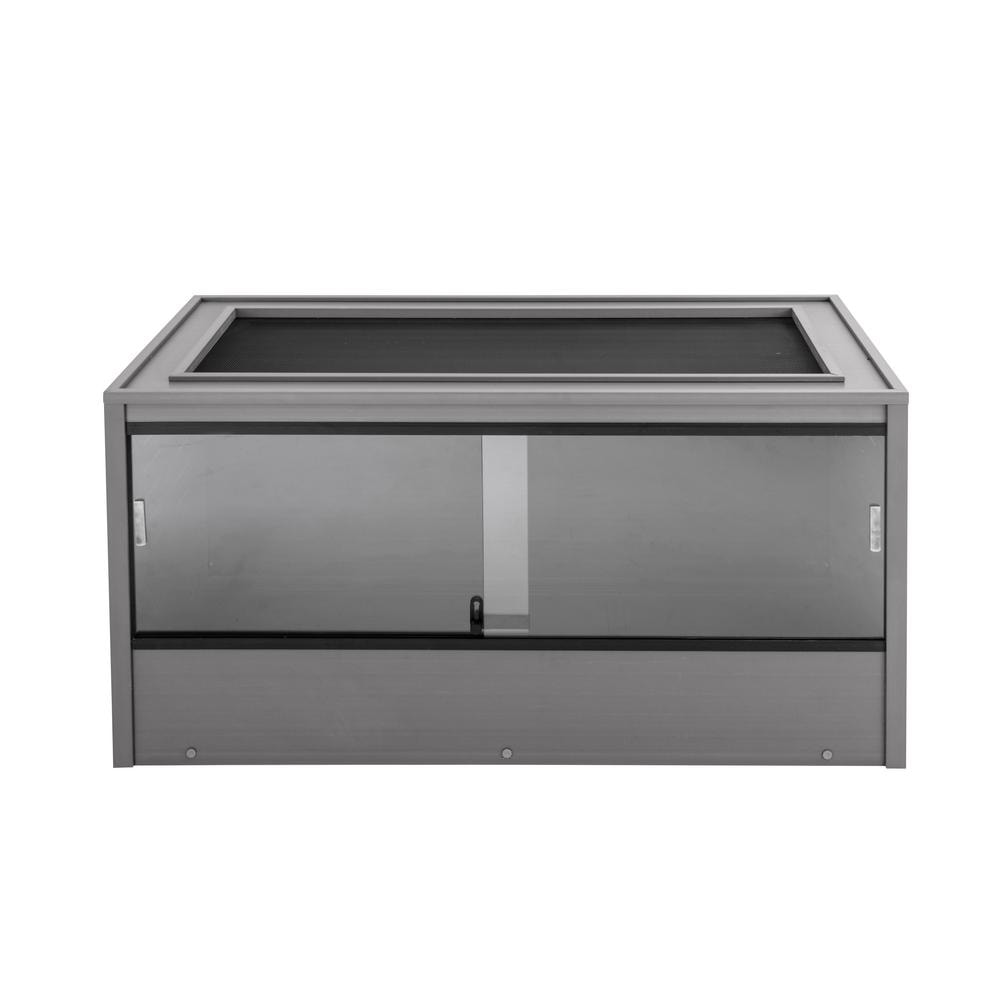
Stock photo of the New Age Pet ECOFLEX 48-inch adult footprint (not one of ours).
Temperature and the gradient
A ball python’s digestion and immune function are tied to temperature. The useful measurement is the floor of the hide the snake is actually using, taken with an infrared temperature gun or a probe sitting on that surface. Air temperature on a glass sticker can look acceptable while the hide is too cool to digest, or hot enough to burn.
A warm hide in the neighborhood of 88 to 92 F supports normal digestion for most adults, while the cool hide in the same enclosure typically sits around 75 to 80 F. The difference between those two ends is what allows the animal to regulate its own body temperature; if the whole box sits at a single temperature, the snake has nowhere to go. Temperatures can drop a few degrees at night, but the floor of the warm hide should not fall into the 60s.
How you measure matters just as much as the numbers themselves. An infrared gun reads a surface, and it averages the temperature across a circle rather than a single magic point under the laser dot. The Etekcity Lasergrip 774 we list has a 12-to-1 distance-to-spot ratio, which means that from about a foot away you are reading a circle roughly one inch across, so move closer when you measure a hide floor. Never take a reading through glass, and do not treat a reading off a shiny water bowl as the hide temperature. Dark, matte surfaces, such as the hide floor, the cypress, or the snake’s own coils if you are checking its body surface, give honest readings. A probe thermometer or hygrometer belongs inside the enclosure, ideally with the sensor in the air or on the floor of a hide, rather than stuck to the outside of the glass. If you run a heat mat or a ceramic emitter, the thermostat probe belongs on the surface being controlled, which is usually the warm hide floor, so that the thermostat regulates the place where the snake actually sits rather than the room air.
Map the temperatures once the enclosure is fully furnished rather than while it is empty, because substrate insulates an under-tank pad and a humid hide changes the air around it. Recheck after you add three inches of cypress, after you cover half the screen, and again when the house heating changes in October. We would much rather a keeper take five infrared readings (warm hide floor, cool hide floor, mid-floor, warm air, and cool air) once a week for a month than glance at a single stick-on thermometer and call it husbandry.
Heat is safest when a thermostat controls it, whether the source is an overhead halogen flood, a radiant panel, a ceramic emitter, or a quality heat pad on the outside of a tub. Unregulated heat mats and hot rocks are a frequent cause of burns. Overhead heat combined with a hide the snake can sit beneath is closer to the way a burrow warms from above than a pad heating the belly through glass. Match the type of thermostat to the heat source: an on/off thermostat suits a heat mat or many ceramic emitters, while a dimming (proportional) thermostat suits a visible bulb, because switching a halogen fully on and fully off is hard on both the lamp and the gradient. Put the heat on a thermostat before the snake moves in, because a lamp that “seems fine” at midnight is exactly how hide floors end up at 110 F.
Light, UVB, and the daily cycle
Ball pythons are largely crepuscular and nocturnal, meaning they are most active at dusk and during the night. They do not need a bright bank of desert lighting the way a bearded dragon does, but they do need a clear day and night. A simple schedule of 12 hours on and 12 hours off, even if the “on” period is just room light, is easier on them than lights switching at random hours, and a snake that never gets a proper dark period has an appetite and hiding pattern that are much harder to read.
Low-level UVB has become more common for this species over the last several years. It is not a substitute for a correct thermal gradient, however, and a high-output desert tube is the wrong lamp for a snake that hides during the day. Keepers who use UVB with ball pythons generally choose a low-output linear tube and give the snake enough cover to get out of the light whenever it wants. If you also use a heat lamp, remember that it provides heat only, not UVB.
Humidity, water, and shedding
Ball pythons are not desert snakes, and ambient humidity of around 50 to 60 percent is typical of a setup that works well. When the eyes turn cloudy, a stage keepers call being “in blue,” the snake is about to shed, and raising humidity into the 70s helps the skin come off in one piece. A humid hide, meaning a hide filled with damp sphagnum or moss that the snake can enter and leave, is often enough on its own without soaking the whole enclosure.
The shed cycle is much easier to live with if you watch it as a predictable sequence rather than a surprise. First the snake’s colors dull, its eyes turn blue-grey, and its belly often looks milky. Next the eyes clear for a day or two, a stage known as “the clear,” and the skin begins to look loose. Finally the snake rubs the old skin off, ideally in one piece that includes both eyecaps and the tail tip. Handling a snake while it is in blue is a good way to provoke a defensive strike or damage the shed, and feeding during this stage often leads to a refusal or a regurgitation, so the best approach is to leave the snake alone, freshen the humid hide, and wait.
Substrate that stays wet over long periods, especially on a cool floor, commonly leads to scale rot, while chronically dry air commonly leads to stuck eyecaps and ragged sheds. What you are aiming for is a surface that feels dry to the touch where the snake rests, with humidity held in the air and a humid hide available. In a mesh-top ECOFLEX or any other screen-lid enclosure, that usually means covering part of the lid, keeping a few inches of cypress at the cool end that you can dampen, and refreshing the sphagnum so it stays damp rather than dripping. A hide sitting in a puddle is not a humid hide at all; it is simply a wet cave on a cool floor.
A healthy shed comes off in one piece, eyecaps included. Patchy sheds that keep recurring usually point to a humidity or hydration problem, or to an animal that is not in good condition. Rings of old skin left on the tail tip can tighten as they dry and eventually cut off circulation to the tip. Rather than peeling stuck shed off with your fingernails, raise the humidity, offer a shallow soak in lukewarm water that the snake can climb out of easily, and see a reptile veterinarian if an eyecap stays in place or a band of skin is tightening.
A snake that sits in its water bowl for days is not showing that it “likes to swim”; more often it is too dry, too hot, or carrying mites. Check the hide floors with the infrared gun, check the hygrometer, and look for tiny black or red specks on the skin, in the water, and on pale substrate. A soak on the night before a shed can be perfectly ordinary, but a soak that lasts all week is a sign to investigate, not a personality trait.
Diet
Ball pythons eat rodents. Depending on the individual, hatchlings usually start on mouse hoppers or rat crawlers, which are small juvenile rodents past pinkie size but not yet adult. A hopper is a young mouse that has fur and open eyes but is still well short of adult size, and a rat crawler is the rat equivalent, a small and mobile juvenile rat. Adults typically move on to rats sized so that the prey is about as wide as the snake at the thickest part of its body. Offering frozen-thawed prey that has been warmed through, using tongs, is the method that avoids most injuries from prey bites. Thaw the prey in the refrigerator or in cold water, then warm it in warm water until it is roughly body temperature, neither hot nor still icy inside the body cavity. A snake that will only strike live prey can often be transitioned to frozen-thawed, and it is worth doing, because a snake that is not hungry can be badly chewed by a live rat left in its enclosure overnight.
Young animals are commonly fed every 7 to 10 days, while adults often go 10 to 14 days between meals, and some heavier adults do well on an even longer interval. Body condition is a better guide than the calendar: a snake whose body folds in on itself with fat pads over the spine is being fed too often or too much, whereas a snake with a sharply triangular cross-section and a visible spine is being fed too little or may be ill.
Hunger strikes
Hunger strikes are ordinary in this species, but they are also the first thing people put down to “the snake being picky,” which is how a cold hide gets overlooked. Males in particular often lose their appetite during the cooler, shorter days of the year; in many U.S. collections this lines up with fall and winter and can stretch from weeks to a couple of months, especially around breeding season. A well-conditioned adult that still uses both hides, still sheds cleanly, still drinks, and still looks like itself can safely go a long stretch without a meal. A thin animal, a new arrival, or a snake that is losing weight does not fall into that category.
Before you try a different color of rat, measure the enclosure. Confirm that the warm hide floor is at 88 to 92 F, the cool hide is in the 75 to 80 range, and humidity is in the 50s to 60s, and make sure the snake is neither in blue nor sitting with its mouth open. Offer food after the room is dark, use tongs rather than fingers, and warm the prey thoroughly. If the snake has just been moved, give it time to settle, and if it has just shed, wait a few days before trying again. Weigh the snake weekly on a kitchen scale and write the number down, because a snake that holds a stable weight and hides with its mouth closed is a very different case from one that has lost ten percent of its body weight, strikes and misses, or regurgitates.
Several common responses do not help: leaving a live rodent in the enclosure overnight, “brumating” a thin animal by cooling the box, handling the snake every evening to see whether it has changed its mind, or working through every prey type in the freezer within a week. What does help is getting the temperatures and hides right, providing darkness, and allowing time. A hunger strike that costs the snake real body condition, or that comes with bubbles, wheezing, or a stuck shed, calls for a veterinary appointment rather than a new color of rat and another two weeks of waiting.
Substrate
Cypress mulch, coconut husk, and similar products that hold a little humidity without turning to mud are widely used for this species. Aspen is cheap and easy to spot-clean, but it is a poor match for an enclosure that is supposed to stay in the 50s and 60s for humidity. Paper and unprinted newsprint work well for quarantine and for animals with wounds, although they hold almost no moisture.
Whatever you use, the substrate needs to stay dry enough beneath the snake that its scales are not resting in wet mulch for weeks at a time. Remove feces and urates as soon as they appear, and change the substrate completely often enough that the enclosure never smells like a damp rodent bin. The same rules apply in a bioactive setup: the surface the snake’s belly rests on should never be a swamp, and the humid hide remains the tool for shedding.
Handling and daily life
Most captive ball pythons will rest calmly in a hand once they are used to being picked up, provided they are supported along the body rather than left dangling from the last third of the tail. Short, calm sessions, begun after the snake has had a chance to settle into its new enclosure, go much better than daily wrestling. Postpone handling for a couple of days after a meal and while the snake is in blue, because both are times when a defensive strike or a regurgitation is likely.
A snake that rolls into a ball, tucks its head into the center of the coil, and stays there is performing the behavior its common name comes from. That is a defensive or uncertain animal, not a snake that is “cuddling.”
Wash your hands thoroughly before and after every session. Use tongs for food and your hands for the snake, and try not to smell like a rat when you reach in to take it out, because a lot of supposedly “mean” ball pythons are simply animals that have learned the opening door predicts dinner.
Body language and behavior
Ball pythons are easy to misread because they are still, and because people put human stories on stillness. A snake wrapped around a forearm is often staying put on a warm surface, not bonding. A snake that hisses and strikes at the enclosure door is often a snake that has learned the door predicts tongs and a rat, not a snake that has decided it “hates” people. Anthropomorphizing (treating the animal as if it has human motives, moods, and social needs) is how keepers miss the actual information: whether this individual is using both hides, eating on its own pattern, shedding clean, and breathing with a closed mouth.
The more useful habit is to learn the patterns of the particular animal in front of you: which hide it uses after the lights come on, whether it usually explores for twenty minutes after dark and then settles, and how it reacts to the lid opening compared with the appearance of the tongs. Once you know that baseline, it is a change from it that matters. Two ball pythons of the same morph and age can have quite different ordinary days, so comparing yours with a video of someone else’s snake is a good way either to invent a problem or to miss a real one.
Pale-morph ball python periscoping — body language, not a husbandry model.
Signals that are usually ordinary
Balling up is a defensive coil that is especially common in younger or newly acquired animals, and tongue-flicking is simply the snake sampling the air. A slow cruise around the enclosure after the room goes dark is ordinary nocturnal behavior. Periscoping, in which the snake raises the front of its body and looks around, reflects attention, often toward movement or a food cue, rather than a snake “standing up to say hello.” A snake that goes off its food for a stretch in winter while still hiding normally and holding its weight is also a common picture in this species, particularly among males.
Hissing, or a closed-mouth strike at the glass when the lid opens, can be either food-related or defensive. The rest of the picture, including the time since the last meal, whether the tongs are in view, and whether the snake is in shed, is what makes the behavior make sense. Neither is a greeting, and neither is a diagnosis of the snake’s personality.
What to watch for
The behaviors worth acting on are those that depart from the animal’s own established pattern, especially when several of them appear together.
- Open-mouth breathing, wheezing, clicking, or bubbles at the mouth or nose. That is a respiratory picture, not a snake that is yawning at you.
- Days on end in the water bowl, especially with tiny black specks on the skin or in the water. Check for mites, then check heat and humidity.
- Stuck eye caps, ragged shed, or constricting bands of skin left on the tail tip after a shed.
- Belly scales that are brown, pink, or blistered, or a snake that is lying in wet substrate and reluctant to move. That is a scale-rot picture.
- Weight loss through a hunger strike, or a snake that strikes and misses, or regurgitates. Check temperatures first, then a reptile veterinarian.
- Stargazing, corkscrewing, or a snake that cannot right itself is a neurological picture and is not something to wait out. In a spider or other wobble-linked morph, some of that may be the animal’s baseline; a sudden worsening, or the same picture in a morph without that history, still needs a veterinarian.
If you notice any of these patterns, check your husbandry first, and then see a reptile veterinarian if the animal does not return to its own normal baseline.
Morphs, spider, and wobble
“Normal” or wild-type ball pythons are the brown-and-tan animals most people picture when they think of the species, and almost everything else in the trade is a morph, meaning a color or pattern gene, or a combination of several, sold under a trade name. Morphs do not change anything about the enclosure a snake needs, but they do change what you are buying when the gene in question is tied to a neurological defect.
Spider is the best-documented example. Animals that carry the spider gene very often show a “wobble,” which can appear as a head tremor, a corkscrewing of the neck, missed strikes, or difficulty righting themselves after rolling over. The severity ranges from a flicker you only notice when the snake is excited to an animal that cannot feed without help. The wobble does not grow out once the hide reaches 90 F, it is not caused by mites, and no humidifier will erase it. Champagne, some woma and hidden-gene-woma lines, and a handful of other named genes come up in the same discussion. Rather than turn this guide into a gene chart, our advice is simple: if a trade name is associated with a wobble, ask to see the animal move, strike, and right itself before any money changes hands, and treat whatever you see as that animal’s permanent baseline rather than a passing phase.
Some keepers live successfully with a mildly affected animal, and that can be true while still being a welfare choice you should make deliberately. Buying a severely affected hatchling because its pattern is pretty is how people end up with a snake that cannot eat and a forum thread that will not fix the problem. We would rather offer honesty than a comforting story that the right enclosure will smooth the problem out.
If a snake from a morph not linked to wobble suddenly corkscrews, stargazes, or cannot right itself, treat it as an emergency, since the cause may be an infection, a toxin, inclusion body disease, or an injury rather than genetics, and take it to a reptile veterinarian promptly.
Problems that show up often
Respiratory disease is the classic captive problem in this species, and it usually follows an enclosure that is too cold, damp and cold together, or too dry and dusty. Open-mouth breathing and bubbles at the mouth or nose call for prompt action rather than waiting to see what happens.
Scale rot tends to follow wet, dirty substrate, especially on a cool floor. Mites reveal themselves as tiny specks, prolonged soaking, and a snake that seems restless or looks anemic. Inclusion body disease, caused by reptarenavirus, is a serious viral disease of pythons and some boas; it spreads between snakes and must be diagnosed by a veterinarian rather than a forum thread, which is one of the main reasons quarantine and keeping animals separate matter so much. Other serious infections exist as well. Finally, a hunger strike that costs the snake real body condition is a reason for an examination, not for trying a new color of rat and waiting another two weeks.
Bringing a new animal home
A quarantine period of at least 60 to 90 days in a separate enclosure, with its own tongs and water bowl and a fecal check, is a much kinder start than placing a new snake straight into a display vivarium on its first day. The goal is not to be unwelcoming; it is that parasites, mites, and viruses such as inclusion body disease give no sign of themselves on the drive home, and they travel easily on shared hooks, bowls, and hands.
Set up quarantine before the snake arrives. A simple tub or the grow-out enclosure works well, furnished with paper or unprinted newsprint so that feces and mites are easy to see, two snug hides, a humid hide, a heavy water bowl, a thermostat on the heat source, and an infrared gun you will actually use. Before adding any decoration, confirm that both hides reach the correct temperatures and that humidity is within range. Do not share tongs, bowls, or substrate scoops with the rest of a collection, and either handle the quarantined animal last or wash your hands and change your shirt in between. A fecal exam at intake, followed by another before the animal moves into a display enclosure, costs very little compared with treating a whole room of snakes.
Leave the animal alone long enough for it to eat at least a couple of meals before you begin regular handling. Those first weeks are also the time to start learning its ordinary behavior, such as which hide it chooses after the lights come on, whether it cruises around after dark, and how it reacts to the door opening compared with the appearance of the tongs. Record its weight as well. A new ball python that hides at first and then eats during its second week is off to a common and good start. One that is still losing weight in its sixth week, has not shed cleanly, or sits with its mouth open is not simply “shy,” and it needs a husbandry check followed by a visit to a veterinarian.
If you already keep other pythons or boas, quarantine is not an optional courtesy; it is the practical safeguard against diseases you cannot see on even the prettiest morph.
Recommended gear
Some of the links below go to Amazon, and if you buy through them we may earn a small commission. This does not change the price you pay.
When you are budgeting, remember that two snug hides and a thermostat matter more than decoration, and that cypress holds humidity better than aspen for this species.
- New Age Pet ECOFLEX 48-inch Mojave Reptile Lounge for a single adult (exterior 48 x 24 x 22.8 inches; cover part of the mesh top to hold humidity)
- New Age Pet ECOFLEX 36-inch Mojave Reptile Lounge as a hatchling-to-subadult grow-out, not a finished adult home
- Etekcity Lasergrip 774 for the hide floors
- TempPro TP65 indoor/outdoor thermometer and hygrometer (previously ThermoPro) so a remote sensor can sit inside the enclosure
- BN-LINK on/off heat-mat thermostat for a heat mat or ceramic emitter
- REPTIZOO dimming thermostat if the heat is a bulb
- Zoo Med Forest Floor cypress
- Zoo Med Repti Shelter 3-in-1 Cave, Large as a humid hide an adult can actually fit, packed with damp moss
- Zoo Med New Zealand Sphagnum Moss for that hide
- Zoo Med stainless steel feeding tongs, 10-inch
Closing
Ball pythons reward keepers who measure their hide floors and leave the animal alone often enough that it will eat. They do poorly in impulse setups, such as a 20-gallon tank meant as a permanent home, an unregulated heat pad, a mesh lid with no plan for humidity, or a spider morph bought from a photo. If you can keep a 4x2 enclosure with two snug hides at two genuinely different temperatures, and you are happy with a snake that spends most of the day tucked away in a hole, this is a good species for you. If you want an animal that is out and busy every evening, it is the wrong one.
If you have questions about an animal you already keep, or you find a loose pet snake near Cartersville and want a photo ID, reach out. We relocate snakes within about an hour of Cartersville at no charge when that is the right help. Nothing in this guide replaces hands-on judgment for a specific animal or an exam by a veterinarian who regularly sees reptiles.