


Bearded Dragon
Pogona vitticeps
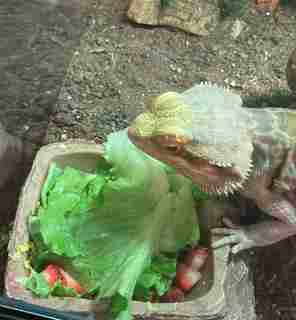
Lizard
Key numbers
The figures below are a working snapshot of what a typical inland bearded dragon needs, rather than a guarantee that every individual will fit them exactly. The rest of this guide explains the reasoning behind each number, so you can adjust sensibly when your own dragon or your own house behaves a little differently.
- Adult size: Adults commonly reach 16 to 24 inches, including the tail.
- Lifespan: With consistent care they often live a decade or more, sometimes into their mid-teens.
- Adult enclosure: An enclosure about 4 feet long by 2 feet deep by 2 feet tall is a practical minimum for one animal.
- Start size / grow-out: A small juvenile can begin in a 40-gallon enclosure, about 36 by 18 inches, if heat and UVB are correct, or go straight into the 48-inch enclosure if the basking perch and UVB distance are right.
- Housing: Keep one dragon per enclosure.
- Basking surface: The basking surface should read about 100 to 110 F, measured on the perch itself.
- Cool side: The cool side should sit around 75 to 85 F.
- Overnight: Overnight temperatures from the mid-60s to the mid-70s are usually acceptable in a typical house; extra night heat is for a genuinely cold room, not simply because the lights go off.
- UVB: Provide a T5 high-output linear tube in the 10 to 12 percent range (or an equivalent 10.0 HO tube) over the basking end, and replace it on the manufacturer’s schedule, commonly every 6 to 12 months.
- Day length: About 12 hours on and 12 hours off is a common indoor light cycle.
- Humidity: Keep ambient humidity around 30 to 40 percent.
- Juvenile diet: Juveniles eat roughly 70 percent insects and 30 percent plant matter, with greens offered daily.
- Adult diet: Adults eat closer to 70 percent plants and 30 percent insects, with insects offered several times a week rather than at every meal.
Do’s and don’ts
This list is the short version of the husbandry covered in detail further down the page. If a line here and a paragraph later on ever seem to pull in different directions, trust the longer explanation, because it carries the context that a one-line rule cannot.
Do
- Give an adult an enclosure about 4 feet long by 2 feet deep by 2 feet tall (a 4x2x2), or larger, with a warm end and a cool end that actually differ.
- Measure the basking surface itself, not the air or the glass.
- Use a long high-output fluorescent UVB tube (T5 HO) in the 10 to 12 percent range and replace it before it looks burned out.
- Keep one dragon in the enclosure.
- Feed the insects a decent diet before offering them (gut-load) and dust them with calcium, especially while the animal is growing.
- Shift the diet toward greens as the animal matures. An adult that still eats like a hatchling is how fat pads and a lazy gut show up.
- Feed on a bowl or a smooth slate if the floor is anything other than solid.
- Quarantine a new animal for at least 60 to 90 days in its own enclosure, with its own dishes, before it shares air or equipment with a collection.
- Learn that individual’s ordinary patterns (appetite, stool, color, how it uses the gradient, how it reacts to people) so a change is visible.
- See a veterinarian who regularly treats reptiles when appetite, stool, breathing, or body condition leaves the animal’s own baseline (local herp groups and exotic-vet directories help you find one before you need them).
Don’t
- Do not leave an adult in a 20- or 40-gallon starter kit, or in a 36-inch grow-out because the dragon still fits.
- Do not house two dragons together because they “get along.”
- Do not treat a compact coil UVB or a sunny windowsill as a substitute for a proper tube.
- Do not use hot rocks or under-tank heat as the main way to warm the animal.
- Do not use calcium sand, or any loose substrate, as the default floor for a juvenile that lunges at food.
- Do not feed insects from the yard or a porch light.
- Do not read a dark beard, closed eyes, or sitting on a person as a human mood.
- Do not cool a thin, parasitized, or shaky animal on purpose because it is “brumating.”
- Do not add another powder and wait when the animal is straining, bubbling at the nose, or losing weight.
- Do not buy a silkback hoping humidity will grow the scales back. The skin is the morph.
- Do not add a new dragon to a room that already has reptiles without isolating it first. Atadenovirus and ordinary parasites travel on shared dishes and hands.
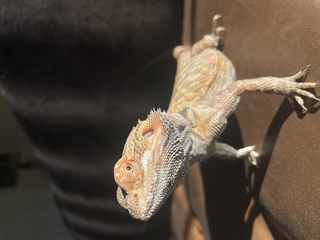
Alert bearded dragon portrait showing beard spikes (morph not confirmed as wild-type).
A bit of background
The inland bearded dragon, Pogona vitticeps, is a medium-sized diurnal lizard native to the arid and semi-arid interior of Australia. In the wild these dragons spend much of the day moving between sun and shade, using rock, fallen timber, and open ground to regulate their body temperature. That daily pattern of basking and retreating is what most captive setups are trying to recreate, whether the enclosure looks like a desert diorama or a simple wooden vivarium with a tile floor, and a glass box with one thin branch under a coil bulb is the opposite of it. A dragon that sits in the same spot all afternoon is not being “lazy”; it is either using the only warm, bright surface it has been given or sitting wherever the temperatures happen to come closest to what it wants.
They became one of the most widely kept pet reptiles in the United States because they are diurnal, reasonably tolerant of people, and show a lot of body language. Those traits can make them look easier than they are. A dragon that sits still on a couch is not evidence that the enclosure is doing its job. Most of the chronic problems we see (soft bone, poor shedding, obesity, chronic low-grade illness) come from heat, light, space, or diet being a little bit off for a long time rather than from a single dramatic mistake. We like them. We also tell people the sit-still-on-a-hand part is the easy part. The hard part is measuring the basking perch instead of trusting a sticker, keeping a linear UVB tube in date, and changing the diet when the animal stops being a growing insectivore and starts being an adult that needs a salad.
Adults commonly reach 16 to 24 inches including the tail and can live well over a decade with consistent care, sometimes into their mid-teens, which makes them a real commitment. Anyone who buys a four-inch hatchling is signing up for many years of consistent heat, a UVB lamp replaced on schedule, and an enclosure that will not remain a starter kit forever. The dragon’s tameness in the hand is what sells it, but the basking surface and the salad bowl are what keep it healthy.
Designer colors and reduced-scale morphs, silkbacks especially, are a purchase decision rather than something a better gradient can fix. A silkback’s skin demands more careful humidity, shed management, and a gentler surface than a standard animal’s, and neither good husbandry nor a prettier enclosure will make the scales grow back. This guide covers general husbandry for Pogona vitticeps; other Pogona species have their own needs, individual animals vary, and nothing here replaces an examination by a veterinarian who regularly sees reptiles.
Whether they are a good fit
A bearded dragon is a long-lived, heat- and light-dependent animal that needs a large footprint and a reliable source of appropriately sized feeder insects when young. They do best in a household that can keep a consistent day and night cycle, afford UVB lamps on a replacement schedule, and make space for an enclosure that will not stay a starter kit forever. They are poor candidates for small bedrooms that cannot get warm enough, or for anyone hoping the animal will live in a 20- or 40-gallon tank as an adult.
We like them. We also tell people the sit-still-on-a-shoulder part is the easy part. The hard part is measuring the perch instead of the glass, keeping a 4-foot box in a room that can actually hold it, and not panicking the first time a healthy adult skips bugs for a week of greens, or the first time a well-conditioned adult sleeps more in January. If that sounds like more patience than you have, this is the wrong species, and that is a kinder conclusion than a dragon that sits in a 40-gallon for five years because the owner is tired of the project.
They are also a poor fit for anyone who wants a tropical climbing lizard in a tall planted enclosure, or a pair that will “keep each other company.” Bearded dragons are ground-basking lizards from arid country, and while they will use a low branch, they will not use height the way a chameleon does, and they will not thank you for a fogger or a roommate.
Enclosure and space
Because bearded dragons are ground-basking lizards that also climb, floor space matters more than height. A practical minimum for a single adult is about 4 feet long, 2 feet deep, and 2 feet tall, which provides enough room for a warm end and a cool end that genuinely differ, and that difference is the whole point of a thermal gradient. If the basking perch and the cool hide sit twelve inches apart in a 40-gallon tank, both ends share the same air mass, and the dragon cannot choose a different temperature because there is no different temperature to choose.
Many animals sold with 40-gallon “breeder” tanks outgrow those dimensions well before they are fully adult. A small juvenile can start in a 40-gallon tank of about 36 by 18 inches as long as the heat and UVB are correct, and a hatchling can also go straight into the 48-inch enclosure if the basking perch is sized to the animal and the UVB distance still matches the lamp chart, which is often the simpler path. What is not acceptable is leaving an adult in the grow-out enclosure. Plan to move to the 4x2 footprint as the dragon approaches adult size, often within its first year to 18 months, and treat the starter kit as short-term housing rather than a finished home, because a dragon that can merely turn around in a 40-gallon tank still has no real gradient.
The adult enclosure we can actually point to on Amazon is the New Age Pet ECOFLEX 48-inch Mojave Reptile Lounge. Its exterior measures 48 inches long by 24 inches deep by 22.8 inches tall, and its interior is about 46.5 by 22.3 by 21.3 inches, which gives a true footprint of roughly 4 by 2 feet. The exterior height is about 1.2 inches short of a marketed 4x2x2 (24 inches), and the interior is closer to 21 inches. For a basking lizard that needs a perch under a lamp, that missing height does matter, because you still have to leave room under the mesh to respect the UVB distance chart, but it is the footprint that makes the gradient work. The manufacturer’s own size chart markets this size for adult bearded dragons, and we will stand behind the 48-by-24 footprint as a reasonable adult option for one animal. Larger is fine, but a 36-inch enclosure is a grow-out rather than a finished home.
The mesh top and side vents need a plan, although for this species the plan is the opposite of a ball python’s. Bearded dragons want the main enclosure kept on the dry side, and the mesh and vents help you hold ambient humidity around 30 to 40 percent without turning the floor into mud. You still need a shallow water dish the dragon can enter and leave. The composite material is moisture-resistant rather than waterproof, so it is the wrong box for standing water, and heat lamps should sit on the mesh without touching the ECOFLEX panels. Front-opening sliding doors are easier on many animals than a lid lifted off from above, and they should always be locked. A bearded dragon is no champion escape artist compared with a kingsnake, but a small gap at the door combined with a warm room is still how pets end up lost under couches.
Dress the box before the dragon goes in, not after. Put a solid basking perch at the warm end, under the heat and the UVB, large enough that the animal can get its entire body into the warm, bright zone, not just the head. Put a hide at the far cool end so they can drop temperature without leaving the enclosure. Branches or a low climb help, but a pile of clutter that blocks the UVB and heat from reaching the animal is less useful than it looks. The water dish belongs where it will not sit on the heat and will not tip when the dragon climbs in. Then turn the heat and the UVB on, and wait. Measure the basking surface the next day, and again after you add a liner or a thin layer of substrate. An empty box and a dressed box do not run the same numbers.
Keeping one dragon per enclosure avoids most social problems. Bearded dragons are not a species that needs a companion, and when two animals share one gradient, one of them usually claims the basking site. Injuries and chronic stress are common when dragons are housed together, even when they appear to “get along” at first, because a dragon that seems to get along with a tankmate has often simply learned to stay off the perch, and that is not enrichment.
A screen top also helps with ventilation and makes it easy to mount lights. Whatever basking furniture you choose, whether wood, rock, or a solid ramp, it works best when the animal can fit its entire body into the warm, bright zone, and a hide on the cool side gives it somewhere to lower its temperature without leaving the enclosure.
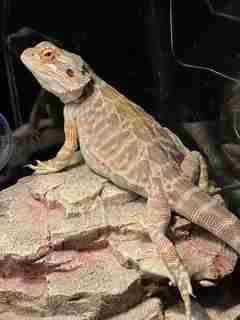
Bearded dragon relaxed on enclosure rock furniture. Loose mix underfoot is a later naturalistic floor, not the default first setup.
Temperature and the gradient
A bearded dragon’s digestion, immune function, and activity are all tied to temperature. The measurement that matters is the temperature of the surface the dragon sits on while basking, taken with an infrared temperature gun rather than a stick-on thermometer on the glass, because glass and air readings can look acceptable while the basking perch is too cool or hot enough to burn. We have seen plenty of enclosures where the sticker read 95 while the perch was actually 88, or 118. The dragon lives on the wood or the rock, not on the glass, so that is where you need to measure.
For most adults, a basking surface in the neighborhood of 100 to 110 F is the range that supports normal behavior and digestion. Juveniles are often kept toward the warmer end of that range because they are growing and feeding more often. The cool side of the same enclosure is typically around 75 to 85 F. The difference between those two ends is what lets the animal self-regulate. If the whole box sits at one temperature, they have nowhere to go. A dragon that spends all day on the cool end is telling you the basking site is too hot, or the perch is too small, or the UVB is in the wrong place. A dragon that never leaves the basking site may be too cool everywhere else, or may simply prefer that surface. Measure before you invent a story.
How you measure matters just as much as the numbers themselves. An infrared gun reads a surface, and it averages the temperature across a circle rather than a single magic point under the laser dot. The Etekcity Lasergrip 774 we list has a 12-to-1 distance-to-spot ratio, so from about a foot away you are reading a circle roughly one inch across; for a basking perch, six to eight inches is a more honest working distance than standing across the room. Never take a reading through glass, because glass reflects infrared and you will measure the glass rather than the wood behind it, and do not treat a reading off a shiny water bowl as the basking temperature. Dark, matte surfaces, such as the perch, the rock, or the dragon’s own back if you are checking its body surface, give honest readings. Take two or three readings of the same perch, use the middle value, and write it down with the date, because a single glance you have forgotten by Thursday is not a record.
A probe thermometer or hygrometer belongs inside the enclosure, ideally with the sensor in the air at the cool end or on the floor away from the lamp, rather than stuck to the outside of the glass. If you run a halogen flood or another overhead bulb, the thermostat probe belongs near the basking surface it controls, so that the thermostat regulates the place where the dragon sits rather than the room air. Tape or weight the probe down so it cannot drift into the lamp or under a pile of décor, because a probe hanging loose in mid-air will either shut the heat off before the perch is warm or leave it running until the wood is dangerously hot, depending on the air that day.
Map the temperatures once the enclosure is fully furnished rather than while it is empty, because a liner or a thin soil mix changes how heat settles and a tall branch changes the distance to the lamp. Recheck after you add substrate, after you move the perch, and again when the house heating changes in October. We would much rather a keeper take five infrared readings (basking surface, mid-floor, cool-end surface, warm air, and cool air) once a week for a month than glance at one stick-on thermometer and call it husbandry. After that first month you will know how your enclosure behaves, and you can ease back to a weekly check plus a fresh check whenever you change something.
Overnight, many rooms in a typical house drop into the mid-60s to mid-70s, which is usually acceptable, so a night heat lamp is not required simply because the lights go off; extra night heat becomes relevant only when the room itself gets genuinely cold. Colored “night glo” bulbs are unnecessary and interrupt the dragon’s dark rest period. A bearded dragon does not need a red lamp to “see at night”; what it needs is a period of true darkness.
A halogen flood on a dimmer or thermostat, or another overhead heat source that can be controlled, is easier to manage than an unregulated bulb that runs wide open. Under-tank heat and hot rocks are a frequent source of ventral burns, because the animal sits on a surface that does not behave like sun-warmed rock and because those products often have poor temperature control. Overhead heat plus a surface the dragon can climb onto is closer to how they warm up in the wild.
Heat is safest when a thermostat controls it, and the type of thermostat should match the heat source. An on/off thermostat suits a heat mat or many ceramic emitters, while a dimming (proportional) thermostat suits a visible bulb, because switching a halogen fully on and fully off is hard on both the lamp and the gradient. The BN-LINK we list is an on/off controller, and the REPTIZOO is a dimming PID unit intended for bulbs. Put the heat on a thermostat before the dragon moves in, because a lamp that “seems fine” at midnight is exactly how perches end up at 120 F.
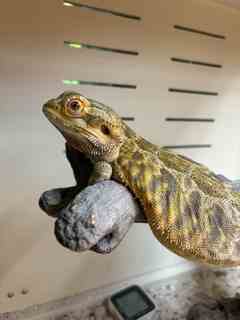
Bearded dragon basking on a branch with temperature and humidity monitors in view. Loose substrate shown here is a later floor option, not the default first setup.
UVB and the daily light cycle
Bearded dragons synthesize vitamin D3 in their skin when exposed to ultraviolet B light, and they use that D3 to move calcium into bone and tissue. A heat lamp produces warmth and visible light, but it does not replace UVB. Ordinary window glass also blocks most UVB, so a tank on a sunny windowsill is still a tank without UVB. We still see animals that spent a year “in the sun” behind a pane of glass and arrived with a soft jaw, because although the window looked bright, the UVB never reached them.
The setup that has become standard for this species is a T5 high-output linear UVB tube in the 10 to 12 percent range (or an equivalent “10.0” HO tube), long enough to cover at least the basking half of the enclosure, placed over the basking end. A 5.0 forest tube is the wrong lamp for a desert basking lizard. The 24-inch 10.0 hood we list sits over the warm half of a 48-inch box, which is the coverage that matches the husbandry above. Distance matters as much as the lamp name. Depending on the fixture and whether screen is between the lamp and the animal, the dragon’s back is often in the 8 to 12 inch range, but the manufacturer’s distance chart for that specific lamp is the reference to follow. Mesh between the tube and the animal cuts output. If the fixture sits on the ECOFLEX mesh, you are already behind a screen. Account for that. Compact coil UVB bulbs have a much smaller useful field and are a common reason animals look “fine” under a light and still develop metabolic bone disease (soft or deformed bone from a long gap in calcium, vitamin D3, and/or UVB).
The interior height of the 48-inch ECOFLEX is about 21 inches, which leaves enough room for a solid perch as long as you keep the lamp-to-back distance the chart calls for. A tall decorative castle that puts the dragon’s spine three inches from a 10.0 T5 tube is how keepers overshoot and cause burns, while a low tile that leaves the back eighteen inches from the same tube is how they undershoot. Measure the perch height, then check the chart, and then measure the surface temperature again, because the UVB fixture is also a source of heat.
UVB tubes age, and their output drops well before the lamp looks burned out, so most keepers replace them on the manufacturer’s schedule, commonly every 6 to 12 months. Write the installation date on the fixture with a marker. An inexpensive UVB meter is useful if you have several enclosures, but without one the replacement date is your safeguard, and a tube you bought “about two years ago” should be assumed to be spent.
The calcium plan and the lighting plan are the same plan. We come back to that in Diet, because stacking D3 from high-dose powders on top of a current T5, or skipping both, is how metabolic bone disease still shows up in a species people call easy.
A simple schedule of 12 hours on and 12 hours off suits most indoor keeping, and some people shorten the photoperiod slightly in winter if they want a more seasonal cycle. Sudden, irregular lighting, with lights coming on late or switching off at random, is harder on dragons than a predictable timer, so put both the heat lamp and the UVB on a timer rather than relying on whoever remembers to flip the switch. A dragon that never gets a dark period has an appetite and coloring that are much harder to read.
Humidity, water, and shedding
Bearded dragons are arid-country lizards, and ambient humidity of around 30 to 40 percent is typical of a setup that works well. Chronically damp substrate, standing fog, and tropical humidity suit other species and commonly lead to respiratory and skin problems in dragons. The ECOFLEX mesh and vents make it easier, not harder, to maintain that dry ambient air, which is a genuine advantage for this species.
A shallow water dish they can enter and leave without swimming is enough for most animals. Fresh water daily matters more than a large decorative bowl. Some dragons rarely drink from a dish and take more water from lightly misted greens or from a brief mist on the snout. Occasional warm soaks are used when an animal is shedding in pieces or looking a little dry, especially around the toes and tail tip, where stuck shed can constrict. Soaking does not correct an enclosure that is too cold or an animal that is not eating because the basking site is wrong.
A healthy shed comes off in large pieces, or as a fairly complete slough, over a few days, and you should be able to find the crumpled skin, including the toe sections, in or near the enclosure. Patchy, stuck shed that keeps recurring usually points to a hydration or general health problem rather than a reason to run the enclosure wet all the time. If you see a thread of skin around a toe, do not pick at it while it is dry; instead offer a shallow warm soak if the animal will sit in one, and see a veterinarian if the toe is swollen, dark, or pinched thread-thin. Waiting for the next shed to “take it off” is how keepers end up with dragons that lose toes.
A dragon that sits in the water dish for hours, especially on a cool floor, is often too hot on the basking end, too dry overall, or unwell. Measure before you invent a story about it “liking baths.”
Diet through their life
Bearded dragons are omnivores, and the balance of animal and plant food in their diet shifts as they grow. That shift is not optional, because it reflects the difference between a growing animal that needs protein and calcium to build bone and an adult that will turn surplus insects into fat pads, a heavy body, and a liver that has been asked to do too much for too long.
Young animals are building bone and muscle and take a much higher proportion of insects. A useful working picture for juveniles is something like 70 percent insects and 30 percent plant matter, with greens offered every day even when they are more interested in bugs. The greens are not optional garnish. They are how the animal learns that plant matter is food, and they are how you start the habit before the appetite for insects starts to drop. Adults that stay on a juvenile insect-heavy diet tend to become overweight, and long-term that shows up as fat pads, lethargy, and sometimes reproductive or liver trouble. For adults, the ratio often flips to something closer to 70 percent plant and 30 percent insects, with insects offered several times a week rather than at every meal.
That dietary flip is the part many households miss. A hatchling that lunges at every cricket is adorable, but a three-year-old that still gets a cup of roaches every afternoon is a very different situation. We would much rather see an adult that walks over to a bowl of collards most mornings and takes insects a few times a week than one that ignores greens because it has never been asked to eat them. Offer the salad first, in the morning, once the animal is warm and the lights have been on long enough for digestion to work, and offer insects later in the day or on a separate day, because a dragon that is already full of roaches will never discover mustard greens.
Widely used feeder insects include dubia roaches, crickets, and black soldier fly larvae. As a working size rule, offer insects no larger than the space between the dragon’s eyes, which is roughly the width of the head at eye level, and feed juveniles as much as they will hunt in a short session rather than leaving a cup of crickets in the enclosure overnight. Stop when interest drops: a juvenile that is still lunging after ten minutes is still hungry, while one that ignores the next cricket has had enough. Insects are also far more nutritious if they have been gut-loaded on a decent diet rather than kept in an empty cup, which means they have eaten greens, a commercial gut-load, carrot, or whatever you actually put in their bin for at least a day before they are offered to the dragon. An insect that has sat in a cup of dry bran since you bought it has spent that time emptying itself, and dusting a starved cricket with powder does not turn it into a meal.
Dusting insects with calcium is routine, especially for growing animals. If the UVB is a correct linear T5 that is still within its replacement date, many keepers use calcium without D3 for most dustings and a reptile multivitamin once or twice a week. That is the plan we list first, because it matches the UVB lamp on our gear list. Stacking D3 from high-dose powders on top of strong UVB is how some animals end up with too much vitamin D rather than too little, so choose one approach, a current T5 tube plus calcium without D3 for most meals, rather than using both a 10.0 tube and a D3 powder at every feeding, and write your choice down so you remember it. Growing juveniles are commonly dusted at most insect feedings, while adults often do well with calcium on the insects they still receive and a light dusting on the salad a few times a week.
Wild-caught insects from a yard or porch light are a poor trade: pesticides, parasites, and hard-bodied wild prey are not worth the convenience.
Plant matter means far more than iceberg lettuce and the occasional strawberry. Collards, mustard greens, dandelion, escarole, and endive are the kinds of staples that appear in diets that work, and unsprayed hibiscus leaves and flowers are useful when available. Rotating among several greens matters more than finding one perfect leaf. Iceberg lettuce is mostly water, and while spinach and kale can appear in a rotation, they are less suitable as the only green every day because of their oxalates (compounds that bind calcium) and goitrogens (compounds that can interfere with thyroid function when the same greens dominate the diet). Fruit is a sweet, occasional item rather than a meal replacement; a strawberry on a holiday is fine, but a fruit bowl served as the salad produces a sweet tooth and a poor nutritional picture.
Chop the greens into pieces the dragon can grab easily, because a whole collard leaf in a bowl looks virtuous but often just gets walked on. A chopped mix that is lightly misted, dusted when your supplement plan calls for it, and offered in the morning is the version that actually gets eaten. Remove whatever is left at the end of the day, since wilted, soiled greens in a warm enclosure stop being a salad and start attracting flies.
Feeding in a bowl or on a smooth slate keeps a lot of substrate out of the stomach, which becomes important if the floor of the enclosure is anything other than solid.
Substrate
There is a long-running argument in this hobby about loose substrate versus a bare or tiled floor. For a typical household, and especially with a juvenile that lunges at its food, a solid surface such as tile, newspaper, paper towel, or a fitted liner removes the most common route to impaction. Calcium sand was marketed as digestible but has a poor record in young dragons that swallow it along with their food, and “reptile sand” with a calcium label is still sand, whatever the bag says.
A dry, arid-mix naturalistic floor can look better and gives dragons something to dig in, and some experienced keepers use one successfully. It asks more of the keeper, though, because the mix has to stay dry, feces must be removed promptly, and feeding is safer on a plate or slate. It is a reasonable project for later rather than the default first setup, and if you do go that way, keep the water in its dish rather than letting the whole floor become a little damp, because the floor as a whole should stay on the dry side.
Handling and daily life
Most bearded dragons will sit on a hand or shoulder once they are used to being picked up, provided they are supported along the body rather than left dangling by the tail or the armpits. Scoop the dragon up from below whenever you can, because a grab from above looks like a predator to many lizards. Short, calm sessions are easier on them than long tours of the house, where they can become chilled, step in something they should not, or fall from a height. A dragon left out of its enclosure for twenty minutes on a cool kitchen floor is steadily losing body temperature, and its digestion and immune function decline along with it.
Let a new animal settle in and start eating in its enclosure before you begin regular handling. Handling is not how you make a dragon “tame” in its first week; consistent heat, a current UVB tube, and food that arrives at the same time each morning are what produce a dragon that will happily walk onto your hand later.
A blackened beard, glass surfing that will not stop, an open-mouthed threat display, or frantic running are all reasons to return the animal to its enclosure and review the setup, including heat, UVB, space, and reflections, rather than reasons to “work through it” with longer sessions. Handling is useful for health checks and for animals that tolerate it, but it is not proof that the husbandry is complete.
Avoid handling for a couple of days after a large insect meal, and while the animal is in heavy shed, which shows as dull skin and extra time spent half-hidden. A dragon that is about to shed is not being difficult; it is quite literally halfway out of its skin.
Body language and behavior
Bearded dragons are easy to read in the sense that they do a lot with posture, color, and small movements. They are easy to misread in the sense that people put human stories on those signals. A dragon that closes its eyes on a lap is often shutting a stimulus down, not relaxing into affection. A dragon that sits still on a couch is often staying put because it has been taken off its heat and light, not because it is content. Anthropomorphizing (treating the animal as if it has human motives, moods, and social needs) is how keepers miss the actual information: whether this individual is using the gradient, eating, shedding, and behaving like itself.
The more useful habit is to learn the patterns of the particular animal in front of you: how dark it is in the morning before it basks, whether it usually glass-surfs for ten minutes after the lights come on and then settles, what its stool looks like, how it reacts to a hand compared with a cricket, and how much of the salad bowl is gone by afternoon. Once you know that baseline, it is a change from it that matters, not a single pose on a single afternoon. A dragon that has always retreated to a cave on the cool end after noon is not “depressed,” whereas a dragon that has always basked hard after the lights come on and suddenly stops is giving you real information.
Signals that are usually ordinary
A dark beard is communication, not a diagnosis. It can appear when an animal is still cold and trying to absorb heat, when it is displaying, when it is in breeding condition, or when it is stressed. The rest of the picture (time of day, temperature, recent handling, whether another dragon or a reflection is in view) is what makes the beard make sense. Treating every dark beard as anger is the anthropomorphic version.
Head bobbing is a territorial or dominance display, especially in males. It can be aimed at another dragon, at a reflection in the glass, or at a person who has just come into view. Arm waving is typically the opposite gesture, an appeasement or “I am not a threat” signal, often from a smaller or younger animal. Neither one is a greeting in the human sense.
Flattening the body (“pancaking”) on a basking surface is usually a way to take in more heat. A slightly open mouth while sitting under the lamp can be the same project: dumping heat after the animal has warmed through. That is different from open-mouth breathing away from the basking site, which belongs in the next list.
Color shifts lighter and darker through the day as the animal warms, cools, sheds, or settles. A pale, alert dragon under the lamp and a darker one first thing in the morning can both be normal for that individual. Slow movement, a raised tail, and a focused stare often mean it has locked onto food. Digging happens in animals that are exploring, looking for a temperature they want, or, in adult females, going through a reproductive cycle even without a male in the house. Females can produce infertile eggs without ever being bred; persistent digging paired with a dropped appetite or weight loss is a husbandry-and-vet check, not a sign the animal is “bored.”
What to watch for
The behaviors worth acting on are the ones that leave that animal’s own pattern, especially when they stack. A dragon that usually basks hard after lights-on and is instead hiding on the cool side for days is saying more than a dragon that hid for one afternoon while shedding. A few combinations show up often enough to take seriously:
- Open-mouth breathing away from the basking perch, bubbles or discharge at the nose or mouth, or sitting with the head elevated as if it is working for air. That is a respiratory picture, not a dragon that is “yawning” at you.
- A soft or rubbery jaw, tremors, a body that sags between the limbs, or fractures from ordinary movement. Those are metabolic bone disease signs and they develop over time.
- Straining, a closed vent, lethargy, and a loss of appetite together can be an impaction picture, especially in a cool animal on loose substrate.
- Weight loss, sunken eyes, or chronically loose stool are reasons for a fecal exam, not a guess and a dewormer.
- Stuck shed that repeats on the toes or tail tip can constrict those digits. It is usually a hydration or overall-health problem rather than a reason to keep the whole enclosure wet.
- Glass surfing that does not settle (hours, days, not a brief morning circuit) often means the enclosure is too small, the gradient is wrong, the animal can see another dragon or its own reflection, or it is in a reproductive cycle. It is not the animal asking to “play.”
- A beard that stays dark, paired with hiding, a closed-up posture, and a dropped appetite is a stress or illness cluster, not a personality change.
- Closing the eyes and going still when handled is often an attempt to wait the handling out. If that is new, or if the animal is also off feed and off the basking site, the useful question is what changed in the enclosure, not whether it has stopped “liking” people.
Any of those patterns is a reason to check the husbandry first (surface temperature, UVB age and distance, whether the animal can actually use both ends of the enclosure) and then to see a reptile veterinarian if the animal does not return to its own baseline. Adding another powder to the insects does not replace that.
Problems that show up often
Metabolic bone disease is still the classic captive problem. A soft jaw, tremors, a body that sags between the limbs, and fractures from minor movements all point to a problem with calcium metabolism, which in this species usually means a UVB problem, a calcium problem, or both. The condition develops over weeks and months, and it is also one of the more preventable ones if the lighting and diet are right from the start. In its early stages it typically looks like a dragon that never filled out, with a jaw that seems slightly too flexible, kept by someone who was told a coil bulb and calcium sand would be enough.
Impaction often shows up as straining, a closed vent, lethargy, and loss of appetite, and it commonly follows the combination of loose substrate and an animal kept too cool for its gut to move properly. A warm, correctly lit dragon on a solid floor that eats and passes stool regularly is the opposite picture.
Internal parasites are not rare, especially in animals that have been through pet stores or mixed collections. Weight loss and chronically loose stool are reasons for a fecal exam rather than a guess and a dewormer from a forum. Atadenovirus (often discussed in this species as “adv”) is a contagious virus that shows up in some collections. It spreads between dragons on shared dishes, tongs, substrate scoops, and hands. It is diagnosed by a veterinarian, not a forum protocol, and it is one of the reasons quarantine and not mixing animals matter. Isolate a new or sick dragon from other reptiles. Do not share water bowls. Handle the isolated animal last, or wash and change shirts in between. A dragon that is losing weight, producing odd or recurrent stools, and not gaining on a correct diet is a reason for a fecal and a conversation with a veterinarian about adv testing, not a new brand of cricket and another two weeks. If you already keep other dragons, isolation is not optional politeness. It is the practical control for a virus you cannot see on a pretty morph.
Respiratory disease (open-mouth breathing, bubbles at the nose, sitting with the head elevated) is more often tied to an enclosure that is too cold, too damp, or both than to a sudden infection out of nowhere.
Obesity is the quiet problem of adulthood. Fat pads behind the limbs, a belly that drags, and a dragon that would rather sit still than walk to the cool end describe an animal that never moved off the juvenile insect schedule, and the fix is the dietary shift described above rather than a new branch.
Silkbacks belong in the category of purchase decisions rather than husbandry fixes. Extra humidity and a careful shed routine will make a scaleless animal more comfortable, but they will not grow the scales back.
Any of these patterns is a reason to see a reptile veterinarian, and adding another powder to the insects is no substitute for an examination, radiographs, or a fecal test.
Brumation and the slow season
Some adults eat less, hide more, and sleep longer during the shorter days and cooler house temperatures of winter, a seasonal slowdown often called brumation. In a well-conditioned adult it can be completely normal, but it can also be the way an illness first shows itself. The distinction is much easier to make when the animal started at a healthy weight, the basking site still reaches a proper daytime temperature, and a recent fecal test is available if anything about the stool or body condition is uncertain.
We do not deliberately cool a bearded dragon to “make it brumate.” Instead, we keep the daytime basking surface in range, leave the UVB on its timer, and let a healthy adult choose to spend more time at the cool end if the house is a little cooler and the days are a little shorter. The lights still come on, the perch still reaches 100 to 110 F, and the salad still goes into the bowl. If the animal eats less under those conditions, that is useful information. If it disappears into a hide for three weeks after you lowered the heat because a forum told you to, that is an entirely different situation, and it is how thin or parasitized animals get worse.
Deliberately cooling a thin, parasitized, or metabolically fragile animal is a reliable way to make it worse. A juvenile that is still growing, a new animal in quarantine, and an animal without a recent fecal test are all poor candidates for a winter shutdown. Check the weight, the stool, and the basking surface, and only then decide whether you are looking at a well-fed adult slowing down naturally or an animal that is off because something is wrong.
An ordinary winter slowdown generally looks like this: the animal was at a good weight in October, its appetite tapers gradually rather than dropping off a cliff, and its stool, when it comes, still looks normal for that individual. The dragon still basks on some mornings, still drinks or takes moisture from its greens, does not sit with its mouth open, and does not lose a dramatic amount of weight. If those conditions are not all met, this is not a brumation to go along with; it calls for a husbandry check followed by a visit to a veterinarian.
When the days lengthen and the house warms up, appetite often returns before full activity does. Offer salad and a few insects, but do not tip a whole cup of roaches in front of an animal that has not eaten in three weeks and assume its gut is ready; make sure it is properly warm first, and then feed it.
Bringing a new animal home
A quarantine period of at least 60 to 90 days in a separate enclosure, with its own dishes and a fecal check, is a far kinder start than introducing a new dragon to an existing collection or a fancy display vivarium on its first day. Sixty days is the short end of a workable quarantine, and ninety is kinder if you already keep other reptiles, because some problems, atadenovirus among them, do not reveal themselves in the first month. The goal is not to be unwelcoming; it is that parasites and viruses give no sign of themselves on the drive home, and they travel easily on shared bowls and hands.
Set up quarantine before the dragon arrives. A simple tub or the grow-out enclosure works well, furnished with paper towel so that feces are easy to see, a solid basking perch, a cool hide, a shallow water dish, a current T5 HO tube over the warm end, a thermostat on the heat, and an infrared gun you will actually use. Confirm that the basking surface temperature, UVB distance, and diet are all in range before you decorate. Do not share dishes, tongs, or substrate scoops with the rest of a collection, and either handle the quarantined animal last or wash your hands and change your shirt in between. A fecal exam at intake, followed by another before the animal moves into a display enclosure, costs very little compared with treating a whole room of dragons.
Leave the animal alone long enough for it to eat at least a couple of meals before you begin regular handling. Those first weeks are also the time to start learning its ordinary behavior, such as how dark it is before its first bask, whether it glass-surfs after the lights come on, what a normal stool looks like for this individual, and whether it walks over to greens or only to insects. Record its weight if you can. A new bearded dragon that hides at first and then eats during its second week is off to a common and good start. One that is still losing weight in its sixth week, has not shed cleanly, or sits with its mouth open is not simply “shy,” and it needs a husbandry check followed by a visit to a veterinarian.
If you already keep other dragons, quarantine is not an optional courtesy; it is the practical safeguard against atadenovirus and everything else that can travel in on even the prettiest morph.
Recommended gear
Some of the links below go to Amazon, and if you buy through them we may earn a small commission. This does not change the price you pay.
These are the pieces that match the husbandry described above. A 4x2 footprint, a linear T5 UVB tube, a way to measure the basking surface, and calcium without D3 will do more for your dragon than any kit sold as complete. The UVB lamp on this list is a 10.0 T5 HO rather than the 5.0 used for leopard geckos.
- New Age Pet ECOFLEX 48-inch Mojave Reptile Lounge for a single adult (exterior 48 x 24 x 22.8 inches; interior about 46.5 x 22.3 x 21.3)
- New Age Pet ECOFLEX 36-inch Mojave Reptile Lounge as a small-juvenile grow-out, not a finished adult home
- Zoo Med ReptiSun T5 HO Terrarium Hood with 10.0 bulb, 24 inch (or longer) mounted over the basking half; replace the tube on the manufacturer’s schedule
- Etekcity Lasergrip 774 to measure the basking surface
- TempPro TP65 indoor/outdoor thermometer and hygrometer (previously ThermoPro) so a remote sensor can sit inside the enclosure
- BN-LINK on/off heat-mat thermostat for a heat mat or ceramic emitter
- REPTIZOO dimming thermostat if the heat is a halogen flood or other visible bulb
- Zoo Med Reptile Calcium without Vitamin D3 for most dustings when the UVB is a current T5
- Zoo Med ReptiVite without D3, 8-Ounce once or twice a week
Closing
Bearded dragons reward keepers who measure the basking surface, keep a linear UVB tube within its replacement date, and let the diet mature along with the animal. They do poorly in impulse setups, such as a 40-gallon tank meant as a permanent home, a coil bulb on a windowsill, a cup of crickets every afternoon for a three-year-old, or a winter cooldown forced on a thin animal. If you can keep a 4x2 enclosure with a perch that genuinely reaches the low 100s and a salad bowl that actually gets used, and you are happy with a lizard that spends a good part of the day sitting at the bright end, this is a good species for you. If you want an animal that can stay in a starter kit or share a tank with a friend, it is the wrong one.
If you have questions about an animal you already keep, or you find a loose pet lizard near Cartersville and want a photo ID, reach out. A bearded dragon on a porch is an escaped pet, not a native animal. Nothing in this guide replaces hands-on judgment for a specific animal or an exam by a veterinarian who regularly sees reptiles.