


Blue-Tongued Skink
Tiliqua scincoides intermedia (northern; see summary for other forms)
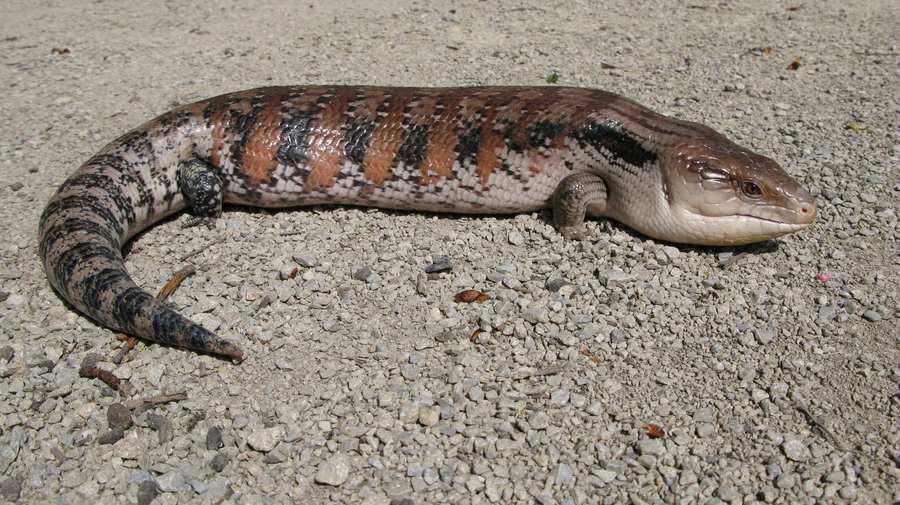
Lizard
Key numbers
The figures below are a working snapshot for a typical northern blue-tongued skink (Tiliqua scincoides intermedia), which is the form most often captive-bred for the U.S. pet trade, rather than a guarantee for every animal. Indonesian blue-tongues need a noticeably wetter enclosure, so if you keep one, read the humidity section carefully before copying a desert-style setup.
- Adult size: Adults commonly reach about 18 to 24 inches, including the tail.
- Lifespan: With consistent care they often live 15 to 20 years or more.
- Adult enclosure: An enclosure about 4 feet long by 2 feet deep by 2 feet tall is a practical minimum for one animal, and larger is better for heavy adults.
- Start size: A juvenile can begin in a smaller footprint if heat, UVB, and a real temperature gradient (a warm end and a cool end that actually differ) are correct; plan on the 4x2x2 as it grows.
- Housing: Keep one skink per enclosure.
- Basking surface: The surface the skink actually sits on should read about 95 to 105 F.
- Cool side: The cool side should sit around 70 to 80 F.
- Night: Nighttime temperatures from the mid-60s to the mid-70s are usually fine in a typical house.
- Humidity (northern / Australian forms): Northern (Australian) forms do well at around 40 to 60 percent ambient humidity, with a moist retreat available.
- Humidity (Indonesian forms): Indonesian forms often need 60 to 80 percent humidity, so do not keep them like a dry northern.
- Diet: Blue-tongues are omnivores, and adults often land near half plant matter and half animal protein across the week, with plenty of variety.
Do’s and don’ts
This list is the short version of the husbandry covered in detail further down the page. If a line here and a paragraph later on ever seem to pull in different directions, trust the longer explanation, because it carries the context that a one-line rule cannot.
Do
- Identify whether you have a northern (Australian) form or an Indonesian form before you lock humidity.
- Give an adult about 4 feet by 2 feet of floor space (a 4x2x2), or larger, with a hot basking end and a cool end that actually differ.
- Measure the basking surface with an infrared gun, and use a long high-output fluorescent UVB tube (T5 HO) on a timer.
- Keep one skink in the enclosure.
- Offer a mixed omnivore diet: greens and vegetables plus insects fed a decent diet before offering (gut-loaded), and occasional other protein, dusted on a calcium schedule.
- Learn that individual’s ordinary patterns so a missed meal, a closed blue tongue on every approach, or soft stools can be read against a baseline.
- See a veterinarian who regularly treats reptiles when appetite, stool, jaw firmness, limb use, or breathing leaves that baseline (local herp groups and exotic-vet directories help you find one before you need them).
- Send a picture if you find a loose pet lizard near Cartersville and want an ID.
Don’t
- Do not leave an adult in a 40-gallon starter kit as a finished home.
- Do not house two blue-tongues together because they “get along.”
- Do not treat every blue-tongue as a dry desert animal. Indonesian localities need more moisture.
- Do not use hot rocks or unregulated under-tank heat as the main heat.
- Do not use calcium sand, or feed on a dusty floor that coats every insect.
- Do not feed only cat food, dog food, or fruit.
- Do not read a flashed blue tongue, hissing, or a flattened body as a human mood.
- Do not release a pet skink into Georgia woods.
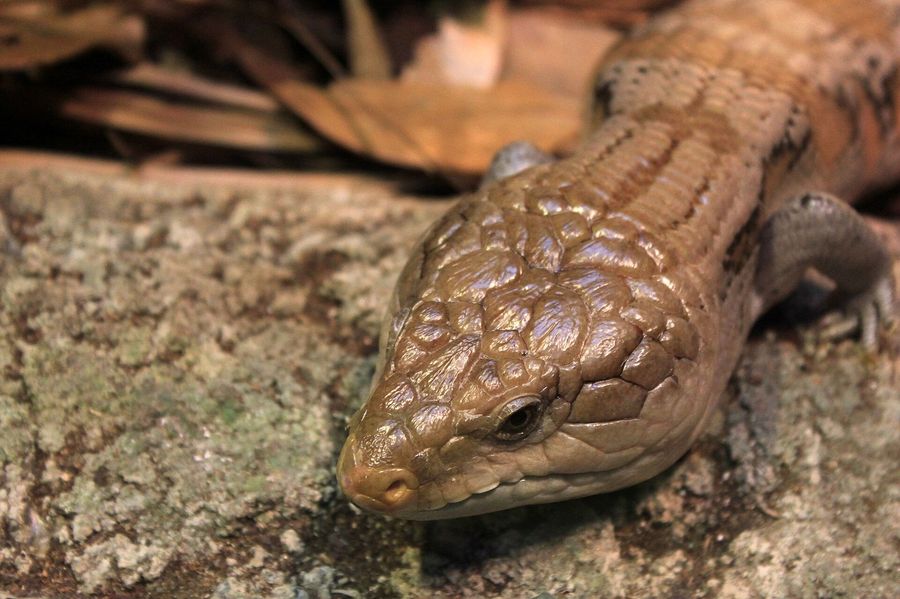
Blue-tongued skink head portrait showing broad skull and smooth scales.
A bit of background
“Blue-tongued skink” is a common name for several related lizards in the genus Tiliqua, native to Australia and parts of Indonesia and New Guinea. The bright blue tongue is a real defensive display, not a party trick. In the United States, the animal you are most likely to buy captive-bred as a pet is the northern blue-tongued skink, Tiliqua scincoides intermedia. Eastern blue-tongues (T. s. scincoides) share broadly similar dry-to-moderate husbandry. Indonesian forms (often sold under names like Halmahera, Merauke, or Irian Jaya, and associated with Tiliqua gigas and related lineages) generally need higher humidity and should not be kept on a northern’s drier schedule.
Because of Australia’s export rules, most true Australian bloodlines in the U.S. hobby today are captive-bred descendants of older imports rather than new wild shipments. That is good for the animals when breeders are honest, but it does not mean every “blue tongue” at a reptile show is the same animal. Before buying, ask about the locality or form, the feeding history, and whether the animal was captive-bred.
Adults commonly reach about 18 to 24 inches, and a lifespan of 15 to 20 years or longer is common. This guide emphasizes northern husbandry and points out where Indonesian humidity needs diverge. Individual animals vary, and nothing here replaces an examination by a veterinarian who regularly sees reptiles. Blue-tongues are not Georgia natives, so a heavy-bodied lizard found on a Cartersville property should be identified from a photo before anyone assumes it is a loose pet.
Whether they are a good fit
A blue-tongued skink is a long-lived, ground-dwelling omnivore that needs a large footprint, UVB lighting, and a keeper who is willing to prepare greens and insects for many years. Blue-tongues are often calm when lifted correctly, but that does not make them a couch companion like a dog. They are a poor fit for anyone who wants a pair in one tank, a tiny enclosure, or a fruit-only diet, and for anyone who has bought an Indonesian animal and intends to set it up like a desert-dwelling northern.
Enclosure and space
For this species, floor space matters more than height. A practical minimum for a single adult is about 4 feet long, 2 feet deep, and 2 feet tall, because that footprint lets you build a genuine temperature gradient, provide deep substrate for digging, and add cover without crowding the animal into a corner. Juveniles can start in something smaller as long as the heat and UVB are correct, but you should plan to move to the adult footprint as the animal grows over its first couple of years rather than treating a 40-gallon tank as a permanent home.
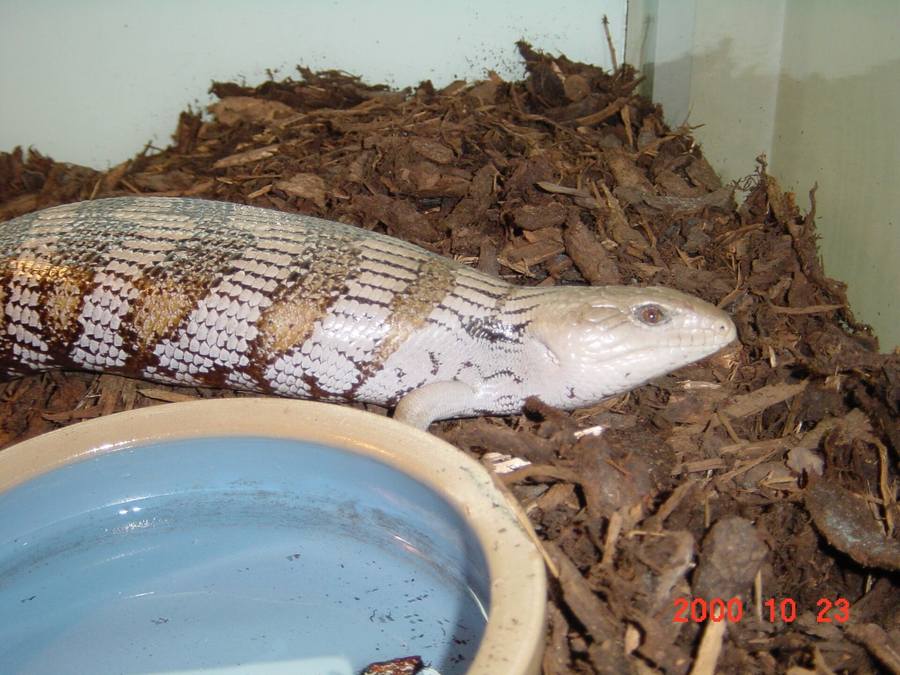
Blue-tongued skink in enclosure with substrate and water dish.
Keeping one skink per enclosure avoids most social problems, because blue-tongues are solitary animals. Two skinks sharing one gradient will fight, stress each other, and compete for the basking site, even if they appear peaceful for the first week.
A sturdy basking platform, a cool hide, a humid hide or other moist retreat, some low climbing structure, and a water dish heavy enough not to tip do far more for the animal than a pile of plastic plants, and the skink should be able to fit its whole body into the basking zone. Either a secure front-opening enclosure or a glass tank with a well-fitted lid will work, but make sure it is truly secure, because blue-tongues are strong and curious about any gap.
Temperature and the gradient
A blue-tongue’s digestion and immune function depend on having both a hot basking surface and a cooler retreat. Measure the surface the skink actually sits on with an infrared temperature gun rather than relying on an air reading.
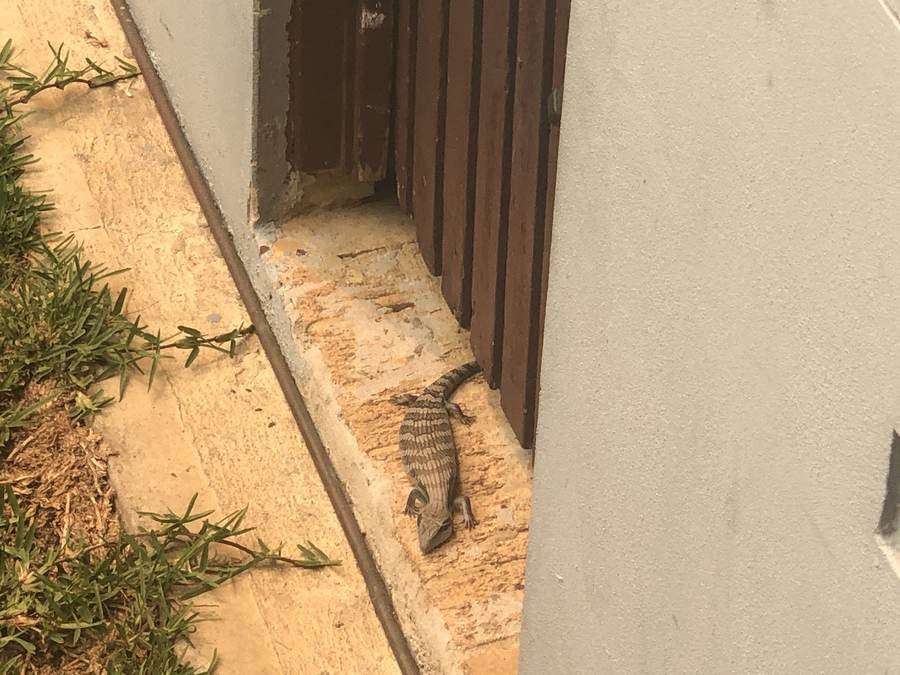
Blue-tongued skink basking on a stone ledge outdoors.
For most northern adults, a basking surface of around 95 to 105 F supports normal behavior, while the cool side of the same enclosure typically sits around 70 to 80 F. Overnight temperatures in the mid-60s to mid-70s are usually acceptable in a typical house. Heat is safest when it runs on a thermostat, usually from overhead halogen flood bulbs; hot rocks and unregulated heat pads can cause burns, and colored night bulbs are unnecessary.
Light, UVB, and the daily cycle
Blue-tongued skinks are active during the day, so indoors they need a clear distinction between day and night, bright visible light, and UVB. A simple cycle of 12 hours on and 12 hours off, run on a timer, is the common approach for indoor enclosures.
Use a linear T5 HO UVB tube of moderate-to-desert strength suited to the height of the enclosure, which often means a 10 to 12 percent class tube for open basking setups or a carefully positioned 6 percent tube where the distance is shorter. The tube should cover the basking end while still leaving shaded areas. Follow the lamp’s distance chart, and replace the tube on the manufacturer’s schedule even if it still looks bright. Keep in mind that sunlight through window glass does not provide UVB, and that a heat lamp provides heat only, not UVB.
Humidity, water, and shedding
Northern and other Australian forms typically do well at around 40 to 60 percent ambient humidity, provided they also have a moist hide they can enter and leave. Indonesian forms usually need a higher ambient range, often around 60 to 80 percent, along with enough ventilation that the enclosure does not become stagnant. Copying a northern’s dry floor for an Indonesian animal is a common mistake that leads to shedding and respiratory problems.
A clean water dish should be available at all times. A healthy shed should not leave rings of skin on the toes, and repeatedly stuck shed points to a problem with humidity, hydration, or general health that needs to be looked into.
Diet
Blue-tongues are omnivores, and in captivity variety serves them far better than any single “perfect” bowl. Their plant matter should include dark leafy greens and suitable vegetables such as collards, mustard greens, dandelion, and squash, with fruit kept as an occasional treat rather than a staple. Their animal protein should come from gut-loaded insects such as dubia roaches, crickets, and black soldier fly larvae, along with occasional other feeders. Some keepers also offer limited amounts of high-quality wet dog food or a similar product as part of the protein portion, but it should supplement a varied diet rather than make up the whole menu, and it is easy to overdo.
Juveniles often eat a higher proportion of insects while they are growing, while adults commonly settle closer to half plant matter and half animal protein across the week, adjusted according to body condition. Dust insects with calcium, using a product without D3 when UVB is correctly provided and one with D3 on a careful schedule if UVB is absent, and add a reptile multivitamin on a light schedule. Body condition is a better guide than the calendar: a skink with fat pads bulging out past its legs is being overfed, while one with a thin tail base and a sharply visible pelvis is underfed or may be ill.
Substrate
A diggable mix of organic topsoil with a smaller proportion of play sand, or a quality soil-based reptile bedding, laid several inches deep suits this species far better than a bare floor. In a northern’s enclosure the surface should stay mostly dry, while an Indonesian setup can hold more moisture lower down as long as dry basking surfaces remain available. Paper works well during quarantine. Calcium sand, pure sand as the only floor covering, cedar, and aromatic pine are all poor choices. Feed on a dish or slate so that insects do not get coated in bedding before they are eaten.
Handling and daily life
Many blue-tongues tolerate short, calm handling sessions once they know the routine, as long as you support the whole body and avoid reaching toward the head right after a feeding cue. A flashed blue tongue accompanied by a hiss is a warning display, and the right response is to give the animal some room. Supervised outdoor time in a secure pen can be excellent when the weather and the risk from predators allow it around Cartersville, but it is enrichment rather than a substitute for correct indoor UVB and heat.
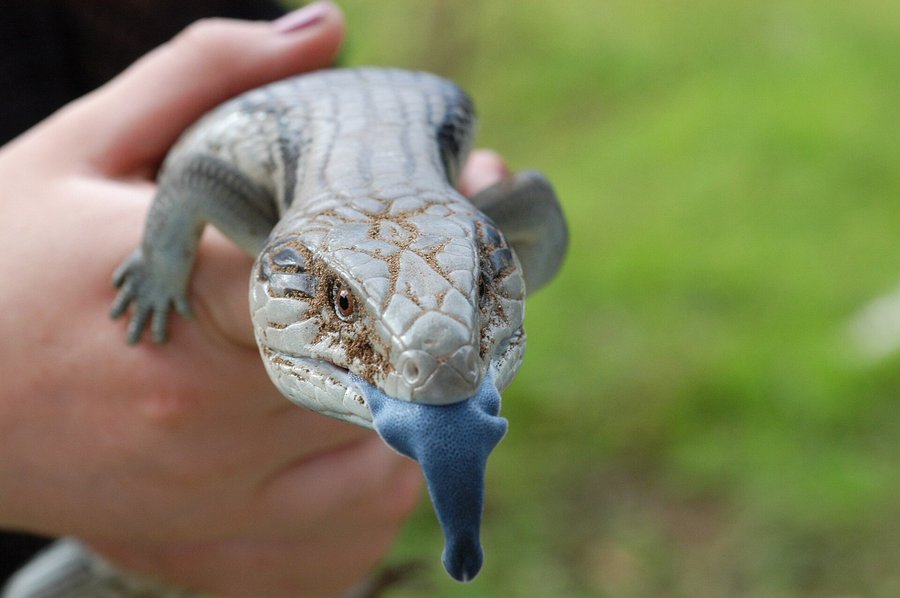
Blue-tongued skink displaying its bright blue tongue while gently handled.
Body language and behavior
Because a flashing blue tongue looks so theatrical, people tend to invent stories about what the animal is thinking. A skink that flashes its tongue is not “talking” to you; it is giving a defensive signal. Likewise, a skink that sits quietly on a lap is usually just warm and well supported rather than showing affection. Reading human emotions into a reptile in this way is how keepers miss the changes that really matter, such as a shift in appetite, soft stools, or tremors in the jaw or limbs.
Signals that are usually ordinary
Basking after the lights come on, tongue-flicking, digging, hiding for much of the day, and flashing the tongue defensively when startled are all ordinary behaviors. Mild dips in appetite around the time of a shed are also common.
What to watch for
- Open-mouth breathing, wheezing, or bubbles at the mouth or nose can signal a respiratory problem.
- A soft jaw, tremors, or swollen limbs should be treated as metabolic bone disease (soft, poorly mineralized bone from insufficient UVB and/or calcium) until proven otherwise.
- Repeated stuck shed on the toes or a chronically wrinkled look usually points to a hydration or humidity problem.
- Watery, foul, or bloody stool, or rapid weight loss, is a reason to see a reptile veterinarian.
- A skink that cannot use its hind limbs normally, or that circles without stopping, needs prompt veterinary attention.
If you notice any of these patterns, check your husbandry first, and then see a reptile veterinarian if the animal does not return to its own normal baseline.
Problems that show up often
The problems we see most often follow predictable causes. Metabolic bone disease usually follows a lack of UVB and a poor history of calcium supplementation, while obesity follows rich food combined with too little movement around the gradient. Respiratory disease tends to follow cold, damp, stagnant air, and also humidity that is chronically wrong for the form you own. Mouth problems and intestinal parasites show up in animals that were not properly quarantined, and bite wounds are what we see when two skinks are housed together.
Bringing a new animal home
Quarantine a new skink in its own enclosure for about 30 to 90 days, with a fecal check, until its appetite is steady, and keep it in quarantine longer if anything seems off. Before decorating, confirm the basking temperature, the cool-end temperature, the UVB, and the humidity appropriate to the animal’s form. Leave the skink alone long enough for it to eat and settle in before you start regular handling. Those first weeks are also the ideal time to learn how this individual uses its gradient and how readily it flashes its tongue.
Northern versus Indonesian setups
If your animal is a northern blue-tongue, lean toward a drier ambient range, combined with a moist hide and a hot basking rock or platform. If it is an Indonesian form, raise the ambient humidity, use a substrate that holds moisture without turning anaerobic, and keep the ventilation adequate so the warm air does not become swampy. When a seller cannot tell you which form you have bought, treat humidity as something to watch and adjust over time, paying attention to shed quality, where the skink chooses to rest, and whether it spends all day in the moist hide or avoids it.
Ask for captive-bred lineage whenever possible, because “blue tongue” on a show table is not a complete label. Locality and form change the moisture plan considerably, but they do not change the need for floor space, UVB, and a solitary enclosure.
Digging, enrichment, and outdoor time
Blue-tongues are natural diggers, so deep substrate, a hide they can burrow into, and an occasional rearrangement of cork and leaf litter all give them something to do. Supervised outdoor time in a secure pen on warm Georgia days can provide natural sunlight, provided the animal cannot dig its way out, dogs cannot dig their way in, and you still maintain indoor UVB for the days it stays inside. Outdoor time is enrichment, not a reason to skip the lamps.
Recommended gear
Some of the links below go to Amazon, and if you buy through them we may earn a small commission. This does not change the price you pay.
When you are budgeting, remember that a 4x2x2 enclosure, UVB lighting, a thermostat, and a temperature gun all matter far more than decoration.
- New Age Pet ECOFLEX 48-inch Mojave Reptile Lounge (48 x 24 inch footprint) for a single adult
- Etekcity Lasergrip 774 infrared temperature gun to measure the surface the animal actually sits on
- ThermoPro probe thermometer and hygrometer to track air temperature and humidity
- REPTIZOO dimming thermostat for halogen heat
- Zoo Med ReptiSun T5 HO Terrarium Hood with 10.0 bulb, a desert-strength UVB fixture; follow the distance chart
- Organic topsoil for substrate
- Zoo Med Reptile Calcium without Vitamin D3 when UVB is in place
- Shallow ceramic water dish