


Boa Imperator
Boa imperator
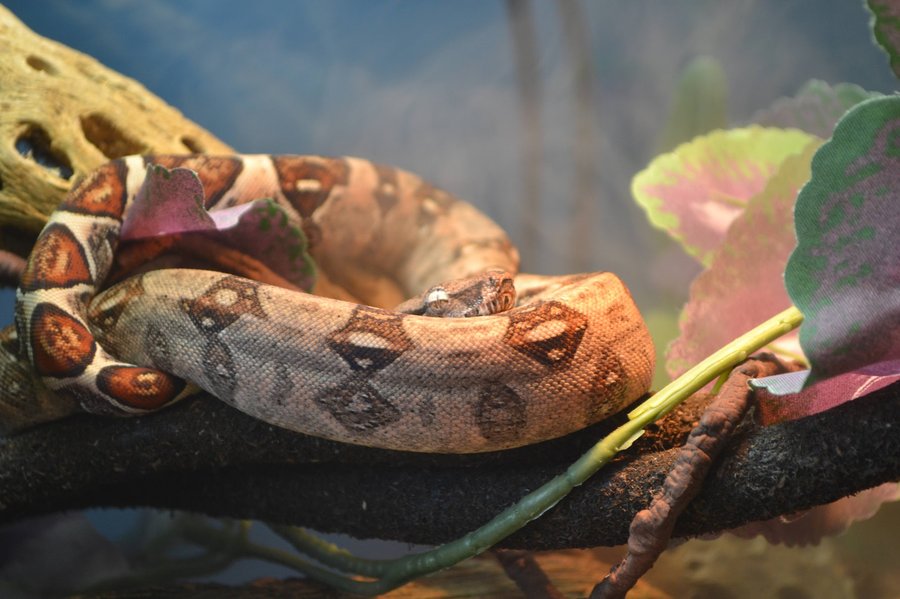
Snake
Key numbers
The figures below are a working snapshot of what a typical boa imperator needs, rather than a guarantee for every animal or every locality. The rest of this guide explains the reasoning behind each number, so you can adjust sensibly when your own snake or your own house behaves a little differently.
- Adult size: Adults commonly reach about 5 to 8 feet; many males stay closer to the lower end, while large females can push past it. True Boa constrictor (often called BCC or “red-tail”) is usually the heavier, longer animal.
- Lifespan: With consistent care they often live 20 to 30 years, sometimes longer.
- Adult enclosure: An enclosure about 6 feet long by 3 feet deep by 3 feet tall is a practical minimum for many males, while large females are more comfortable in something closer to 8x3x3 or larger.
- Start size: A neonate can begin in a secure tub or a footprint of about 20 to 40 gallons if the temperature gradient (a warm end and a cool end that actually differ) and locks are right, then step up through intermediate sizes as it grows, so plan the adult enclosure early.
- Housing: Keep one snake per enclosure.
- Warm hide / basking surface: The surface the snake actually sits on in the warm hide should read about 88 to 92 F.
- Cool side: The cool side should sit around 75 to 80 F.
- Night: Nights are often kept in the low-to-mid 70s; avoid long, cold nights in the 60s.
- Humidity: Keep humidity around 55 to 70 percent most of the time, with a humid retreat and a large water bowl, but do not keep the whole floor soaked.
- Diet: Feed a single appropriately sized rodent (rats for most growing and adult animals), usually frozen-thawed; adults are fed on a schedule of weeks, not days.
Do’s and don’ts
This list is the short version of the husbandry covered in detail further down the page. If a line here and a paragraph later on ever seem to pull in different directions, trust the longer explanation, because it carries the context that a one-line rule cannot.
Do
- Plan the adult enclosure before the animal outgrows the starter tub. A boa that will be six to eight feet needs a footprint that lets it stretch, hide on both ends, and climb low shelves.
- Measure the temperature of the surface the snake sits on in the warm hide, not a stick-on thermometer on the glass.
- Keep moderate humidity with a large water bowl, moisture-friendly substrate, and a humid hide the snake can leave — ventilation still matters.
- Offer frozen-thawed rodents with tongs. Prey about as wide as the snake at mid-body is the usual starting rule; body condition adjusts the calendar.
- Support the animal’s weight when you handle. An adult boa is a heavy, muscular animal, not a corn-snake-sized pet that drapes without planning.
- Learn that individual’s ordinary patterns so a missed meal, a long soak before shed, or a defensive coil at the glass can be read against a baseline.
- See a veterinarian who regularly treats reptiles when breathing, body condition, or shed quality leaves that baseline (local herp groups and exotic-vet directories help you find one before you need them).
- Send a picture if you find a large blotched or patterned snake on a property near Cartersville and want an ID. If you want it moved, we relocate snakes within about an hour of Cartersville at no charge.
Don’t
- Do not leave an adult in a hatchling tub or a 40-gallon “temporary” tank as a finished home.
- Do not house two boas together. They are solitary animals outside deliberate, supervised breeding.
- Do not power-feed juveniles into early breeding size, or keep feeding an adult on a growing schedule. Obesity and fatty liver are common in this species when the calendar never slows down.
- Do not treat a calm boa as a “beginner large snake” that needs no respect. Size, strength, and a long lifespan are the commitments.
- Do not run the enclosure as a permanently wet swamp. Moderate humidity with a humid retreat is different from a floor the snake lies in.
- Do not use a hot rock or an unregulated heat pad as the main heat.
- Do not handle for a couple of days after a meal, or while the snake is in blue (cloudy eyes before a shed).
- Do not release a pet boa, or any pet snake, into Georgia woods. This species is not native here.
- Do not assume every “common boa” or “BCI” label on an old receipt matches current taxonomy. Ask for Boa imperator versus Boa constrictor when it matters for size expectations.
- Do not read a defensive hiss, a tight coil, or a strike at the tongs as a human mood.
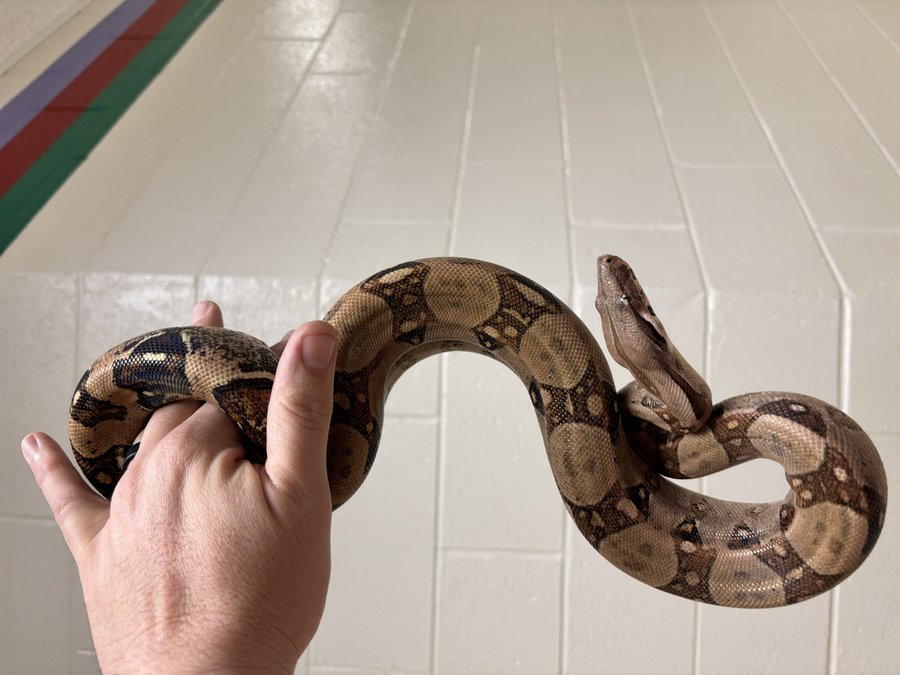
Boa imperator portrait showing saddles and postocular stripe (not a ball python).
A bit of background
The boa imperator, Boa imperator, is a large, heavy-bodied, nonvenomous constrictor whose range runs from Mexico through Central America and into northwestern South America west of the Andes, with plenty of variation between localities along the way. For a long time the hobby treated it as a subspecies of the boa constrictor and sold it as the “common boa,” the “Colombian boa,” or BCI (Boa constrictor imperator), but current taxonomy recognizes it as a species in its own right. The change of name matters for paperwork and for expectations, because Boa imperator is usually the more practical large boa to keep in captivity, while true Boa constrictor, often labeled BCC, tends to grow longer and heavier.
In the field these snakes use forest edge, dry forest, scrub, river corridors, and cover near human settlement. They climb as juveniles and still use low branches and shelves as adults, but they are not a canopy specialist that needs a tall vertical vivarium the way some arboreal pythons do. Secure hides, a clear warm-to-cool gradient, and enough floor to stretch are the picture most captive setups are trying to recreate.
Adults commonly reach about 5 to 8 feet, and there is often a real size gap between many males and a heavy female. Island and dwarf localities can stay smaller, but mainland females can still become substantial animals. In captivity, a lifespan of 20 to 30 years is common. This guide covers general husbandry for Boa imperator; locality, morph, and individual temperament all vary, and nothing here replaces an examination by a veterinarian who regularly sees reptiles.
Because this species is not native to Georgia, two extra points belong up front. First, a pet boa that gets loose is not a wild animal and should never be turned out “to be free.” Second, a large patterned snake that someone finds on their land is not automatically an escaped pet just because it looks tropical, since copperheads, ratsnakes, and other local species are misidentified every season. If you would like an identification, send us a picture, and if you want the snake moved, we relocate snakes within about an hour of Cartersville at no charge.
Whether they are a good fit
A boa imperator is a long-lived, large constrictor that needs adult-sized housing planned in advance, a reliable source of frozen rats, humidity that is managed without soggy floors, and a keeper who can safely support and move a heavy snake. Many boas are calmer than their size suggests once they have settled in, but calm is not the same thing as small, cheap, or low-commitment. They are a poor fit for anyone who only has room for a temporary tub, for a household that plans to feed “as much as it will take” every week into adulthood, and for anyone who wants a display animal that is constantly out and sociable. They are also a poor choice of first snake for a keeper who has never managed heat, humidity, and secure locks with a smaller species. Large constrictors are restricted or banned in some cities and counties, so check your local rules before you buy rather than after the animal is already home.
Enclosure and space
Floor space matters because an adult needs a warm hide and a cool hide with real distance between them, room to stretch out most of its length, and somewhere to climb other than the glass. A practical minimum for many adult males is about 6 feet long, 3 feet deep, and 3 feet tall, while large females are more comfortable in something closer to 8x3x3 or larger. Newborn boas can start in a secure tub or smaller enclosure as long as the gradient and locks are right. Move them up as they grow, typically through intermediate sizes over the first few years, rather than waiting until an eight-foot animal is still living in a forty-gallon box.
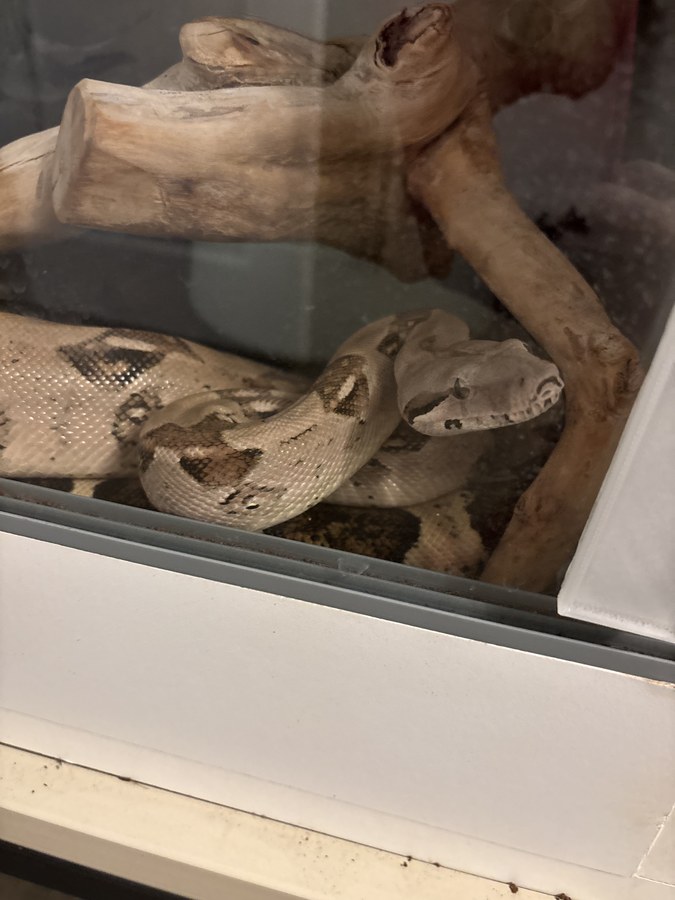
Boa imperator in vivarium with substrate and wood enrichment.
Keeping one snake per enclosure avoids most social problems, and boas are not a species that needs a companion. When two animals share one gradient, they usually compete for the better hide, and feeding two snakes in the same box is how keepers end up with both snakes on the same rat.
A snug hide at each end, a humid hide or other moist retreat the snake can enter and leave, sturdy shelves or branches that will hold an adult’s weight, and a water bowl large enough to soak in will do far more for the animal than a pile of decoration. Brace any heavy décor so it cannot tip onto the snake, and fit the enclosure with a lid or door that locks, because adult boas are strong enough to push open weak latches and shift light furniture.
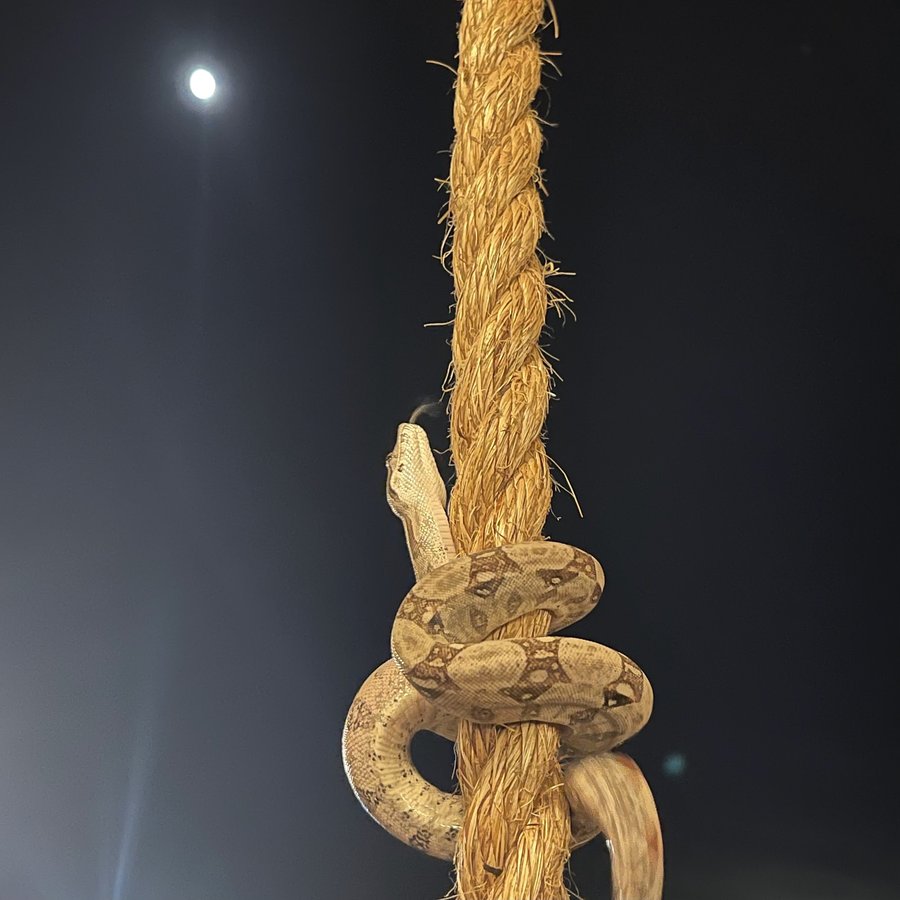
Boa imperator climbing rope enrichment; normal saddle pattern.
Temperature and the gradient
A boa’s digestion depends on temperature, so the measurement that matters is the temperature of the warm hide floor, or of the basking surface the snake actually coils on, taken with an infrared temperature gun. An air reading from a stick-on thermometer on the glass can look acceptable while the hide is too cool for digestion or hot enough to burn.
A warm hide or basking surface in the neighborhood of 88 to 92 F supports normal digestion for most adults, and the ambient air on the warm side often sits a little lower, in the high 80s. The cool side of the same enclosure is typically around 75 to 80 F. The difference between those two ends is what allows the animal to regulate its own body temperature; if the whole enclosure sits at one temperature, the snake has nowhere to go.
Heat is safest when a thermostat controls it. For large enclosures, overhead options that work well include ceramic heat emitters and radiant heat panels, both of which should be guarded and regulated. Quality heat pads can help with tubs and smaller setups, but they are rarely enough on their own for a tall adult vivarium, and unregulated heat mats and hot rocks are a frequent cause of burns. A modest overnight drop into the low 70s is usually acceptable, but prolonged chilling below the high 60s is not the goal, and colored night bulbs are unnecessary.
Light, UVB, and the daily cycle
Boa imperators are not desert baskers that need a bright bank of lights, but they do need a clear day and night. A simple schedule of 12 hours on and 12 hours off, even if the “on” period is just room light plus the heat source, is much easier on them than lights switching on and off at random hours.
Some keepers provide low-level UVB for this species, although it is not a substitute for a correct thermal gradient. A high-output desert tube is the wrong lamp for a snake that spends much of the day under cover, so keepers who offer UVB generally choose a moderate, forest-strength linear tube and give the snake enough hides and branches to get out of the light whenever it wants. If you also use a heat lamp, remember that it provides heat only, not UVB.
Humidity, water, and shedding
Boa imperators are tropical-to-subtropical snakes that usually do well at around 55 to 70 percent ambient humidity, adjusted for locality, shed quality, and the conditions in your room. The usual tools are a large water bowl, a moisture-friendly substrate, light misting of one end when readings drop, and a humid hide, meaning a hide filled with damp sphagnum or moss that the snake can enter and leave. Substrate that stays wet with poor airflow commonly leads to scale rot and respiratory trouble, while chronically bone-dry air with no humid retreat commonly leads to stuck eyecaps and ragged sheds.
Many boas soak before a shed, and that is perfectly ordinary. A water bowl that is dirty, tipped over, or too small to climb into is not acceptable, however, because clean water matters just as much as the humidity number on the gauge.
A healthy shed comes off in one piece, eyecaps included. Patchy sheds that keep recurring usually point to a humidity or hydration problem, or to an animal that is not in good condition. As a side note for homeowners, a shed skin found on a property is not a sign of a nest; it simply means that a snake passed through, not that a family is living there.
Diet
In the wild, boa imperators eat a range of vertebrates sized to the snake, but in captivity they are kept on rodents, because that is the diet we can source cleanly and consistently. Newborns usually start on mouse hoppers, which are young mice a step up from pinkies, or on small rats, and growing animals and adults typically move on to rats sized so that the prey is about as wide as the snake at mid-body. Offering frozen-thawed prey that has been warmed through, using tongs, is the method that avoids most feeding injuries. A snake that will only strike live prey can often be transitioned to frozen-thawed, which is worth doing, because a live rodent left in the enclosure overnight can injure a snake that is not hungry.
Young boas are commonly fed every 7 to 14 days while they are growing, and subadults and adults often move to a meal every 2 to 4 weeks, with prey size and body condition as the real guides. A boa whose body folds in on itself, with fat rolls along the spine and a thick neck, is being fed too often or too much, while one with a sharply triangular cross-section and a visible spine is being fed too little or may be ill. Postpone handling for a couple of days after each meal. Power-feeding a boa to reach breeding size early is a husbandry choice that shows up later in life as obesity and stress on the organs.
Substrate
Cypress mulch, coconut husk blends, and similar moisture-friendly substrates are the usual choices for this species, because they hold humidity without flooding the hide. Paper works well during quarantine. Aspen can work in drier rooms as long as humidity still meets the target and the snake is shedding cleanly, but it is a poorer default if the enclosure tends to run dry.
Whatever substrate you use, remove feces as soon as they appear, and keep the surface dry enough that the snake is never lying in wet mulch. Cedar and aromatic pine should never be used as bedding. Heavy cork, shelves, and branches should rest on a solid base so the snake cannot collapse a cave onto itself while burrowing.
Handling and daily life
Most captive boa imperators will rest calmly once they are used to being picked up, provided they are supported along the body rather than dangled by the head or neck. Short, calm sessions, begun once the snake has settled in, go much better than daily wrestling. Postpone handling for a couple of days after a meal and while the snake is in blue. As the animal grows, plan on having a second person present when handling large adults, especially heavy females nearing the upper end of the size range, because “it has always been fine” is no substitute for properly supporting the weight, and handling a large constrictor alone is a risk you do not need to take.
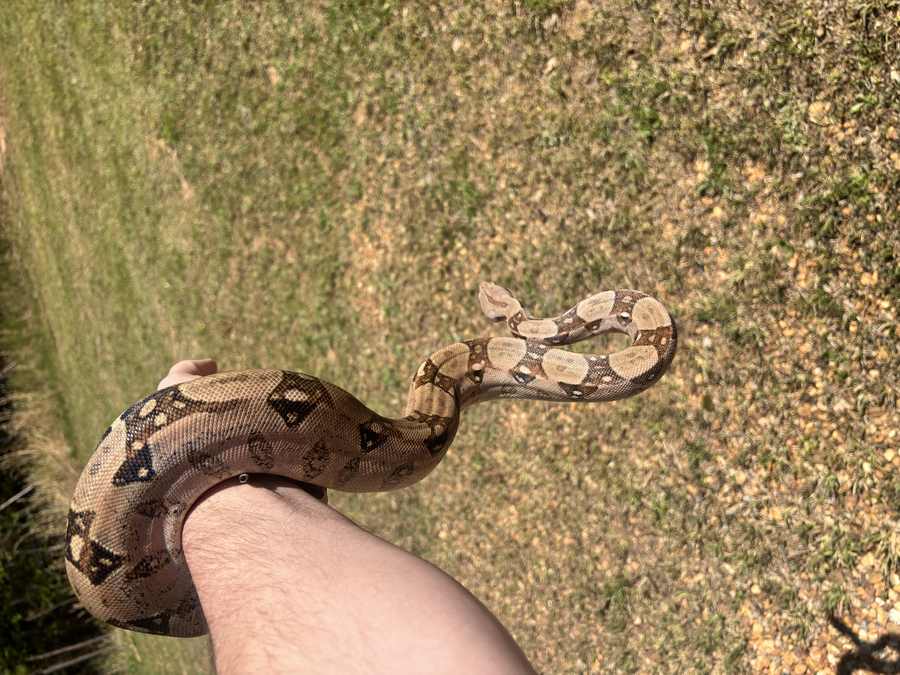
Boa imperator (normal) handled outdoors; classic saddle markings.
A snake that hisses, draws itself into a tight coil, or follows the tongs along the glass is not greeting you; it is either defensive or focused on food. Give it room, and never pick it up just to show someone how “tough” it looks.
Body language and behavior
Boas are easy to misread, because a calm adult can look affectionate and a defensive adult can look angry in a human sense, and neither story is useful. Anthropomorphizing, which means treating the animal as if it had human motives, moods, and social needs, is how keepers miss the information that actually matters: whether this individual is using both ends of the gradient, eating on its own pattern, shedding cleanly, and breathing with its mouth closed.
The more useful habit is to learn the patterns of the particular animal in front of you, such as how much of the day it spends hidden, whether it usually soaks before a shed, and how it reacts to the door opening compared with the appearance of the tongs. Once you know that baseline, it is a change from it that matters.
Signals that are usually ordinary
Tongue-flicking is simply the snake sampling the air, and resting in a hide for much of the day is ordinary security behavior rather than a sign that the snake is “depressed.” Climbing onto a low shelf or draping over a branch is ordinary use of the enclosure. A defensive hiss or a sudden draw-back when the enclosure is opened is a warning, not a verdict on the snake’s personality, and a strike at the tongs when there is prey scent in the room is often a feeding response. The rest of the picture, including the time since the last meal, whether the snake is in shed, and whether your hand smells like a rat, is what makes these behaviors make sense.
Dull, bluish skin and cloudy eyes mean a shed is on the way, and hiding or soaking for a few days around that shed is ordinary. Likewise, a long rest in the warm hide after a meal is digestion at work, not laziness.
What to watch for
- Open-mouth breathing, wheezing, or bubbles at the mouth or nose point to a respiratory problem, not a snake that is “panting from stress” in a human sense.
- Regurgitation, or a snake that strikes and refuses to finish, is a reason to check the warm-hide temperature, the prey size, and how soon the animal was handled after its last meal.
- Stuck eyecaps or ragged sheds that keep repeating point to a humidity or hydration problem.
- Belly scales that are brown, pink, or blistered, or a snake lying in wet substrate, suggest scale rot.
- Rapid weight gain with fat folds, or a snake still on a juvenile feeding schedule after its growth has slowed, means the feeding plan needs to change.
- Weight loss through a hunger strike, or a reliable eater that has stopped, calls for a temperature check first and then a reptile veterinarian.
- Burns, raw spots, or a snake pressed against an unregulated heat source mean the heating needs a thermostat and a guard right away.
- A snake that cannot right itself, or that corkscrews, is showing a neurological problem and is not something to wait out.
If you notice any of these patterns, check your husbandry first, and then see a reptile veterinarian if the animal does not return to its own normal baseline.
Problems that show up often
Respiratory disease usually follows an enclosure that is too cold, or one that is cold and damp with poor airflow, while scale rot follows wet, dirty substrate. Inclusion body disease (IBD) is a serious viral disease of boas and pythons; it spreads between snakes and must be diagnosed by a veterinarian rather than a forum thread, which is another reason quarantine and separate tools matter. Obesity is common in animals that are still fed as though they are growing long after they have finished growing. Stuck shed is less common when proper humidity, a humid hide, and a clean soaking bowl are available, and burns usually trace back to unregulated heat. Finally, a feeding bite or a snake constricting around a hand is more often a problem of tongs and planning than of a “mean snake.”
An escaped pet is a husbandry problem of a different kind. Check the locks, then search the house, and never release the animal outside. And once again, a large snake that someone finds on a property here is not automatically a boa, so send us a picture before deciding it is a loose pet, and do not try to pick it up.
Bringing a new animal home
A quarantine period in a separate enclosure, with its own tongs and water bowl and a fecal check, is a much kinder start than placing a new snake straight into a display vivarium on its first day. A common working window is about 30 to 90 days, or until the snake’s appetite is steady and a fecal test comes back clear, and longer if anything seems off. Before decorating, confirm that both ends of the enclosure reach the right temperatures and that humidity is within range. Leave the animal alone long enough for it to eat at least a couple of meals before you begin regular handling, and use tongs from the very first feeding. Those first weeks are also the time to start learning the snake’s ordinary behavior, including how much of the day it spends hidden and how it reacts when the door opens.
Recommended gear
Some of the links below go to Amazon, and if you buy through them we may earn a small commission. This does not change the price you pay.
When you are budgeting, remember that adult-sized floor space, a thermostat, a large water bowl, and feeding tongs all matter far more than decoration, and that the temperature to measure is that of the hide floor the snake actually rests on.
- A 6x3x3 (72 x 36 x 36 inch) PVC enclosure for an adult, and larger for big females. ECOFLEX does not make a 6x3 model, so this is a custom or specialty-builder purchase rather than a product we can link
- Etekcity Lasergrip 774 for the hide floor the snake sits on
- ThermoPro probe thermometer and hygrometer to track air temperature and humidity
- BN-LINK on/off thermostat for a heat mat. Use a dimming or proportional stat if the heat is a bulb or radiant panel
- Zoo Med Forest Floor cypress mulch
- Snug opaque hides for the warm end, the cool end, and a humid hide with damp sphagnum
- Long feeding tongs — longer tongs matter more as the animal grows