


Brazilian Rainbow Boa
Epicrates cenchria
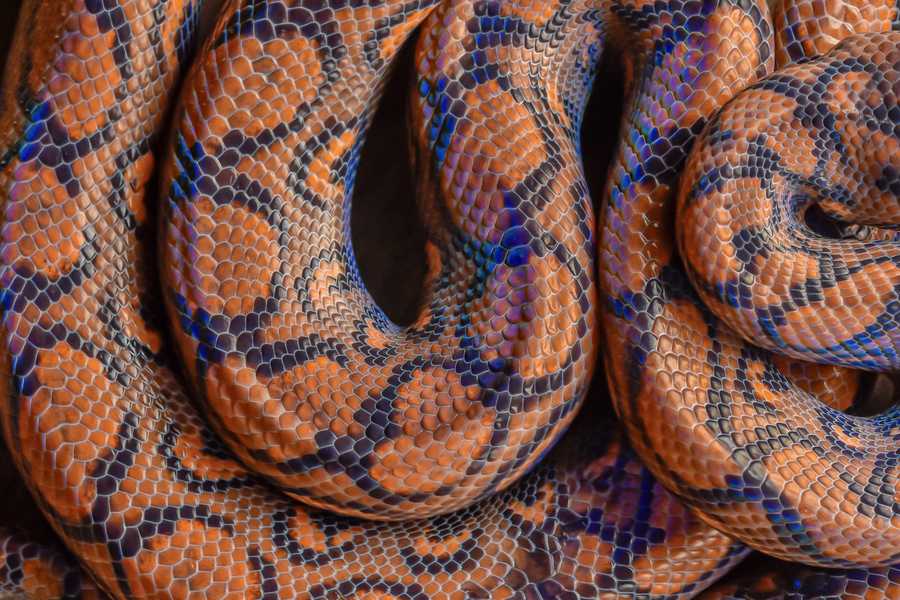
Snake
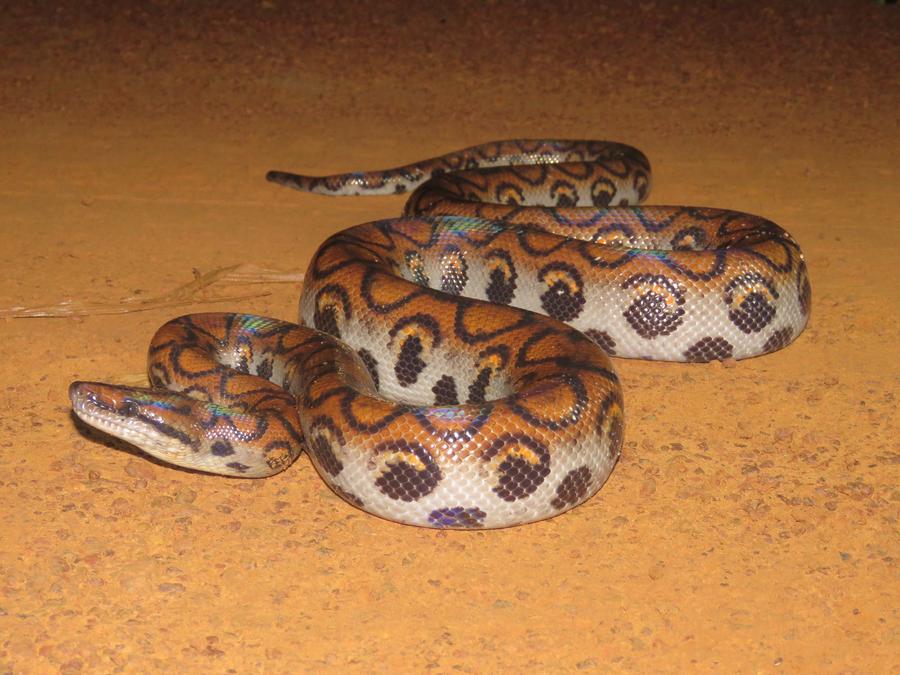
Brazilian rainbow boa full body — orange ground color, side eye-spots, and iridescent sheen.
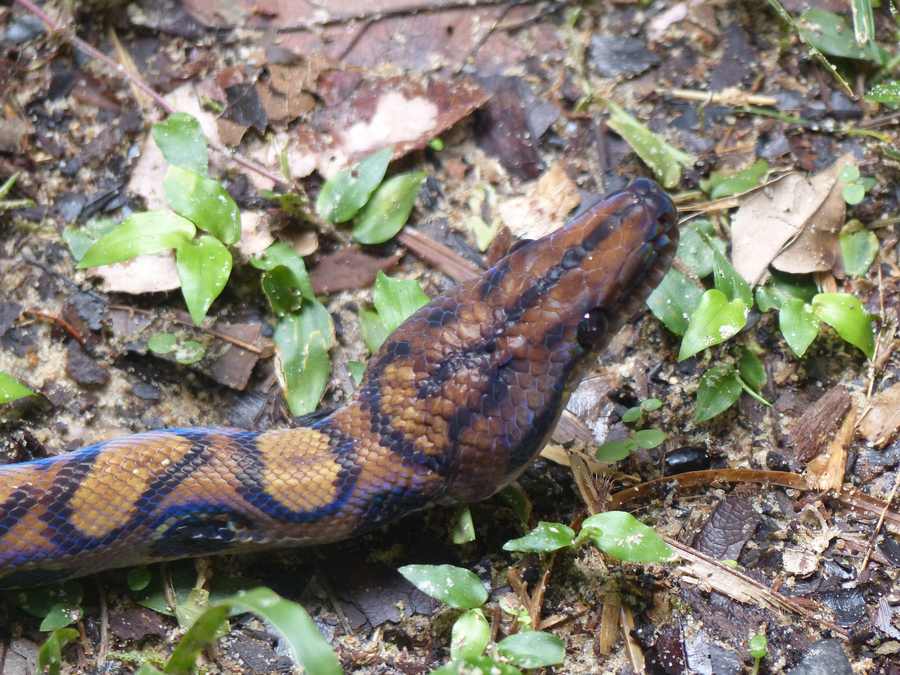
Brazilian rainbow boa head portrait — longitudinal head stripes and iridescent neck scales.
Key numbers
The figures below are a working snapshot of what a typical Brazilian rainbow boa needs, rather than a guarantee that every individual will fit them exactly. The rest of this guide explains the reasoning behind each number, so you can adjust sensibly when your own snake or your own house behaves a little differently.
- Adult size: Adults commonly reach about 5 to 7 feet, and females are often the larger and heavier of the two.
- Lifespan: They often live 20 to 30 years, sometimes longer.
- Adult enclosure: An enclosure about 4 feet long by 2 feet deep by 2 feet tall is a practical minimum for one adult, and many keepers prefer something closer to 5 to 6 feet long for a heavy female.
- Start size: A hatchling can begin in a smaller tub or enclosure that holds humidity, provided the temperature gradient (a warm end and a cool end that actually differ) and cover are right, then move toward the adult footprint as it grows.
- Housing: Keep one snake per enclosure.
- Warm hide / basking surface: The surface the snake actually sits on in the warm hide should read about 84 to 88 F.
- Cool hide: The cool hide should sit around 75 to 80 F.
- Night: Nighttime temperatures in the mid-70s are usually fine; avoid long, cold nights.
- Humidity: Keep humidity around 75 to 90 percent most of the time; neonates often do better toward the upper end of that range.
- Diet: Feed a single appropriately sized rodent, usually frozen-thawed, on a schedule that matches age and body condition.
Do’s and don’ts
This list is the short version of the husbandry covered in detail further down the page. If a line here and a paragraph later on ever seem to pull in different directions, trust the longer explanation, because it carries the context that a one-line rule cannot.
Do
- Give an adult an enclosure about 4x2x2 or larger, built to hold humidity (PVC or sealed wood beats open screen tops).
- Measure the warm surface and track humidity with a real digital hygrometer, not a guess.
- Keep ambient humidity high while still ventilating enough that the surface is not a permanent swamp.
- Offer a humid hide with damp sphagnum the snake can enter and leave, especially for babies and animals in shed.
- Offer frozen-thawed rodents with tongs; prey about as wide as the snake at mid-body.
- Learn that individual’s ordinary patterns so a missed meal, extra soaking, or a defensive baby’s strike can be read against a baseline.
- See a veterinarian who regularly treats reptiles when breathing, body condition, or shed quality leaves that baseline (local herp groups and exotic-vet directories help you find one before you need them).
- Send a picture if you find an unfamiliar boa on a property near Cartersville and want an ID. If you want it moved, we relocate snakes within about an hour of Cartersville at no charge.
Don’t
- Do not run this species bone-dry the way you would a desert snake.
- Do not seal the enclosure into a hot, stagnant box to “raise humidity.”
- Do not let the warm end sit at or above about 90 F for long stretches; overheating with dehydration is a fast way to lose animals.
- Do not house two rainbow boas together.
- Do not use a hot rock or an unregulated heat pad as the main heat.
- Do not handle for a couple of days after a meal, or while the snake is in blue (cloudy eyes before a shed).
- Do not leave live prey unsupervised overnight.
- Do not release a pet rainbow boa, or any pet snake, into Georgia woods.
- Do not read a baby’s repeated strikes, or an adult wrapping for stability, as a human mood.
A bit of background
The Brazilian rainbow boa, Epicrates cenchria, comes from the humid tropical forests and river-edge country of parts of South America, including much of the Amazon basin. In the wild these boas rely on cover, moisture, and a mix of ground and low structure, and juveniles often climb more than heavy adults do. That humid, cover-rich environment is what a captive setup is trying to recreate, and a dry glass box with a single thin hide is the opposite of it.
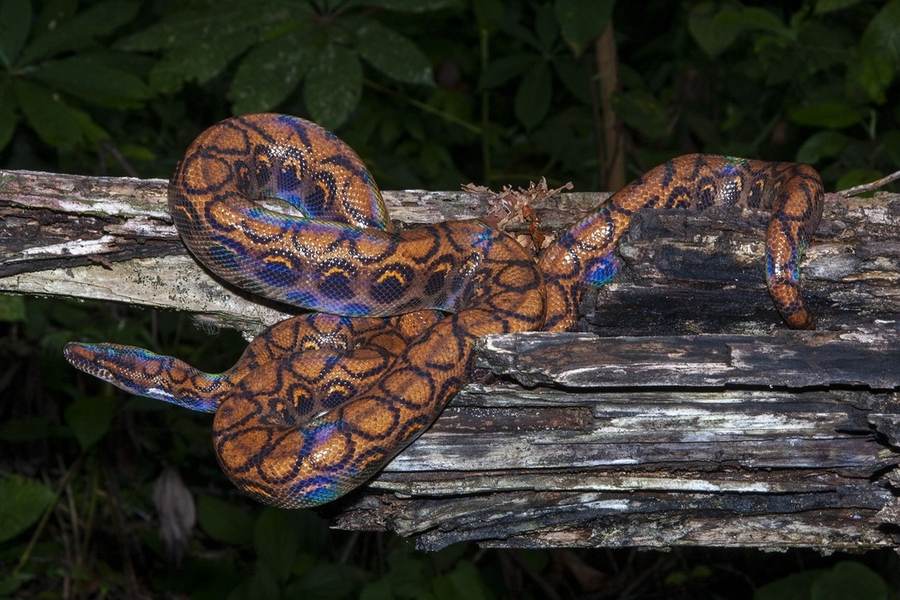
Brazilian rainbow boa resting on a log; blue-purple rainbow sheen visible on scales.
Rainbow boas became popular because of their iridescence, which comes from microscopic structures on the scales that refract bright light into shifting colors. The sheen is neither paint nor a separate set of pigments, which is why it looks different from different angles and under different lamps. Captive-bred animals usually settle in better than field-collected ones, and babies are often defensive even though adults will commonly rest calmly in a hand.
Adults commonly reach about 5 to 7 feet, and a lifespan of 20 to 30 years in captivity is common. This guide covers general husbandry for Brazilian rainbow boas (Epicrates cenchria). Colombian rainbow boas (Epicrates maurus) are a related but separate animal whose care overlaps, so do not assume that a “rainbow boa” label on a receipt means you have a Brazilian. Individual animals vary, and nothing here replaces an examination by a veterinarian who regularly sees reptiles.
A rainbow boa is not a native Georgia snake, so a pet that gets loose is not a wild animal and should never be turned out “to be free.” If you find an unfamiliar boa on your land near Cartersville and would like an identification, send us a picture, and if you want it moved, we relocate snakes within about an hour of Cartersville at no charge.
Whether they are a good fit
A Brazilian rainbow boa is a long-lived, humidity-dependent snake that needs an enclosure that holds moisture, accurate gauges, and a keeper who will clean a humid enclosure before mold and scale problems start. They are a poor fit for anyone who wants a “set and forget” dry setup, for a household that routinely lets the warm end climb past 90 F, and for a first-time keeper who is not ready to track humidity daily during the early months. A defensive hatchling is common, but that is not the same thing as an aggressive adult, and it is not a reason to skip quarantine or a calm settling-in period.
Enclosure and space
For this species, floor space and the enclosure’s ability to hold humidity matter equally. A practical minimum for a single adult is about 4 feet long, 2 feet deep, and 2 feet tall, and a heavy female will be more comfortable with extra length. PVC and sealed wooden vivaria hold moisture much better than screen-lid aquariums, so if you use glass, plan in advance how you will maintain humidity without cutting off airflow entirely.
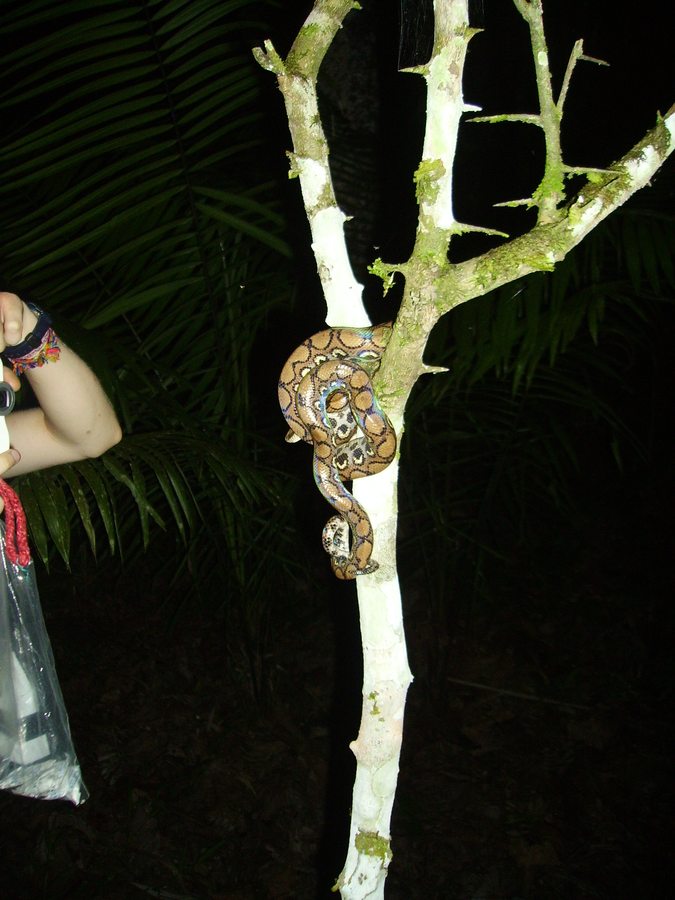
Brazilian rainbow boa coiled on a branch; flash highlights rainbow iridescence.
A hatchling can start in a smaller enclosure as long as the cover is dense and the humidity holds. Move toward the adult footprint as the snake grows, rather than years later, when the tub no longer leaves room for a proper shed or soak.
Keeping one snake per enclosure avoids most social and feeding problems, and rainbow boas are not a species that needs a companion.
A warm hide, a cool hide, a humid hide, a large and stable water bowl, deep moisture-retentive substrate, and low, sturdy branches or shelves, which are especially valued by juveniles, will do far more for the animal than a pile of decoration. Any climbing structure must be anchored, because a heavy adult will pull loose branches down, and the enclosure should have a lid that latches securely.
Temperature and the gradient
Rainbow boas need warmth, but they are not a species that wants desert or hot-python temperatures. The measurements that matter are the temperature of the warm surface the snake sits on, taken with an infrared temperature gun, and probe readings of the ambient air in each zone.
A warm hide or basking surface in the neighborhood of 84 to 88 F supports normal digestion for most adults, while the ambient air often sits around 78 to 82 F and the cool end around 75 to 80 F. Sustained temperatures at or above about 90 F pose a serious risk, especially if the animal is also drying out. The difference between the warm and cool ends is what allows the snake to regulate its own body temperature.
Heat is safest when a thermostat controls it, and radiant panels and guarded overhead sources are common choices in moisture-resistant enclosures. Unregulated heat mats and hot rocks can cause burns. Never try to “fix” low humidity by sealing the enclosure and turning the heat up.
Light, UVB, and the daily cycle
Brazilian rainbow boas are largely nocturnal and crepuscular, meaning they are most active at night and around dawn and dusk. They do not need intense desert lighting, but they do need a clear day and night, and a simple schedule of 12 hours on and 12 hours off is much easier on them than lights that switch at random hours.
Low-level UVB is optional when the diet and the rest of the husbandry are correct, and it is never a substitute for proper humidity and a temperature gradient. Bright white display lighting can show off the iridescence, but it should not overheat the enclosure, and the snake should always have shaded hides available. Colored night bulbs are unnecessary.
Humidity, water, and shedding
Humidity is the defining requirement for this species. The working target for most adults is ambient humidity of around 75 to 90 percent, with babies often kept toward the higher end of that range. High humidity does not mean standing water, mold, and no airflow, however. What you are aiming for is moist air, damp deeper layers of substrate, a surface that can dry out between mistings or waterings, and steady ventilation.
A large water bowl adds moisture to the air and gives the snake a place to soak, while a humid hide filled with damp sphagnum provides a moist retreat without soaking the whole floor. Substrate that stays wet and dirty commonly leads to scale irritation and respiratory trouble, and chronically dry air commonly leads to stuck sheds, wrinkled skin, and dehydration.
A healthy shed comes off in one piece, eyecaps included, and patchy sheds that keep recurring usually point to a humidity or hydration problem. Do not try to peel retained skin or eyecaps off yourself. As a side note for homeowners, a shed skin found on a property is not a sign of a nest.
Diet
In the wild, rainbow boas eat rodents, birds, and other small vertebrates, while in captivity they are kept on mice and rats. Offering frozen-thawed prey that has been warmed through, using tongs, is the method that avoids most injuries from prey.
Hatchlings are commonly fed every 5 to 7 days, juveniles often move to a meal every 7 to 10 days, and adults often maintain their condition well on a meal every 10 to 14 days, or even less often for sedentary animals. A good working rule is to offer prey about as wide as the snake at mid-body. Obesity is common when adults are still fed as though they were juveniles, so let body condition, rather than appetite, guide you.
Some animals go through seasonal drops in appetite, and the snake’s weight and normal baseline matter far more than a single refused meal. Wait a couple of days after a meal before handling, and never leave live prey in the enclosure overnight, because it can injure a snake that is not hungry.
Substrate
Coconut husk, coconut fiber, cypress mulch, and reptile-safe tropical soil mixes all hold moisture without needing to stay swampy. A deep layer of substrate lets you dampen the lower layers while keeping the top only lightly moist. Paper towels work well during quarantine as long as you watch the humidity closely, because they dry out quickly.
Cedar and aromatic pine should never be used as bedding, and fertilized garden soils and calcium sand are poor choices. Spot-clean feces and soiled patches promptly, because waste is easy to miss under the bedding of a humid enclosure if you do not look for it.
Handling and daily life
Baby rainbow boas often strike when startled, which is defensive behavior rather than a verdict on their personality, and adults from good captive lines are often calm once settled. Support the whole body when handling, and avoid reaching down from above right after the door opens. Short sessions that begin once the snake has eaten a few meals in its new home go much better than daily wrestling during the first week.
Postpone handling for a couple of days after a meal and while the snake is in blue. A snake that is soaking constantly, looks wrinkled, or is breathing oddly should be left alone while you look into the cause.
Body language and behavior
Rainbow boas are easy to misread because people attach human stories both to their beauty and to a baby’s strikes. A hatchling that repeatedly strikes at the tongs is not “mean”; it is a small animal defending itself. Likewise, an adult that drapes over your arms while supported is not “cuddling.” Anthropomorphizing, which means treating the animal as if it had human motives, moods, and social needs, is how keepers miss the information that actually matters: whether this individual is hydrated, using both hides, eating on its own pattern, shedding cleanly, and breathing with its mouth closed.
Instead, learn the patterns of the particular animal in front of you, such as how much of the day it spends hidden, whether it soaks only occasionally around a shed or constantly, and how it reacts to the lid opening compared with the appearance of the tongs. Once you know that baseline, it is a change from it that matters.
Signals that are usually ordinary
Tongue-flicking is simply the snake sampling the air. Hiding during the day and moving around more at night is ordinary, as is a juvenile climbing on low branches, and soaking around shed time is common. Dull, bluish skin and cloudy eyes mean a shed is on the way. A defensive strike from a newly acquired baby is also common, so watch whether the behavior softens as the husbandry and routine settle down.
What to watch for
- Open-mouth breathing, wheezing, or bubbles at the mouth or nose point to a respiratory problem.
- Wrinkled skin, repeated incomplete sheds, or constant soaking are reasons to check humidity, water, and whether the warm end is too hot.
- Belly scales that are brown, pink, or blistered, or a sour, moldy enclosure, suggest scale rot and a sanitation problem.
- Regurgitation, or prey refusal with weight loss, calls for a check of temperatures and handling timing, then a reptile veterinarian.
- Tiny moving specks around the eyes, chin, or heat pits and labial area are likely mites, which are both a veterinary and an enclosure problem.
- A snake that cannot right itself, or that corkscrews, is a neurological picture and is not something to wait out.
If you notice any of these patterns, check your husbandry first, and then see a reptile veterinarian if the animal does not return to its own normal baseline.
Problems that show up often
Dehydration and poor sheds usually follow humidity that is too low or heat that is too high, while scale problems and respiratory disease follow enclosures that are wet, stagnant, and dirty. Inclusion body disease (IBD) is a serious viral disease of boas and pythons; it spreads between snakes and must be diagnosed by a veterinarian rather than a forum thread, which is another reason quarantine and separate tools matter. Obesity follows adult feeding schedules that never slowed down, and defensive babies that never settle often turn out to be reacting to too little cover, dry conditions, or constant handling.
An escaped pet is a husbandry problem. Check the lid, then search the house, and never release the animal outside.
Bringing a new animal home
A quarantine period in a separate enclosure, with its own tongs and water bowl and a fecal check, is a much kinder start than placing a new snake straight into a display vivarium on its first day. A common working window is about 60 to 90 days, or until the snake’s appetite is steady and a fecal test comes back clear, and longer for animals of uncertain origin. Confirm the humidity and the temperatures at both ends before the snake arrives, and leave the animal alone long enough for it to eat at least a couple of meals before you begin regular handling. Those first weeks are also the time to start learning its ordinary behavior, including how often it soaks and how it sheds.
Recommended gear
Some of the links below go to Amazon, and if you buy through them we may earn a small commission. This does not change the price you pay.
When you are budgeting, remember that an enclosure that holds humidity, a thermostat, a hygrometer you trust, and a deep layer of cypress or coconut substrate all matter far more than decoration.
- New Age Pet ECOFLEX 48-inch Mojave Reptile Lounge for a single adult (cover most of the mesh top to hold 75 to 90 percent humidity)
- Etekcity Lasergrip 774 for the warm surface
- ThermoPro probe thermometer and hygrometer to track air temperature and humidity
- BN-LINK on/off thermostat for pads or ceramic emitters. Use a dimming stat if the heat is a bulb
- Zoo Med Forest Floor cypress or coconut husk bedding
- A humid hide and sphagnum
- Snug opaque hides for warm and cool ends
- Feeding tongs