


Burmese Python
Python bivittatus
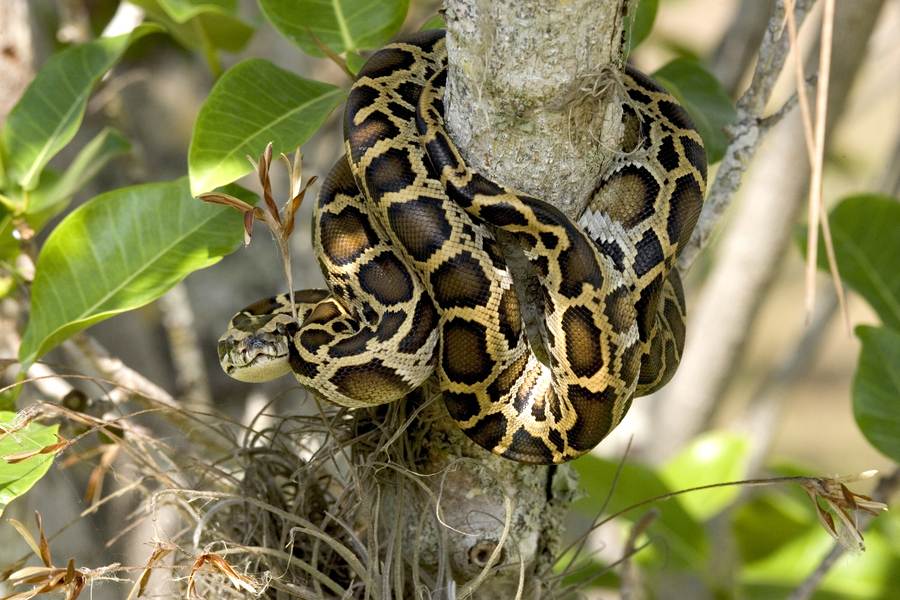
Snake
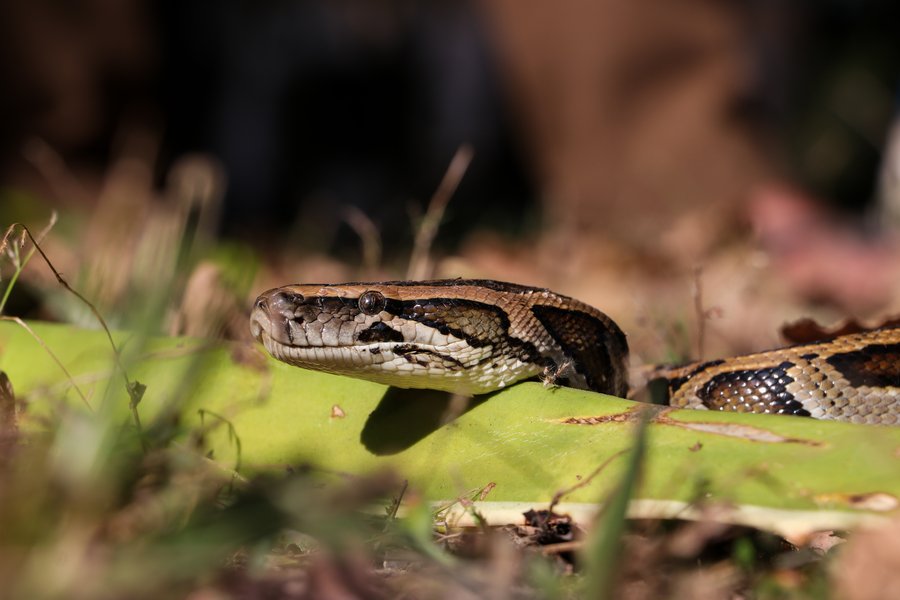
Burmese python head — dark arrowhead blotch and through-eye stripe (Python bivittatus).
Key numbers
The figures below are a working snapshot of what a typical Burmese python needs, rather than a guarantee that every individual will fit them exactly. The rest of this guide explains the reasoning behind each number, so you can adjust sensibly when your own snake or your own setup behaves a little differently.
- Adult size: Males commonly reach 8 to 14 feet and females often 12 to 18 feet, with some larger, and a heavy adult can weigh well over 100 pounds.
- Lifespan: With consistent care they often live 20 to 30 years.
- Adult enclosure: An enclosure around 8 feet long by 4 feet deep by 2 feet tall is a practical minimum for many adults, and a large female needs custom housing beyond that footprint.
- Start size: A hatchling can begin in a secure 4x2x2-class enclosure with a real temperature gradient (a warm end and a cool end that actually differ), then step up as its length and mass grow; the adult cage is part of the purchase decision, not a later surprise.
- Housing: Keep one snake per enclosure.
- Basking / warm surface: The surface the snake actually sits on at the warm end should read about 90 to 95 F.
- Cool end: The cool end should sit around 75 to 80 F.
- Night: Nighttime temperatures in the mid-70s are usually fine; avoid long, cold nights.
- Humidity: Keep humidity around 55 to 70 percent most of the time, with a large, clean water source and dry retreats.
- Diet: Feed appropriately sized frozen-thawed rodents (and later rabbits for large adults) on a schedule that matches body condition rather than appetite alone.
- Handling safety: Large individuals require a second competent adult during handling; never be alone with a powerful adult constrictor.
Do’s and don’ts
This list is the short version of the husbandry covered in detail further down the page. If a line here and a paragraph later on ever seem to pull in different directions, trust the longer explanation, because it carries the context that a one-line rule cannot.
Do
- Plan and build (or buy) the adult enclosure, locking system, and prey supply before you acquire the hatchling.
- Measure the warm surface the snake sits on with an infrared gun, not a sticker on the glass.
- Keep every heat source on a thermostat, with bulbs and emitters guarded so a heavy body cannot press against them.
- Use a clear feeding routine and tongs or a hook so opening the door is not always a food cue.
- Handle large animals with a second person present, and practice shifting the snake into a secure temporary container for cleaning.
- Learn that individual’s ordinary patterns so a missed meal, restless pacing, or a strong strike at the tongs can be read against a baseline.
- Confirm legality and any permit, PIT-tag, or registration requirements where you live before you buy or move the animal.
- See a veterinarian who regularly treats large reptiles when breathing, body condition, or shed quality leaves that baseline (local herp groups and exotic-vet directories help you find one before you need them).
- Send a picture if you find a large patterned python on a property near Cartersville and want an ID. If you want it moved, we relocate snakes within about an hour of Cartersville at no charge.
Don’t
- Do not buy a baby Burmese on the assumption that “someone else will take it when it gets big.”
- Do not house two Burmese pythons together.
- Do not handle a large adult alone, or let children manage one without direct adult control.
- Do not use a hot rock or an unregulated heat pad as the main heat.
- Do not leave live prey unsupervised overnight; a hungry rodent can injure a snake that is not feeding.
- Do not handle for a couple of days after a meal, or while the snake is in blue (cloudy eyes before a shed).
- Do not release a Burmese python, or any pet snake, into Georgia woods or wetlands.
- Do not assume a large dark-blotched snake in north Georgia is automatically a Burmese. Local lookalikes and other escaped pets exist — send a photo before you decide.
- Do not read a strike at the tongs, a wrap around a wrist, or sitting in water as a human mood.
A bit of background
The Burmese python, Python bivittatus, is a large constrictor from mainland Southeast Asia, where it lives in wetlands, grasslands, forest edges, farmland, and other ground near water. Adults are heavy-bodied, ground-dwelling snakes that can swim and climb when they choose, and that combination of mass, strength, and longevity is what captive care has to plan for from the very first day.
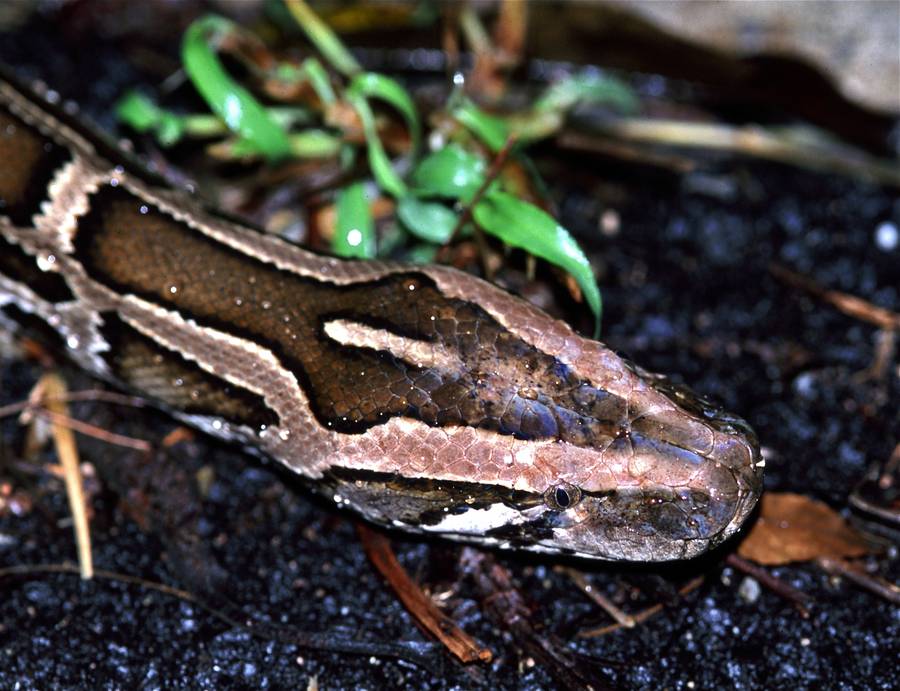
Burmese python close-up showing arrowhead head mark and labyrinth body blotches.
Burmese pythons became popular because hatchlings are manageable and often calm, but that early impression is not a picture of the adult. A snake that is six feet long at a year old and still growing is already a very different animal to clean around, feed, and move. Females are commonly the larger sex. Captive morphs, including albino, labyrinth, granite, and dwarf lines among others, change the snake’s appearance but not its need for locks, thermostats, and a second person on hand.
This guide covers general husbandry for Python bivittatus. Individual animals vary, and nothing here replaces an examination by a veterinarian who regularly sees reptiles. Ownership rules also vary from place to place. In Georgia, Burmese pythons are on the state’s wild-animal list: private pet possession is limited to animals that were already owned and properly tagged and registered under the state’s timeline, and new possession is generally tied to scientific, educational, or exhibition permits rather than ordinary pet ownership. Elsewhere, city and county rules may be stricter than state rules, so check the current local requirements before you acquire, transport, or rehome one. Federally, the U.S. Fish and Wildlife Service lists the Burmese python as injurious wildlife under the Lacey Act, which bars importing one into the United States and shipping one between the continental states and Hawaii, Puerto Rico, or other U.S. territories; check the agency’s current guidance before you move an animal. We mention this as part of sensible planning rather than as a lecture, because a giant snake with no legal place to live is a crisis for both the animal and the household.
Because a large constrictor on land near Cartersville is not a native species, two extra points belong up front. First, a pet that gets loose is not a wild animal and should never be turned out “to be free.” Second, a big blotched snake that someone finds on their land is worth identifying properly before anyone decides what it is. If you would like an identification, send us a picture, and if you want the snake moved, we relocate snakes within about an hour of Cartersville at no charge.
Whether they are a good fit
A Burmese python is a decades-long commitment to custom housing, a reliable supply of large frozen prey, and a household that can handle a powerful adult safely. They are a poor fit for anyone shopping for a “big snake” without the floor space for an enclosure in the 8x4 class, for a keeper who will always be handling alone, and for anyone who has not checked whether the animal can legally live where they do. They are also a poor fit for a household that wants a small display animal that will stay three feet long forever. Dwarf lines do stay smaller than classic Burmese, but they are still large constrictors that call for the same safety habits.
Enclosure and space
For this species, floor space and structural strength matter more than height. A practical minimum for many adults is about 8 feet long, 4 feet deep, and 2 feet tall, and a large female often needs more length plus a layout whose hides, shelves, and water vessels can bear her weight. Glass aquariums are a poor solution for adults, because they are hard to lock, hard to heat evenly, and rarely strong enough. The usual answer is a purpose-built enclosure of wood or PVC, or a custom room, with front access and proper locks.
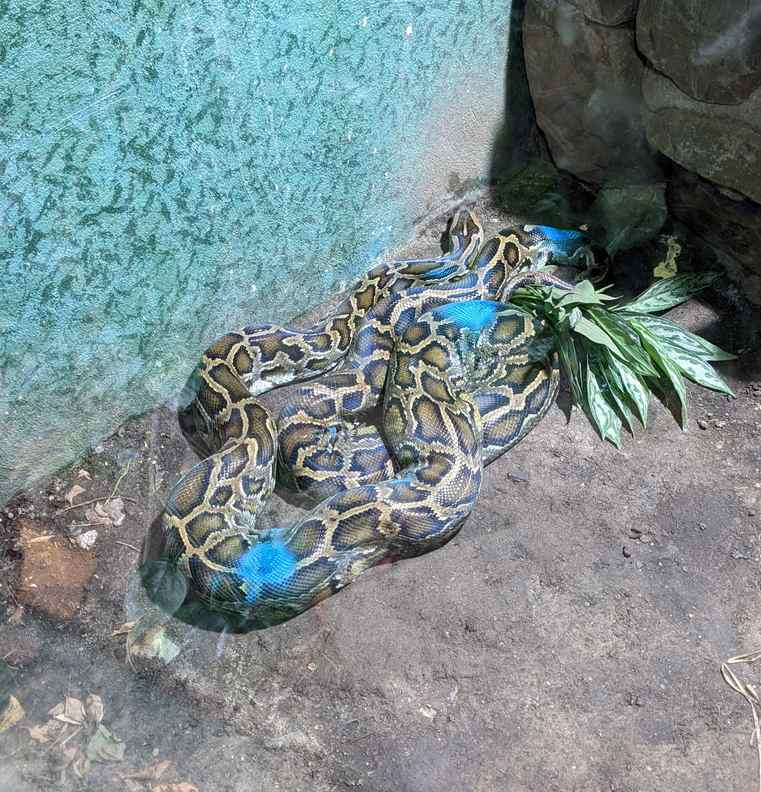
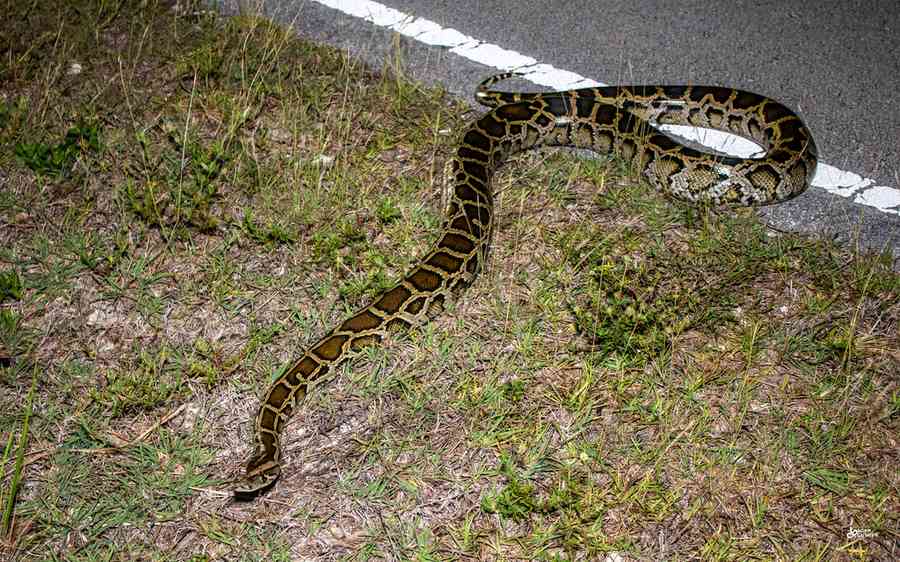
Burmese python in a zoo enclosure; large heavy body with labyrinth blotches (glass reflections present).
A hatchling can start in a secure enclosure with a footprint of around 4x2x2, as long as the warm and cool ends genuinely differ and the lid is secure. Move the snake up as it grows, because leaving a six-foot animal in a starter tub is not temporary housing; it is housing you have not finished providing.
Keeping one snake per enclosure avoids most social and feeding problems. With two large constrictors in one enclosure, keepers lose track of which animal struck, and cleaning becomes unsafe.
Every furnishing has to withstand the snake’s weight. Heavy hides at the warm and cool ends, visual barriers, a water vessel large enough to soak in and heavy enough not to tip, and climbing or resting structures anchored as firmly as furniture rather than simply set in place like ornaments are what do the real work. Cable ports, sliding doors, and screen panels are common escape points, so design the enclosure with them in mind. Plan, too, for how you will move the snake into a temporary container, because a snake you cannot safely shift is a snake you cannot safely clean around.
Temperature and the gradient
A Burmese python’s digestion and immune function both depend on temperature. The measurement that matters is the temperature of the warm surface the snake coils on, taken with an infrared temperature gun, because an air reading from a stick-on thermometer can look fine while the floor is too cool for digestion or hot enough to burn.
A warm basking or hide surface in the neighborhood of 90 to 95 F supports normal digestion for most adults, while the cool end of the same enclosure typically sits around 75 to 80 F, and night temperatures in the mid-70s are usually acceptable. The difference between the two ends is what allows the snake to regulate its own body temperature.
Heat is safest when every source is controlled by a thermostat, whether you use radiant panels, ceramic emitters, guarded halogen floods, or quality heat pads used as designed. Unregulated heat mats and hot rocks burn large snakes that rest on them. All fixtures must be protected, because a Burmese can crush flimsy equipment and then end up pressed against a live heat source.
Light, UVB, and the daily cycle
Burmese pythons are largely crepuscular and nocturnal, meaning they are most active around dawn and dusk and during the night. They do not need a bright bank of desert lighting, but they do need a clear day and night, and a simple schedule of 12 hours on and 12 hours off makes inspections and routine care much easier than lights that switch at random hours.
Low-level UVB is optional for this species and is never a substitute for a correct thermal gradient. If you do provide it, give the snake shaded retreats and keep the fixtures guarded. If you also use a heat lamp, remember that it provides heat only, not UVB, and note that colored night bulbs are unnecessary.
Humidity, water, and shedding
Aim for ambient humidity of around 55 to 70 percent in most setups, with good ventilation so that the enclosure feels humid rather than stagnant. A large, clean water vessel and a substrate that holds some moisture without staying swampy accomplish more than constant misting. Dry retreats matter too, because a snake that has nowhere dry to go will simply sit wet.
Substrate that stays wet and dirty commonly leads to scale rot and respiratory trouble, while chronically bone-dry air commonly leads to stuck sheds and dehydration. What you are aiming for is moist air, clean surfaces, and a place where the snake can dry off.
A healthy shed comes off in one piece, eyecaps included. Patchy sheds that keep recurring usually point to a humidity or hydration problem, or to an animal that is not in good condition. As a side note for homeowners, a shed skin found on a property is not a sign of a nest; it simply means that a snake passed through, not that a family is living there.
Diet
In the wild, Burmese pythons eat a wide range of mammals and birds. In captivity they are kept on rodents and, for large adults, on rabbits sized to the snake. Offering frozen-thawed prey that has been warmed through, using tongs or a clear target routine, is the method that avoids most feeding injuries and most accidental bites to people.
A good working rule is to offer prey about as wide as the snake at mid-body. Hatchlings usually start on mice or small rats every 5 to 7 days, growing juveniles often move on to larger rats at a slightly longer interval, and adults commonly eat every 10 to 21 days, depending on prey size and body condition. Overfeeding produces an enormous, unhealthy adult that is harder to handle. Body condition is a better guide than the calendar: folds of fat and a rounded cross-section mean the snake is getting too much, while a sharp spine and wasted muscle mean it is getting too little or may be ill.
Live prey left in the enclosure overnight can chew on a snake that is not hungry, so avoid it. Wait a couple of days after a meal before handling. Opening the enclosure should not always signal food, so use a hook to shift the snake when you can, and keep your feeding cues clearly distinct from your cleaning cues.
Substrate
Cypress mulch, coconut husk, and similar moisture-tolerant bedding work well for many keepers, provided they are spot-cleaned diligently. Paper or a similar simple floor covering works for quarantine and for some heavy adults where speed of cleaning matters. Whatever you choose, use enough depth that the snake can settle into it rather than lying on bare plastic.
Cedar and aromatic pine should never be used as bedding, and substrate that stays soaked and dirty is a health hazard. Remove feces and urates as soon as they appear. A giant snake produces giant messes, and that cleaning is part of the weekly workload you should plan for before you buy.
Handling and daily life
Juveniles are often calm, but adults are very strong. Support the body along its whole length rather than letting a heavy midsection dangle from one pair of hands. Once the snake is large enough that one person cannot control both the head and the coils, a second competent adult should always be present, and children should never handle large constrictors unsupervised.
Short, planned sessions are much safer than casual handling to “show the guests.” Postpone handling for a couple of days after a meal and while the snake is in blue. A snake that has locked onto a prey item, or that has struck at a hand it mistook for food, should be managed with patience and the right tools rather than by pulling.
Never let a large constrictor near your neck or face, or wrap around your torso without someone else present. That is not drama; it is how serious accidents happen.
Body language and behavior
Burmese pythons are easy to misread because people attach human stories to their size and stillness. A snake that drapes across a lap is not “cuddling”; it is using a warm surface and a secure perch. A strike at movement near the door is usually a feeding or defensive response rather than spite. Anthropomorphizing, which means treating the animal as if it had human motives, moods, and social needs, is how keepers miss the information that actually matters: whether this individual is using both ends of the gradient, eating on its own pattern, shedding cleanly, and breathing with its mouth closed.
The more useful habit is to learn the patterns of the particular animal in front of you, such as how it reacts to the door opening compared with the appearance of the tongs, whether it usually soaks before a shed, and how hard it feeds. Once you know that baseline, it is a change from it that matters.
Signals that are usually ordinary
Tongue-flicking is simply the snake sampling the air, resting in a hide for most of the day is ordinary, and soaking in the water vessel around shed time is common. A firm wrap while the snake is being supported is usually about stability rather than an attack, although a free head combined with coils tightening in a feeding pattern is a very different picture and a clear reason to have help nearby. Dull, bluish skin and cloudy eyes mean a shed is on the way, and hiding for a few days around that shed is ordinary.
What to watch for
- Open-mouth breathing, wheezing, or bubbles at the mouth or nose point to a respiratory problem.
- Regurgitation, or a snake that strikes and refuses to finish, is a reason to check the warm-surface temperature and how soon the animal was handled after its last meal.
- Stuck eyecaps or ragged sheds that keep repeating point to a humidity or hydration problem.
- Belly scales that are brown, pink, or blistered, or a snake lying in wet substrate, suggest scale rot.
- Burns or raw patches under heat fixtures are usually an equipment and thermostat problem.
- Weight loss through a hunger strike, or a reliable eater that has stopped. Check temperatures first, then a reptile veterinarian.
- A snake that cannot right itself, or that corkscrews, is a neurological picture and is not something to wait out.
- Inclusion body disease (IBD) and other serious infections are diagnosed by a veterinarian, not a forum thread — another reason quarantine matters.
If you notice any of these patterns, check your husbandry first, and then see a reptile veterinarian if the animal does not return to its own normal baseline.
Problems that show up often
Respiratory disease usually follows cold, damp, stagnant air, and scale rot follows wet, dirty substrate. Inclusion body disease (IBD) is a serious viral disease of pythons and some boas; it spreads between snakes and must be diagnosed by a veterinarian rather than a forum thread, which is another reason quarantine and separate tools matter. Obesity is common in animals that are still fed as though they are growing long after they have finished growing. Burns trace back to unguarded or unregulated heat, escapes to weak latches and cable ports, and feeding bites to a routine where the opening door always means food, or to large animals being handled by one person alone.
An escaped pet is a husbandry problem of a different kind. Check the locks, then search the house, and never release the animal outside. If someone finds a large constrictor on a property here, it is worth photographing before anyone decides whether it is a Burmese, a different python, or something else entirely. Send us a picture, and if you want it moved, we relocate within about an hour of Cartersville at no charge.
Bringing a new animal home
Confirm that ownership is legal and that housing is ready before anything else. A quarantine period in a separate enclosure, with its own tongs, hook, and water vessel and a fecal check, is a much kinder start than placing a new snake straight into a display room on its first day. A common working window is about 60 to 90 days, or until the snake’s appetite is steady and a fecal test comes back clear, and longer if anything seems off. Before decorating, confirm that the warm surface and the cool end reach the right temperatures. Leave the animal alone long enough for it to eat at least a couple of meals before you begin regular handling, and practice your routine for moving it out for cleaning while it is still small enough to forgive mistakes. Those first weeks are also the time to start learning its ordinary behavior.
Recommended gear
Some of the links below go to Amazon, and if you buy through them we may earn a small commission. This does not change the price you pay.
When you are budgeting, remember that locks, a thermostat, an infrared gun, and a clear plan for feeding and handling all matter far more than decoration. Adult Burmese housing is usually custom-built, so shop for strength and footprint rather than a glass starter kit.
- New Age Pet ECOFLEX 48-inch Mojave Reptile Lounge as a secure start for a hatchling or juvenile, then custom-build or commission the adult cage
- Etekcity Lasergrip 774 for the warm surface the snake sits on
- ThermoPro probe thermometer and hygrometer to track air temperature and humidity
- BN-LINK on/off thermostat for pads or ceramic emitters. Use a dimming or proportional stat if the heat is a bulb or panel
- Zoo Med Forest Floor cypress or similar moisture-tolerant bedding for setups that need humidity
- Heavy reptile hides that will not tip under mass
- Snake hook and long feeding tongs so door-opening is not always a hand near the head — longer tongs matter more as the animal grows