


Chinese Water Dragon
Physignathus cocincinus
Lizard
Key numbers
The figures below are a working snapshot of what a typical Chinese water dragon needs, rather than a guarantee that every individual will fit them exactly. The rest of this guide explains the reasoning behind each number, so you can adjust sensibly when your own dragon or your own house behaves a little differently.
- Adult size: Adults commonly reach about 24 to 36 inches including the long tail, and males are often the larger and more heavily jowled of the two.
- Lifespan: With consistent care they often live 10 to 15 years, sometimes longer.
- Adult enclosure: An enclosure about 6 feet long by 3 feet deep by 6 feet tall is a practical minimum for one adult, and taller and larger is better.
- Start size: A juvenile can begin in a smaller tall enclosure if humidity and cover are right, then move toward adult dimensions as it grows, rather than staying in a starter tank as a three-foot adult.
- Housing: Keep one dragon per enclosure.
- Basking perch surface: The branch the dragon actually sits on to bask should read about 90 to 95 F.
- Cool areas: The lower and shaded zones should sit around 75 to 80 F.
- Night: At night, keep the enclosure from falling much below the mid-70s.
- Humidity: Keep ambient humidity around 60 to 80 percent, with a large, clean water basin for swimming.
- Diet: The diet is primarily insects (gut-loaded and calcium-dusted), with greens becoming a larger share as the animal matures; fish or a pinky mouse is a rare treat, not a staple.
Do’s and don’ts
This list is the short version of the husbandry covered in detail further down the page. If a line here and a paragraph later on ever seem to pull in different directions, trust the longer explanation, because it carries the context that a one-line rule cannot.
Do
- Give an adult a tall enclosure on the order of 6x3x6 feet, or larger, with climbing branches at several heights and a swimming basin large enough for the body.
- Measure the basking perch surface with an infrared gun, not a sticker on the glass.
- Keep humidity in the 60 to 80 percent range with misting, and keep the water basin clean.
- Offer a long high-output fluorescent UVB tube (T5 HO) over the basking zone and a clear day/night cycle.
- Feed a varied insect diet (feed the insects a decent diet before offering — gut-load) with calcium, and add leafy greens as the dragon matures.
- Prefer opaque sides or soft-sided grow-tent setups for adults to reduce nose-rub injuries on clear glass.
- Learn that individual’s ordinary patterns (appetite, stool, how it uses the height, whether the snout stays intact).
- See a veterinarian who regularly treats reptiles when appetite, stool, shed, breathing, or the snout leaves that baseline (local herp groups and exotic-vet directories help you find one before you need them).
- Send a picture if you find a green lizard on a property near Cartersville and want an ID. If you want it moved, we relocate within about an hour of Cartersville at no charge.
Don’t
- Do not leave an adult in a 40- or 55-gallon aquarium as a finished home.
- Do not house two water dragons together because they “look peaceful.” They are not a species that needs a friend.
- Do not run the enclosure bone-dry the way you would for a desert agama.
- Do not use a hot rock or an unregulated heat pad as the main heat.
- Do not skip the swimming basin. Diving into water is part of how this species escapes and cools.
- Do not feed a mealworm-only diet, or insects from the yard.
- Do not grab the tail or chase the dragon around the enclosure for photos.
- Do not release a pet water dragon into Georgia woods or a local pond.
- Do not read glass surfing, a dive into the pool, or a dark color change as a human mood.
A bit of background
The Chinese water dragon, Physignathus cocincinus, is a large, day-active agamid lizard from the humid forests of southern China and Southeast Asia. In the wild these dragons spend much of the day on branches overhanging streams and ponds, and when startled they drop into the water, where they swim well and can stay submerged for a long time. That combination of tree-dwelling and aquatic life is what a captive setup is trying to recreate, and a short glass tank with a water dish the size of a coffee cup is the opposite of it.
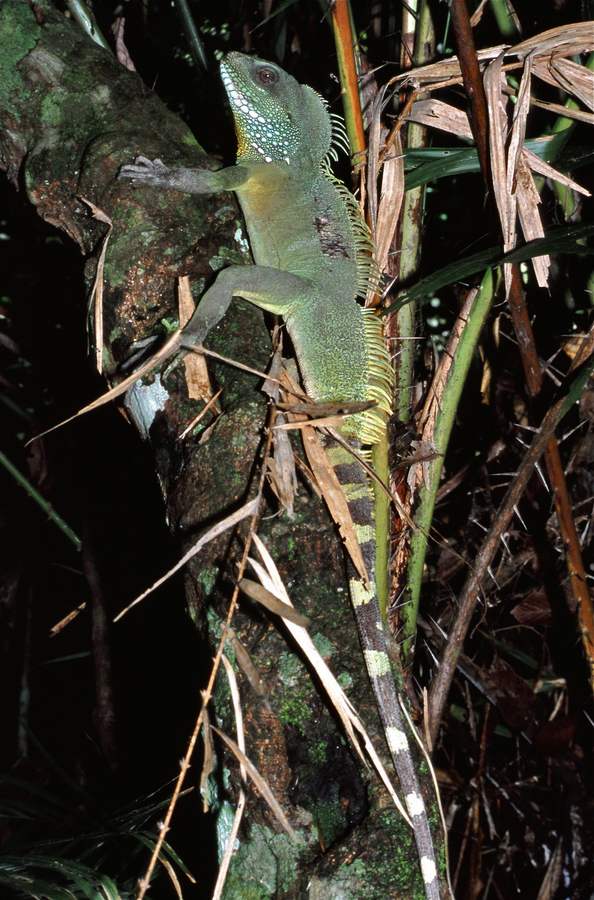
Adult male Chinese water dragon (Physignathus cocincinus) climbing — pointed snout, nuchal crest, and banded tail.
Photo: Bernard DUPONT, CC BY-SA 2.0, via Wikimedia Commons.
Water dragons became popular because their green color and sail-like crest look dramatic in a pet-store window, and those traits sometimes lead to them being sold as a “bearded dragon alternative.” They are nothing of the kind. Adults are long, they need height and a real pool, they rub their noses raw against glass they cannot make sense of, and they are sensitive to chronically low humidity and weak UVB. Most of the long-term problems we see, including metabolic bone disease, stuck shed, mouth and nose injuries, and respiratory illness, trace back to an enclosure that was never upgraded, a coil UVB bulb, or a dry room with only occasional misting.
Adults commonly reach 24 to 36 inches including the tail, with males often heavier in the head and jowls, and a lifespan of 10 to 15 years in captivity is common. This guide covers general husbandry for Physignathus cocincinus. Australian water dragons (Intellagama lesueurii) are a different animal with their own needs, so a “water dragon” label on a shipping tote is not enough information. Individual animals vary, and nothing here replaces an examination by a veterinarian who regularly sees reptiles. If you find a green lizard on a Cartersville property, it is far more likely to be a green anole or another local species than an escaped water dragon, and you are welcome to send us a picture if you would like an identification.
Whether they are a good fit
A Chinese water dragon is a long-lived, humidity-dependent, climbing insect-eater that needs a room-scale enclosure as an adult, a clean swimming basin, strong UVB, and a keeper who will mist regularly and maintain water quality. They are a poor fit for anyone hoping the animal can live in a starter aquarium forever, for a household that cannot keep feeder insects and a large wet setup, and for anyone who wants a lizard that sits on a shoulder every evening. Many adults are better suited to being display animals that tolerate limited handling than to being “lap lizards.”
Enclosure and space
Both height and length matter, because an adult needs climbing routes, a basking perch under UVB, shaded cooler zones, and a pool large enough to submerge and turn around in. A practical minimum for a single adult is about 6 feet long, 3 feet deep, and 6 feet tall, and custom PVC builds and converted grow tents are common ways to reach that size. A glass aquarium is at best a short-term option for a juvenile, and only if three sides are covered and humidity is maintained; it is not a home for an adult.
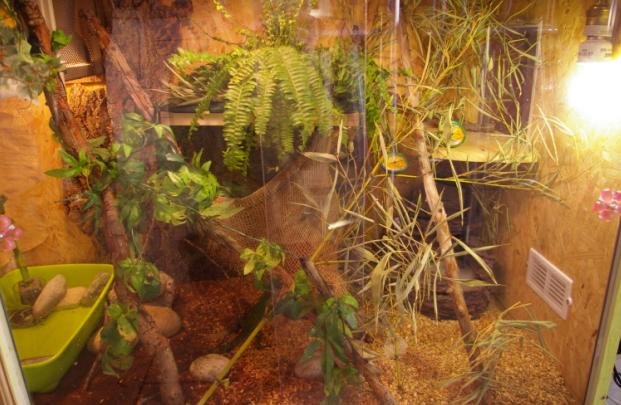
Tall arboreal vivarium with climbing branches, a swimming basin, plants, and a bright basking lamp — the footprint Chinese water dragons need.
Photo: Korova-milkbar, public domain, via Wikimedia Commons.
Keeping one dragon per enclosure avoids most social problems, and water dragons are not a species that needs a companion. Breeding groups require far more space than most pet keepers can provide, and injuries are common when two adults share one gradient.
Sturdy branches at several heights, visual cover from live or artificial plants, and a swimming basin that holds a substantial volume of water accomplish far more than decoration alone. Many keepers use a large plastic tub or a built-in pool holding on the order of tens of gallons, cleaned whenever it is soiled. Soft or opaque side walls reduce the chronic nose-rubbing that clear glass invites, and the setup needs a lid or tent that holds in humidity and prevents escape.
Temperature and the gradient
A water dragon’s digestion depends on having a warm basking perch with cooler options below it. The measurement that matters is the surface temperature of the branch under the heat lamp, taken with an infrared temperature gun, because an air reading on the glass can look acceptable while the perch is too cool for digestion or hot enough to burn.
A basking perch in the neighborhood of 90 to 95 F supports normal digestion for most adults, while the cooler zones lower in the enclosure commonly sit around 75 to 80 F. Overnight, many keepers try not to let the enclosure fall much below the mid-70s, and when the room is cooler, a ceramic heat emitter or radiant panel on a thermostat is the usual nighttime tool. All heat is safest when it is controlled; hot rocks and unregulated heat pads are a frequent cause of burns, and colored night bulbs are unnecessary.
Light, UVB, and the daily cycle
Chinese water dragons are active during the day and need bright daytime lighting and UVB rather than a dim corner. A photoperiod of around 11 to 13 hours on a timer, with a shorter day in winter if you choose to make a seasonal adjustment, is much easier on them than lights that switch at random hours.
The usual approach is a linear T5 HO UVB tube in the high-moderate to desert class, commonly a 10 to 12 percent T5 HO, mounted so that the basking zone reaches a measured UV Index in a moderate working range, often targeted at around 3 to 4. Follow the lamp’s distance chart, allowing for any mesh between the lamp and the dragon, and replace the tube on schedule. A bright full-spectrum LED alongside the UVB helps live plants and gives the dragon a clearer signal that it is daytime. Remember that window glass blocks most UVB, and that a heat lamp provides heat only, not UVB.
Humidity, water, and shedding
Water dragons are humid-forest lizards, and ambient humidity of around 60 to 80 percent is typical of a setup that works well. Mist in the morning and evening, which at adult enclosure size is commonly handled by an automatic misting system, and let some surfaces dry out between cycles so the enclosure does not become a sealed swamp with no airflow. Chronically dry air commonly leads to stuck shed and ongoing dehydration, while chronically stagnant, wet air with poor ventilation commonly leads to respiratory trouble.
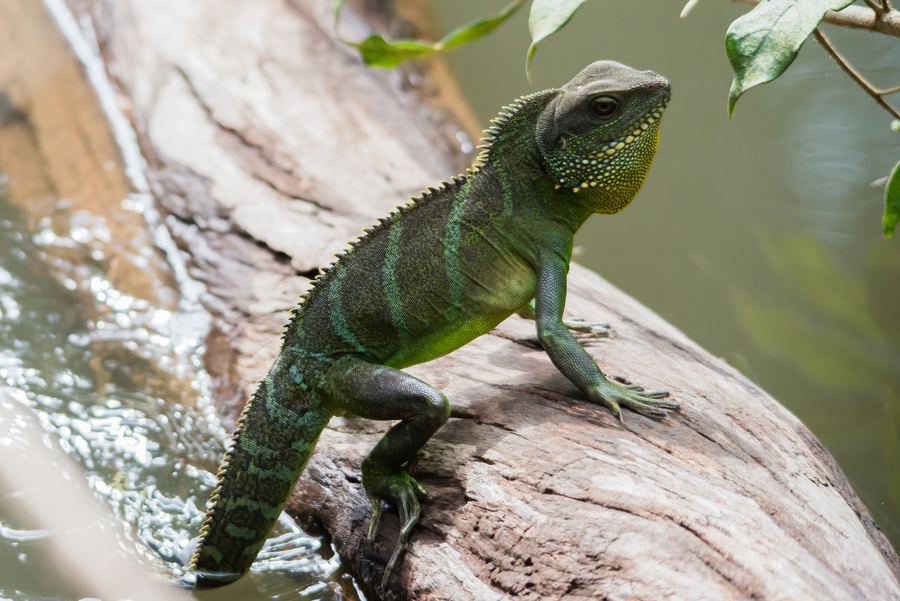
Chinese water dragon basking on a log beside water (Khao Yai) — nuchal crest and pointed snout clear.
Photo: Rushenb, CC BY-SA 3.0, via Wikimedia Commons.
The swimming basin is not optional decoration, and because dragons often defecate in water, it should be changed or fully cleaned whenever it is fouled. A healthy shed comes off in pieces without binding the toes or the crest spines, and patchy sheds that keep recurring usually point to a humidity or hydration problem, or to an animal that is not in good condition.
Diet
Hatchlings and juveniles eat mostly insects and are commonly fed daily or every other day, while many adults take insects every few days and accept more leafy greens as they mature. At each feeding, offer as many appropriately sized insects as the dragon will take in a short window, choosing insects no wider than the space between its eyes. Crickets, dubia and discoid roaches, silkworms, hornworms, and similar feeders form the core of the diet, and they should be gut-loaded before they are offered. Dust them with calcium, using a product without D3 when UVB is correct and including one with D3 in the rotation if UVB is absent (although providing UVB is still the better path), and add a multivitamin on the schedule your supplement label and veterinarian support.
Leafy greens such as collards, dandelion, hibiscus, and spring mixes, without iceberg lettuce as a staple, become more important with age. Fruit, pinky mice, and feeder fish are occasional treats rather than part of the regular diet. Body condition is a better guide than the calendar: a dragon with fat pads that has difficulty climbing is being fed too richly or too often, while one with a sharply triangular cross-section and a visible spine is being fed too little or may be ill.
Substrate
Because adults climb and swim far more than they dig, substrate is secondary to branches and water, but a moisture-retentive floor of coconut fiber, cypress, or a bioactive soil mix a few inches deep cushions falls and helps maintain humidity. Spot-clean feces on land daily, and fully replace non-bioactive substrate on a regular schedule before it sours. Paper works well during quarantine. Cedar and aromatic pine should never be used as bedding, and calcium sand has no place in this enclosure.
Handling and daily life
Many Chinese water dragons become calm enough to step onto an arm once they are used to tongs and to a person moving around in the enclosure, but they are still better suited to being display animals than pets handled every day. Approach from below or from the side, support the body, and work over a soft landing area. Wait to begin handling until the animal is eating reliably in its new setup, and never pull a dragon out of the water or off a high perch for a photo.
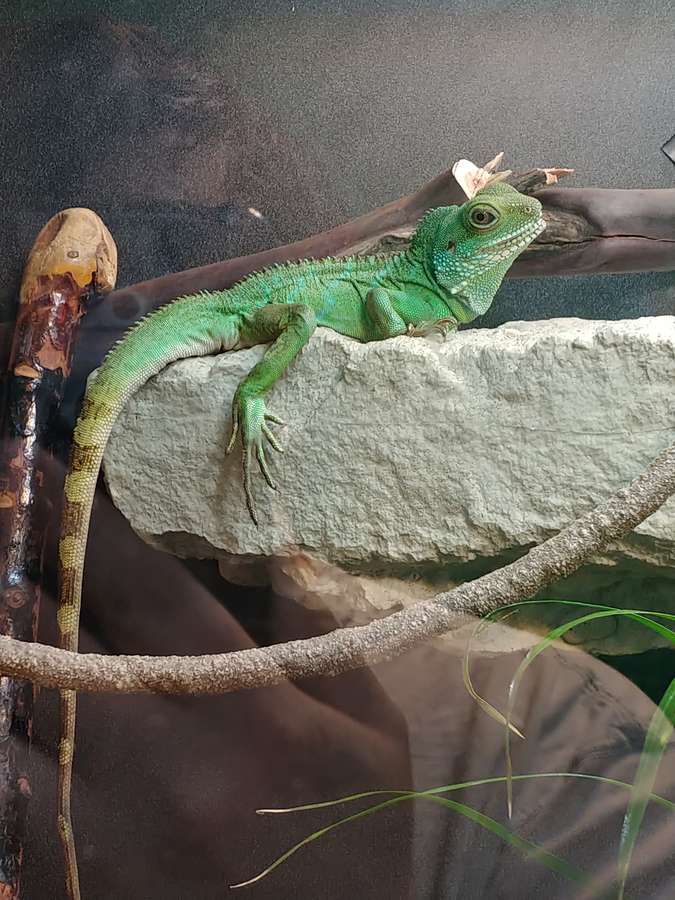
Captive Chinese water dragon on a rock ledge in a vivarium — pointed snout, nuchal crest, banded tail.
Photo: SuperSaiyaMan, CC BY-SA 4.0, via Wikimedia Commons.
A dragon that dives into the water when the door opens is using an ordinary escape response. Give it room, and do not fish it out again and again in a single session in an attempt to “desensitize” it.
Body language and behavior
Water dragons are easy to misread because their color, their crest, and their sudden dives look so theatrical that people attach human stories to them. A dragon that darkens is usually cold, stressed, or simply in different light, not depressed. A dragon that surfs the glass is not bored in a human sense; it is often reacting to its reflection, looking for an exit, or responding to movement outside the enclosure. Reading human emotions into a reptile in this way is how keepers miss the information that actually matters: whether this individual is using the height and the pool, eating on its own pattern, shedding cleanly, and keeping its snout intact.
The more useful habit is to learn the patterns of the particular animal in front of you, such as where it basks, whether it usually enters the water after being startled, and how it reacts to tongs compared with a hand. Once you know that baseline, it is a change from it that matters.
Signals that are usually ordinary
Tongue-flicking is simply the dragon sampling its surroundings, and perching high under the lamp after the lights come on is ordinary temperature regulation. Dropping into the water when startled is ordinary behavior for avoiding predators, and a mild shift in color between bright green and darker tones with temperature and time of day is common. A short bout of glass surfing after a change in the room can settle down on its own, but continuous surfing that does not settle usually points to a problem with the enclosure, reflections, temperature, or humidity.
What to watch for
- Open-mouth breathing, wheezing, or bubbles at the mouth or nose can signal a respiratory problem.
- A soft jaw, tremors, or a dragon that cannot hold a perch should be treated as metabolic bone disease (soft, poorly mineralized bone from insufficient UVB and/or calcium) until proven otherwise.
- A raw, abraded, or continually bleeding snout usually comes from rubbing against glass.
- Stuck shed on the toes or crest spines that keeps repeating points to a humidity or hydration problem.
- Weight loss, repeated refusal of feeders, or abnormal stool is a reason to see a reptile veterinarian.
- Lethargy in a cold enclosure, or a dragon that will not leave the water and looks weak, needs prompt attention to heat and a veterinary check.
If you notice any of these patterns, check your husbandry first, and then see a reptile veterinarian if the animal does not return to its own normal baseline.
Problems that show up often
The problems we see most often have predictable causes. Metabolic bone disease follows weak UVB and inconsistent calcium supplementation, and nose injuries follow clear glass and undersized enclosures. Respiratory disease follows cold combined with poor airflow or dirty water, stuck shed follows chronically low humidity, and obesity follows pinkies and fruit fed as though they were staples. Escapes and injuries trace back to lids that do not latch and branches that are not secured.
An escaped pet is a husbandry problem. Search the room first, then the rest of the house, and never release the animal outside. A bright green lizard on a Georgia porch is still most likely a local anole until a photo shows otherwise, so send us a picture if you find something unexpected near Cartersville and would like an identification.
Bringing a new animal home
A quarantine period in a separate enclosure, with its own tongs, water-cleaning tools, and a fecal check, is a much kinder start than placing a new dragon in a giant decorated display vivarium on its first day. A common working window is about 30 to 90 days, or until the dragon’s appetite is steady and a fecal test comes back clear, and longer if anything seems off. Confirm that the basking perch, cool zones, humidity, UVB, and water quality are all in range before doing much handling, and leave the animal alone long enough for it to eat several meals. Those first weeks are also the time to start learning its ordinary behavior, including how it uses the pool.
Substrate and water hygiene in more detail
Paper or tile make quarantine and medical housing easy to sanitize. Long-term display setups often use a soil-based bioactive floor over a drainage layer, planted with species that tolerate high humidity, or a bare, easily cleaned floor beneath the branches if the keeper prefers simplicity. The deciding factor is not appearance but whether feces, shed skin, and drowned feeder insects are removed before the water and soil become a breeding ground for bacteria.
The swimming basin should be deep enough for the dragon to submerge and push off, with an easy exit ramp so that a tired animal can never become trapped. How often you change the water depends on its volume and filtration, but a pretty waterfall that recirculates filthy water is worse than a plain tub that is changed often. Wash your hands after servicing the water, just as you would after any other reptile chore.
Growth, sex, and temperament
Males typically develop larger heads, fuller crests, and stronger territorial displays, while females stay slightly smaller on average but still need adult-scale housing. Juveniles are bright and busy, and adults are powerful animals that can deliver a defensive bite if cornered. Many individuals never become relaxed couch companions, and that is normal for the species rather than a failure of “taming.”
Rubbing the snout against clear walls causes one of the most common chronic injuries in this species. Before assuming the animal needs more handling to “get used to people,” cover the outside of the glass with a background, add sight barriers inside the enclosure, increase the number of usable branch routes, and make sure the enclosure is large enough.
Recommended gear
Some of the links below go to Amazon, and if you buy through them we may earn a small commission. This does not change the price you pay.
When you are budgeting, remember that height, UVB, a clean pool, and humidity control all matter far more than decoration, and plan for the adult-sized enclosure before you buy the baby.
- A 6x3x6-foot enclosure for an adult. That size is custom-build territory (a specialty PVC builder or a converted grow tent), so we do not link a single product for it
- Etekcity Lasergrip 774 for the basking perch surface
- ThermoPro probe thermometer and hygrometer to track air temperature and humidity
- REPTIZOO dimming thermostat for basking bulbs
- A high-output T5 HO UVB kit sized to the basking zone; follow the distance chart
- Automatic misting system or a pump pressure sprayer
- Large plastic stock tank or storage tub for a swimming basin
- Zoo Med Reptile Calcium without Vitamin D3 for dusting when UVB is in place, plus a reptile multivitamin on a light schedule