


Corn Snake
Pantherophis guttatus
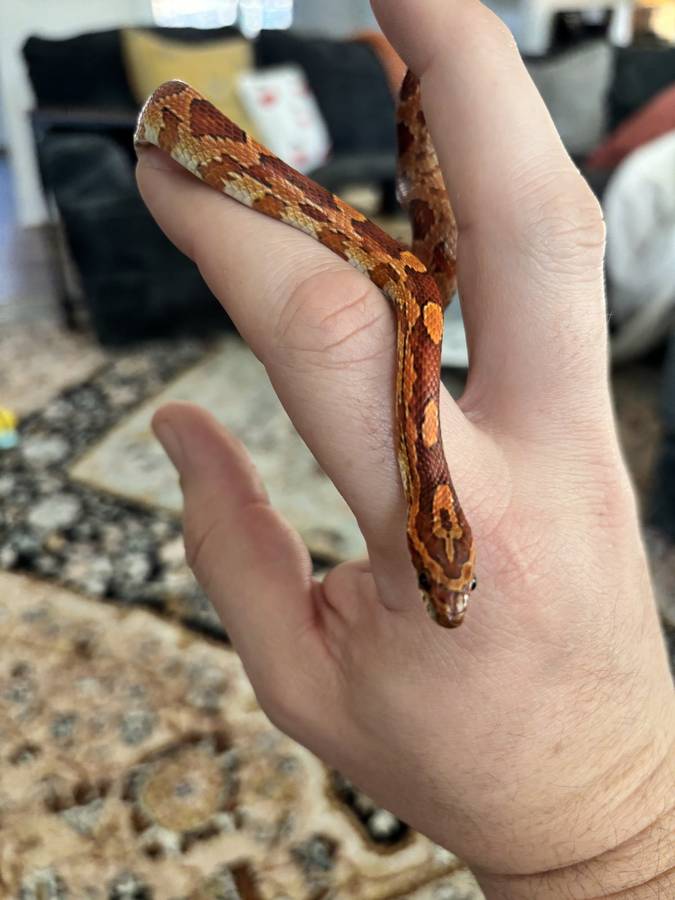
Snake
Key numbers
The figures below are a working snapshot of what a typical corn snake needs, rather than a guarantee that every individual will fit them exactly. The rest of this guide explains the reasoning behind each number, so you can adjust sensibly when your own snake or your own house behaves a little differently.
- Adult size: Adults commonly reach 3 to 5 and a half feet.
- Lifespan: They often live 15 to 20 years, sometimes longer.
- Adult enclosure: An enclosure about 4 feet long by 2 feet deep by 2 feet tall is a practical minimum for one adult, and corn snakes use height more than a ball python does.
- Start size: A hatchling can begin in a 20-gallon enclosure, or one about 24 to 36 inches long, if the temperature gradient and lid are right, then move toward the 4x2x2 as it grows.
- Housing: Keep one snake per enclosure.
- Warm end: The surface the snake sits on at the warm end should read about 82 to 86 F.
- Cool end: The cool end should sit around 72 to 76 F.
- Humidity: Keep humidity around 40 to 50 percent most of the time, with a rise when the snake is in shed.
- Hides: Provide at least one hide on the warm end and one on the cool end; a humid hide helps when the snake is in shed.
- Diet: Feed a single appropriately sized rodent, usually frozen-thawed.
Do’s and don’ts
This list is the short version of the husbandry covered in detail further down the page. If a line here and a paragraph later on ever seem to pull in different directions, trust the longer explanation, because it carries the context that a one-line rule cannot.
Do
- Give an adult an enclosure about 4 feet long by 2 feet deep by 2 feet tall (a 4x2x2), or larger, with a warm hide, a cool hide, and something to climb.
- Measure the basking or hide surface itself, not the air or the glass.
- Keep a secure lid. Corn snakes are curious and they are good at finding the one gap in a top.
- Offer frozen-thawed rodents with tongs, sized about as wide as the snake at mid-body.
- Learn that individual’s ordinary patterns so a missed meal or a restless night can be read against a baseline.
- See a veterinarian who regularly treats reptiles when breathing, body condition, or shed quality leaves that baseline.
Don’t
- Do not leave an adult in a 20-gallon tank as a finished home.
- Do not house two corn snakes together.
- Do not use a hot rock or an unregulated heat pad as the main heat.
- Do not handle for a couple of days after a meal, or while the snake is in blue (cloudy eyes before a shed).
- Do not release a pet corn snake, or any pet snake, into Georgia woods. That animal is not a wild one, and it is not a favor.
- Do not assume a blotched snake in the yard is a corn snake because the colors are close. Send a picture if you want an ID.
- Do not read musking, an S-coil, or climbing a person as a human mood.
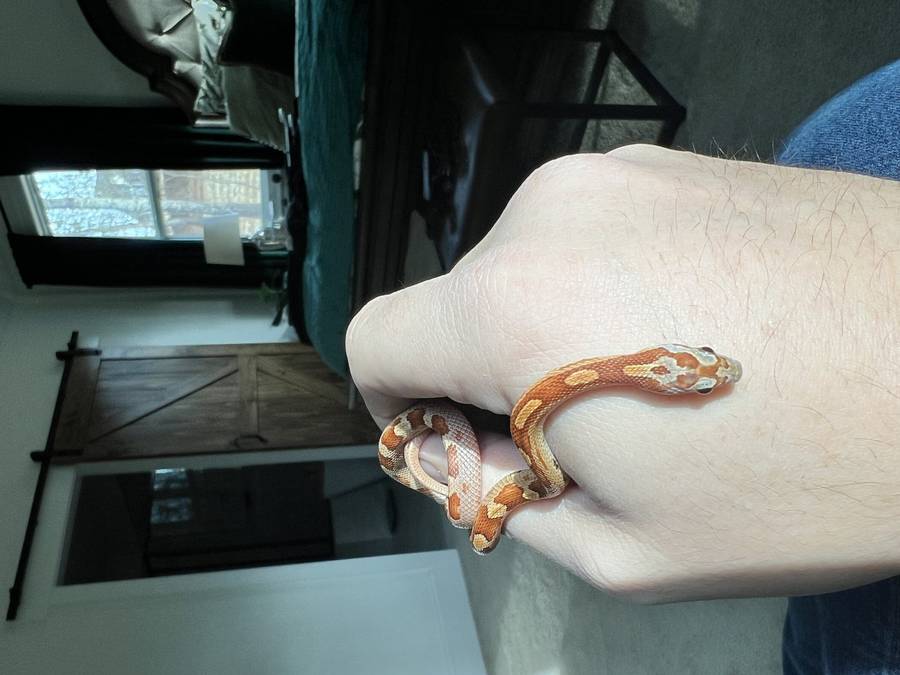 Captive-bred corn snake hatchling resting on a keeper’s hand — a size a 20-gallon grow-out suits.
A bit of background
The corn snake, Pantherophis guttatus, is a harmless constrictor native to the southeastern United States, including Georgia. In the wild, corn snakes make use of barns, woodpiles, rodent burrows, and low trees, where they hunt mice and rats. That mix of ground-dwelling and climbing, together with their preference for a hide they can disappear into, is what most captive setups are trying to recreate.
Corn snakes became one of the most widely kept pet snakes because they stay a manageable size, usually take frozen-thawed rodents without much fuss, and tolerate handling better than many other colubrids, the family that includes corn snakes, kingsnakes, and many other common pet snakes. Those traits can make them seem almost like a toy. In reality, a corn snake that is always out and climbing the glass is sometimes a curious animal in an enclosure that is too small, rather than a snake that wants more attention.
Adults commonly reach 3 to 5 and a half feet and can live 15 to 20 years. This guide covers general husbandry for Pantherophis guttatus; related ratsnakes have their own needs, individual animals vary, and nothing here replaces an examination by a veterinarian who regularly sees reptiles.
Because corn snakes are a local wild species as well as a common pet, two extra points belong up front. First, a pet corn snake that gets loose is not the same as the wild ones living on a Cartersville property, and it should never be turned out “to be free.” Second, a blotched snake that someone finds on their land is not automatically a corn snake just because its colors are somewhere near orange, because copperheads are common here. If you would like an identification, send us a picture, and if you want the snake moved, we relocate snakes within about an hour of Cartersville at no charge.
Whether they are a good fit
A corn snake is a long-lived, moderately active constrictor that needs a large enclosure as an adult, a secure lid, and a reliable source of frozen rodents. Corn snakes cope with regular, calm handling better than many snakes do, but they still need proper heat, hides, and time to digest their meals. They are a poor fit for a household that cannot keep a lid latched, and for anyone hoping a five-foot adult will live in a 20-gallon tank.
Enclosure and space
Corn snakes use both the ground and climbing structures, but floor space still matters, because an adult needs a warm end and a cool end that genuinely differ. A practical minimum for a single adult is about 4 feet long, 2 feet deep, and 2 feet tall, and height is more useful for this species than it is for a ball python. A hatchling can start in a 20-gallon tank, or an enclosure about 24 to 36 inches long, as long as the gradient and lid are right. Move it to the 4x2x2 as it grows, rather than leaving a five-foot adult in a 20-gallon tank. Branches, a shelf, or a cork round give the snake somewhere to go other than up the glass.
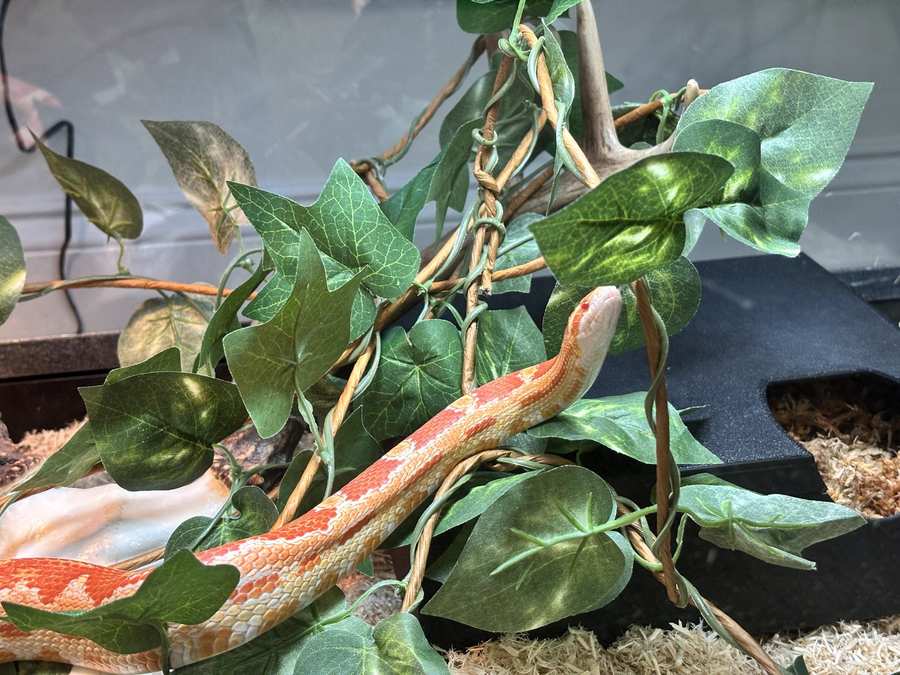 Corn snake climbing in a furnished tub — they use height more than a ball python does.
Keeping one snake per enclosure avoids most social problems, and corn snakes are not a species that needs a companion. Feeding two snakes in the same enclosure is how keepers end up with the wrong animal on the rodent.
A hide at the warm end and another at the cool end, a heavy water bowl, and a lid that genuinely latches are the pieces that do the real work. Corn snakes are escape artists when it comes to small gaps, and if the top can shift even half an inch, they will find the opening.
Temperature and the gradient
A corn snake’s digestion depends on temperature, so the measurement that matters is the temperature of the surface the snake rests on at the warm end, taken with an infrared temperature gun. For most adults, that surface should sit in the neighborhood of 82 to 86 F, while the cool end of the same enclosure is typically around 72 to 76 F. If the whole enclosure sits at a single temperature, the snake has nowhere to go to regulate its body heat.
Heat is safest when a thermostat controls it. A halogen flood or another overhead source at the warm end, or a quality heat pad on the outside of a tub, will both work well as long as they are regulated, whereas hot rocks and unregulated pads are a frequent cause of burns. Overnight, a typical house in the mid-60s to low 70s is usually acceptable, and colored night bulbs are unnecessary.
Light, UVB, and the daily cycle
Corn snakes are often active at dusk and during the night, although they will also move around by day in a dim enclosure. They need a clear day and night, and a simple schedule of 12 hours on and 12 hours off is much easier on them than lights that switch at random hours.
Some keepers provide low-level UVB for this species, although it is never a substitute for a correct thermal gradient. A high-output desert tube is the wrong lamp, and providing cover so the snake can get out of the light matters just as much as the choice of lamp.
Humidity, water, and shedding
Corn snakes are temperate animals, not rainforest dwellers, and ambient humidity of around 40 to 50 percent is typical of a setup that works well. When the eyes turn cloudy, a stage keepers call being “in blue,” a rise in humidity or access to a humid hide helps the skin come off in one piece. For most animals, a water bowl large enough to soak in and heavy enough not to tip provides all the water they need.
A healthy shed comes off in one piece, eyecaps included, and patchy sheds that keep recurring usually point to a humidity or health problem. As a side note for homeowners, a shed skin found on a property is not a sign of a nest of snakes. Corn snakes do not live in nests; they shed, hide, and move on, and the young of the year leave the hatching site and disperse. Finding a skin simply means that a snake passed through, not that a family is living there.
Diet
Corn snakes eat rodents. Hatchlings usually start on mouse pinkies or fuzzies, which are very young mice that are still hairless or just getting their first fur, and adults typically move on to adult mice, with some large animals taking small rats. Offering frozen-thawed prey that has been warmed through, using tongs, is the method that avoids most injuries from prey bites, and the usual guide to size is prey about as wide as the snake at mid-body.
Young animals are commonly fed every 5 to 7 days, while adults often go 7 to 10 days between meals, and body condition is a better guide than the calendar. Postpone handling for a couple of days after a meal. A snake that regurgitates is telling you that the prey was too large, that it was handled too soon after eating, or that the warm end is too cool for proper digestion.
Many corn snakes keep eating right through the winter. A mild dip in appetite during the shortest days can still be ordinary as long as the snake’s weight and behavior hold steady, but it is never a reason to deliberately cool a thin animal.
Substrate
Aspen, cypress, and similar products are widely used as substrate, and paper works well during quarantine. Whatever you use, keep it dry enough that the snake is never lying in wet mulch, and remove feces as soon as they appear. If your snake is a messy striker that tends to pick up loose substrate with its food, consider feeding it in a separate tub or on a plate.
Handling and daily life
Most corn snakes will glide calmly from hand to hand once they are used to being picked up, provided they are supported along the body. They are more restless than a ball python, but that is ordinary for the species and does not mean the snake is “unhappy to see you.” Short, calm sessions go much better than long tours of the house, where a corn snake can disappear up a curtain or down a vent. Postpone handling for a couple of days after a meal and while the snake is in blue.
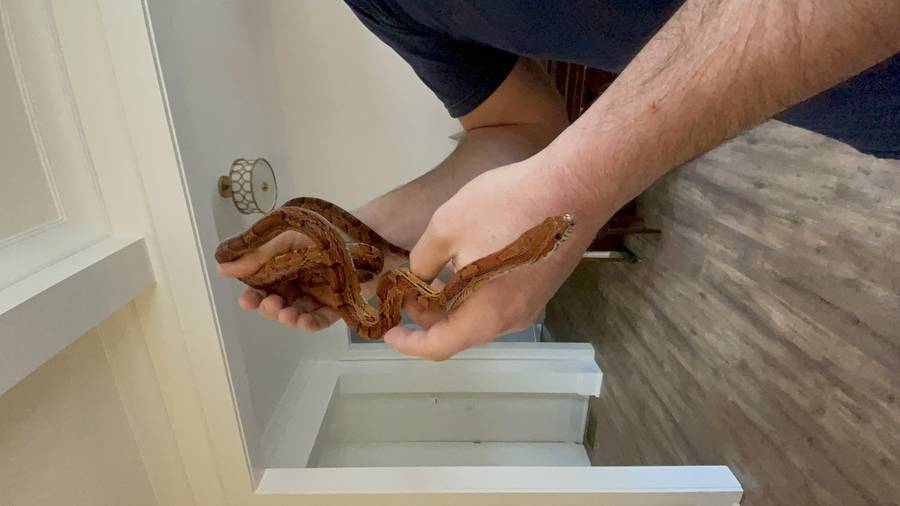 Pet corn snake supported with two hands during handling.
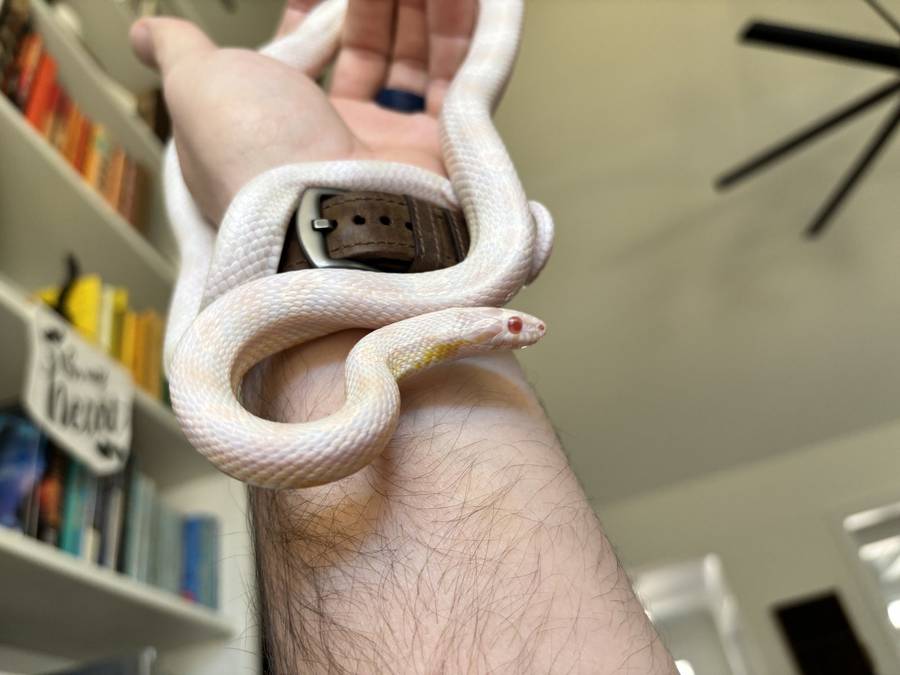 Snow morph corn snake, a captive-bred pet, on a keeper’s wrist.
Body language and behavior
Corn snakes are easy to misread simply because they are so busy. A snake climbing your sleeve is usually just climbing, and a snake that musks, releasing a foul-smelling fluid from its vent, when first picked up is using a defensive tool rather than insulting you. Reading human emotions into a reptile in this way is how keepers miss the information that actually matters: whether this individual is using both ends of the enclosure, eating on its own pattern, shedding cleanly, and breathing with its mouth closed.
The more useful habit is to learn the patterns of the particular animal in front of you, such as whether it usually comes out after dark, how it reacts to the lid opening compared with the appearance of the tongs, and what a normal stool looks like. Once you know that baseline, it is a change from it that matters.
Signals that are usually ordinary
Tongue-flicking is simply the snake sampling the air. An S-shaped coil in the neck can be either a defensive or a feeding posture, and the rest of the picture, such as whether the tongs are in view, how long it has been since the last meal, and whether the snake feels cornered, is what makes it make sense. Musking and a little tail vibration are common in nervous or newly acquired animals and often fade with calm, infrequent handling. Dull, bluish skin and cloudy eyes mean a shed is on the way, and hiding for a few days around that shed is ordinary.
Climbing the glass for a few minutes after something in the room changes can be ordinary curiosity. Glass climbing that never settles down in a small enclosure, however, usually points to a problem with space or temperature rather than a snake asking to “play.”
What to watch for
- Open-mouth breathing, wheezing, or bubbles at the mouth or nose point to a respiratory problem.
- Regurgitation, or a snake that strikes and refuses to finish. Check the warm-end temperature and how soon the animal was handled after the last meal.
- Stuck eyecaps or ragged sheds that keep repeating point to a humidity or hydration problem.
- Tiny black specks, soaking, and restlessness can all be signs of mites.
- Weight loss, sunken eyes, or chronically odd stool are reasons for a fecal exam.
- A snake that cannot right itself, or that corkscrews, is a neurological picture and is not something to wait out.
If you notice any of these patterns, check your husbandry first, and then see a reptile veterinarian if the animal does not return to its own normal baseline.
Problems that show up often
Respiratory disease usually follows an enclosure that is too cold, or one that is cold and damp at the same time. Mites tend to arrive with pet-store animals and in mixed collections. Regurgitation is usually a husbandry issue involving temperature, prey size, or handling before it is any kind of mystery disease, and mouth rot and retained shed are less common when the gradient and humidity are within range. An escaped pet is a husbandry problem of a different kind: check the lid, then search the house, and never release the animal outside.
Bringing a new animal home
A quarantine period of at least 60 to 90 days in a separate enclosure, with its own tongs and water bowl and a fecal check, is a much kinder start than placing a new snake straight into a display vivarium on its first day. Before you begin regular handling, confirm that the gradient is right, that the lid is secure, and that the snake has eaten a couple of meals without trouble. Those first weeks are also the time to start learning its ordinary behavior.
Recommended gear
Some of the links below go to Amazon, and if you buy through them we may earn a small commission. This does not change the price you pay.
When you are budgeting, remember that a secure lid and a genuine temperature gradient matter far more than a starter kit, because corn snakes will find the one gap in a poorly fitting top.
- New Age Pet ECOFLEX 48-inch Mojave Reptile Lounge for a single adult (secure the lid; corn snakes find any gap)
- Etekcity Lasergrip 774 infrared temperature gun to measure the surface the animal actually sits on
- ThermoPro probe thermometer and hygrometer to track air temperature and humidity
- BN-LINK on/off thermostat for a heat mat. Use a dimming stat if the heat is a bulb
- Aspen bedding if humidity stays in the 40 to 50 percent range, or Forest Floor cypress if the box runs dry
- Zoo Med stainless steel feeding tongs, 10-inch