


Crested Gecko
Correlophus ciliatus
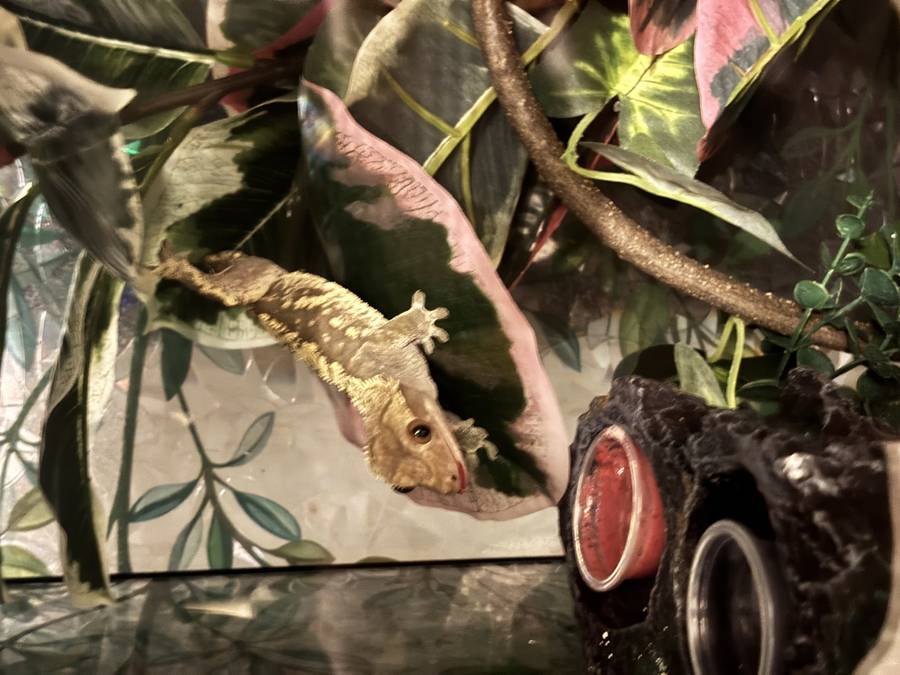
Lizard
Key numbers
The figures below are a working snapshot of what a typical crested gecko needs, rather than a guarantee that every individual will fit them exactly. The rest of this guide explains the reasoning behind each number, so you can adjust sensibly when your own animal or your own house behaves a little differently.
- Adult size: Adults commonly reach 7 to 9 inches, including the tail, and weigh about 35 to 45 grams.
- Lifespan: With consistent care, they often live 15 to 20 years.
- Adult enclosure: An enclosure about 18 inches long by 18 inches deep by 24 inches tall (an 18x18x24) is a common practical minimum for one adult, and taller is better.
- Start size: A hatchling or small juvenile can begin in something closer to 12 inches by 12 inches by 18 inches tall (a 12x12x18), then move up toward the 18x18x24 as it starts using the height.
- Housing: Keep one gecko per enclosure.
- Daytime temperature: Keep the enclosure at about 72 to 78 F during the day; if you use a gentle warm perch at the top, the surface the gecko sits on should stay around 80 to 82 F.
- Do not exceed: Sustained temperatures of around 85 F and up are a common way to cook this species, so do not let the enclosure stay that warm.
- Overnight: Overnight temperatures from the mid-60s to the low 70s are usually acceptable in a typical house.
- Humidity: Humidity should run high right after a misting and then be allowed to dry toward the 50s before the next misting.
- Diet: Feed a complete gecko diet (CGD), the Pangea- or Repashy-style powder mixed with water, as the staple, with insects as part of the diet and no grocery-store fruit puree.
Do’s and don’ts
This list is the short version of the husbandry covered in detail further down the page. If a line here and a paragraph later on ever seem to pull in different directions, trust the longer explanation, because it carries the context that a one-line rule cannot.
Do
- Give an adult a tall enclosure about 18 inches long by 18 inches deep by 24 inches tall (an 18x18x24), or taller, with cover at several heights.
- If you add heat, measure the temperature of the perch the gecko sits on, not a stick-on thermometer on the glass. Many rooms do not need a heat source at all.
- Mist so the enclosure goes wet, then let it dry toward the 50s. That cycle matters more than a single humidity number.
- Feed a complete gecko diet (CGD): a formulated powder, mixed with water, made for New Caledonian geckos. Insects are a useful extra, not a replacement, and not a bowl of mango from the fridge.
- Learn that individual’s ordinary patterns (appetite, stool, how it uses the height, whether the tail is still there).
- See a veterinarian who regularly treats reptiles when appetite, stool, shed, or body condition leaves that baseline (local herp groups and exotic-vet directories help you find one before you need them).
Don’t
- Do not leave an adult in a 12x12x12 cube as a finished home.
- Do not house two crested geckos together because they “need a friend.” They do not.
- Do not run the enclosure at 85 F or leave it in a window that cooks in the afternoon.
- Do not force a heat mat under the belly. This is not a leopard gecko, and most of them do not want belly heat.
- Do not use a desert 10.0 UVB tube. If you offer UVB, use a moderate, forest-strength lamp and give cover.
- Do not feed grocery fruit puree as the diet. It is sugar and water, not a complete gecko diet.
- Do not grab the tail. Crested geckos can drop it, and it does not grow back the way an anole’s tail does.
- Do not read jumping, vocalizing, or a tail wave as the gecko being happy to see you.
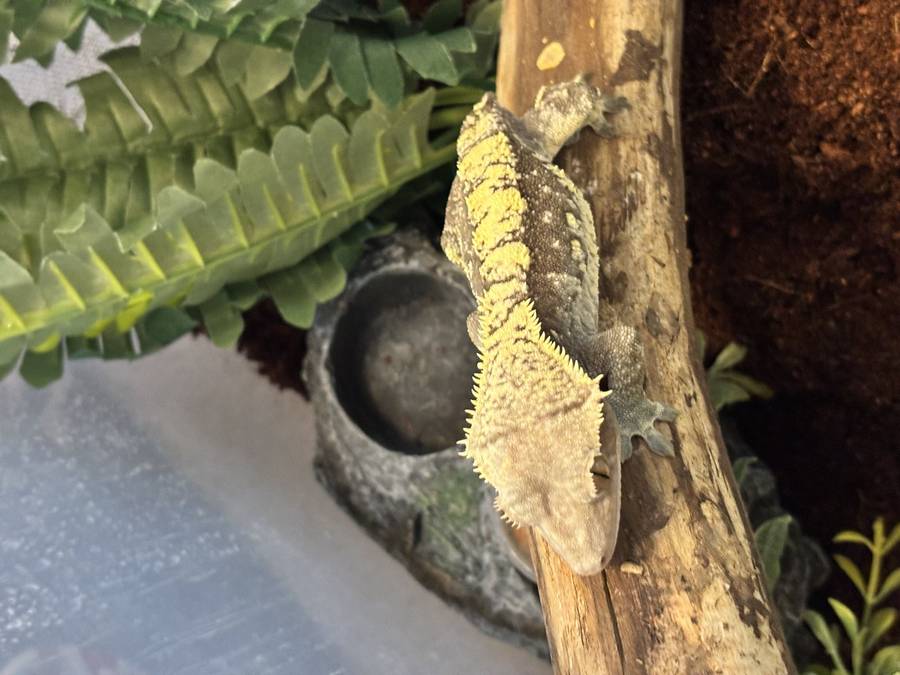 Crested gecko side profile showing crests and cilia.
A bit of background
The crested gecko, Correlophus ciliatus, is a climbing gecko from the humid forests of New Caledonia, a group of islands east of Australia. The species was thought lost to science for most of the twentieth century until it was rediscovered in the 1990s, and almost every animal in the pet trade today is captive-bred from stock collected after that rediscovery. Its eyelash-like crests, sticky toe pads, and habit of leaping from perch to perch are the features most captive setups are trying to make room for.
Crested geckos became one of the most widely kept pet lizards because they stay small, tolerate cooler rooms than a bearded dragon, and can live largely on a complete gecko diet (CGD) that replaced most of the nightly cricket chore. Those traits can make them seem like a desk pet, but a gecko sitting still on a curtain is no evidence that its enclosure is doing its job. Most of the chronic problems we see, including thin animals, stuck shed, floppy tail syndrome, and geckos that overheated during a heat wave, come from temperature, humidity cycling, or diet being slightly off for a long time.
Adults commonly reach 7 to 9 inches including the tail and weigh about 35 to 45 grams, and they can live 15 to 20 years. Crested geckos have no eyelids, so they lick their eyes to keep them clean. They can also drop their tails, a process called autotomy, when badly startled or grabbed, and unlike a leopard gecko or an anole, a crested gecko never regrows its tail. The animal lives perfectly well without it, but the tail will not come back. This guide covers general husbandry for Correlophus ciliatus; individual animals vary, and nothing here replaces an examination by a veterinarian who regularly sees reptiles.
Whether they are a good fit
A crested gecko is a long-lived climber that prefers a cool room and needs vertical space, a daily humidity cycle, and a reliable supply of complete gecko diet. They do best in a household that can keep the room out of the mid-80s in summer and is willing to mist and mix powdered food on a schedule. They are a poor fit for a hot sunroom, for anyone hoping the animal can live in a small cube forever, and for a keeper who wants a desert lizard that basks on a rock. They also jump, as any household that cannot keep a lid latched or that handles its gecko over a hard floor will discover quickly.
Enclosure and space
Because crested geckos climb and jump, height matters more than floor space. A practical minimum for a single adult is about 18 inches long, 18 inches deep, and 24 inches tall, and taller is better as long as you can maintain the humidity cycle. A hatchling or small juvenile can start in a 12x12x18 enclosure, where it can easily find food and feel well covered. Upgrade toward the 18x18x24 once it starts using the height, which is typically well before it reaches full adult weight, rather than leaving it in a grow-out cup for a year.
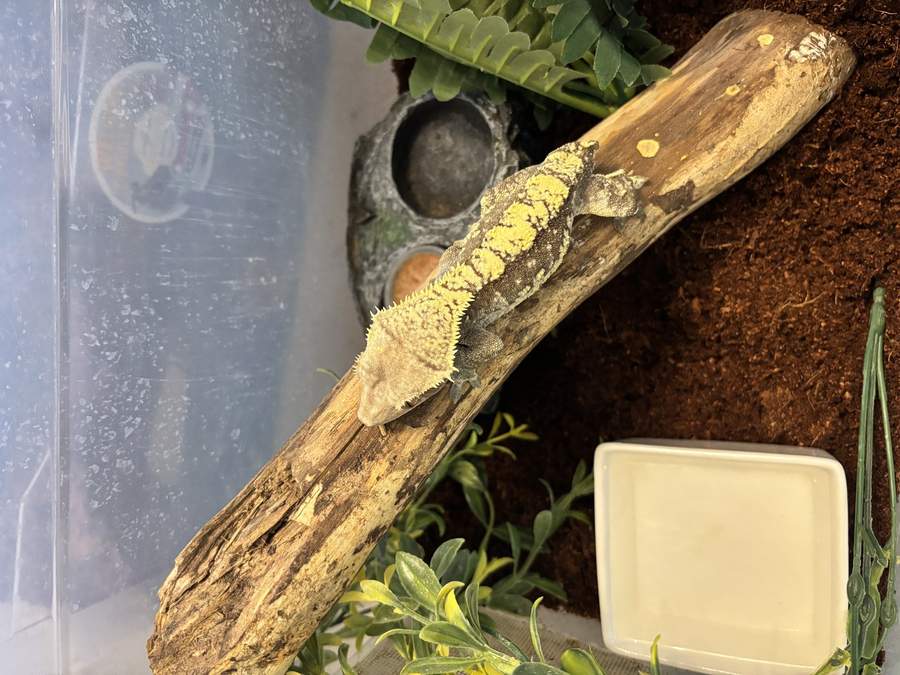 Crested gecko on a branch perch with coir floor, water dish, and elevated feeding ledge — furnished tub/grow-out, not a finished tall adult viv. Frogbutt (tailless; cresteds do not regrow a dropped tail).
Keeping one gecko per enclosure avoids most social problems, and crested geckos are not a species that needs a companion. When two animals share one enclosure, one of them usually claims the better perch and the feeding ledge, and injuries, dropped tails, and chronic stress are common, even in pairs that appeared peaceful for months.
The enclosure should be full of climbing routes rather than empty air. Cork rounds, branches, a background the gecko can grip, and foliage at several heights give it somewhere to sit other than the front glass. A feeding ledge or a stable cup holder keeps the complete gecko diet off the floor, and a shallow water dish the gecko can find belongs in the enclosure even though many crested geckos drink droplets after a misting. Screen-sided cages vent well and dry out faster, while glass enclosures hold humidity longer but also overheat faster. Either can work, provided you watch the actual humidity cycle rather than relying on the marketing label.
Temperature and the gradient
Crested geckos are animals of cool forests, and the working target for most adults is about 72 to 78 F in the enclosure during the day. Overnight, a typical house in the mid-60s to low 70s is usually acceptable. Sustained temperatures of around 85 F and above are one of the most common ways this species gets into serious trouble, and a Georgia afternoon in a closed room can produce them without any lamp at all.
In many climate-controlled homes, the room needs no extra heat source at all. Do not add a heat mat under the floor simply because a kit included one, because belly heat is the wrong tool for a gecko that lives up in the plants. If the room runs cool enough that the gecko sits in the mid-60s during the day and stops eating, the usual fix is a low-wattage overhead lamp aimed at a high perch and run on a dimming thermostat. If you add such a lamp, measure the temperature of the surface the gecko sits on with an infrared temperature gun rather than relying on a stick-on thermometer on the glass. A gently warm perch of around 80 to 82 F is plenty, and the rest of the enclosure should still offer cooler places to sit.
Any heat source without a thermostat can drift upward over time, so always pair the two. Colored night bulbs are unnecessary.
Light, UVB, and the daily cycle
Crested geckos are crepuscular, meaning they are most active around dusk and after dark. They do not need blazing desert lighting, but they do need a clear day and night, and a simple schedule of 12 hours on and 12 hours off is much easier on them than lights that switch at random hours.
Low-level UVB has become a common recommendation for this species. Crested geckos can make use of it, although they can also live on a complete gecko diet without it. A 10.0 desert tube is the wrong lamp. Keepers who offer UVB generally choose a 5.0 T5 HO, which is a long, high-output fluorescent tube at forest strength rather than the 10.0 used for bearded dragons, or another moderate forest-strength linear tube, and they give the gecko enough cover to get out of the light. Follow the lamp’s distance chart, and do not think of that 5.0 tube as “low UVB,” because it is a high-output lamp with a moderate output rating. Remember too that a heat lamp provides heat only, not UVB, and that window glass blocks most UVB, so a cage on a windowsill is still a cage without UVB.
Humidity, water, and shedding
Although crested geckos come from humid forests, their enclosure still needs to dry out regularly. What you are aiming for is a daily cycle: mist in the evening so that surfaces become wet and humidity rises, then let it fall back toward the 50s before the next misting. A constant 80 percent with no drying period commonly leads to mold, shedding problems of a different kind, and respiratory trouble, while an enclosure that never rises above the 40s commonly leads to stuck shed on the toes and the tip of the tail.
Most crested geckos drink droplets off leaves, glass, and cork after a misting, but a shallow water dish is still worth providing. A humid hide, meaning a hide filled with damp sphagnum that the gecko can enter and leave, is useful in a screen cage that dries out quickly, especially around shedding time.
A healthy shed comes off in large pieces, including the skin over the toes and over the tail tip if the gecko still has its tail. Bands of stuck shed on the toes can cut off circulation, and patchy sheds that keep recurring usually point to a problem with the humidity cycle or hydration, or to a gecko that is not in good condition.
Diet
The staple of the diet is a complete gecko diet (CGD), a formulated powder made for these New Caledonian species and mixed with water to the consistency of ketchup or pudding. Pangea- and Repashy-style diets are the ones we actually see working well. This powder is neither a treat nor optional, and grocery-store fruit puree, baby food, and mashed banana, which are essentially sugar and water, are no substitute for it.
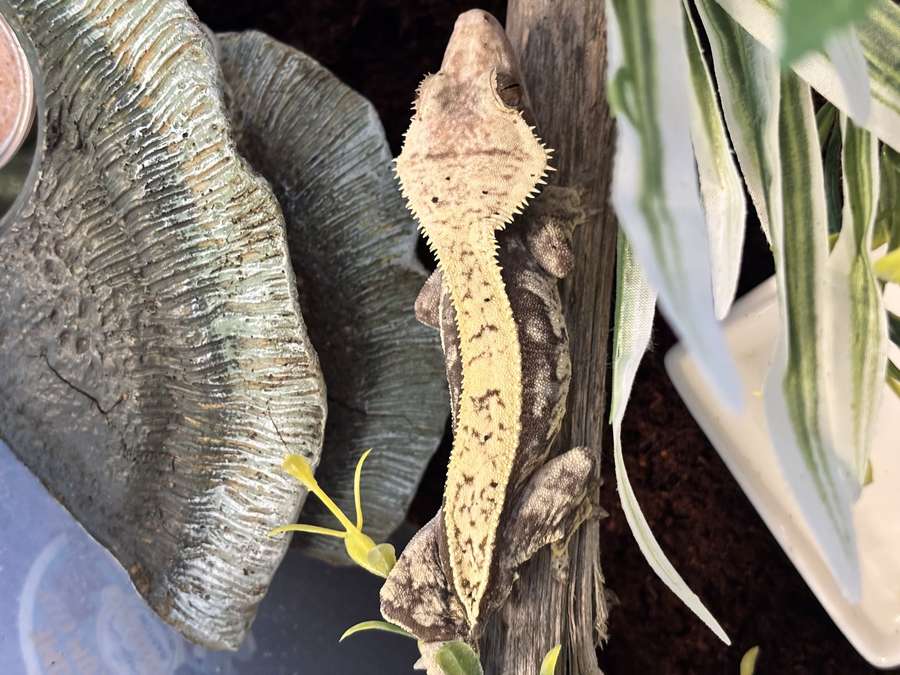 Crested gecko near a CGD cup on a mushroom hide — diet station. This animal is a frogbutt (no regenerated tail).
Insects are part of the diet, but not the whole of it, and they are not needed at every meal the way they are for a leopard gecko. Gut-load the insects, meaning feed them a decent diet before offering them, and dust them with calcium, especially while the gecko is still growing. Each prey item should be no wider than the space between the gecko’s eyes, and crickets and dubia roaches are widely used. Do not leave uneaten live insects in the enclosure overnight, where they can nibble on a sleeping gecko.
Juveniles are commonly offered fresh CGD daily, or at least several times a week, with insects a couple of times a week, while adults often do well on CGD every other day or every two to three days, with insects about once a week. Remove any uneaten diet before it spoils. Body condition is a better guide than the calendar, and a gecko that looks like all head and hips is underweight, not “a slim morph.”
If a moderate forest-strength UVB lamp is in place, many keepers dust insects with calcium without D3 rather than stacking D3 from both the powder and the lamp. If you skip UVB, use a calcium with D3 on a regular schedule whenever insects are offered. Keep in mind that the CGD already contains a vitamin and mineral package, and adding three extra powders on top of it is how some animals end up with too much of a good thing.
Substrate
Paper towel is the right floor covering during quarantine and for a gecko that is still learning to find its feeding ledge. For a finished enclosure, a moisture-retentive mix of cypress, coconut husk, or a similar product that can become damp and then dry out again is widely used, but it should never be left sitting as mud. Remove feces as soon as they appear.
A bioactive floor with leaf litter and a cleanup crew of small invertebrates is a common finished setup for this species, and it can work well if you already know how to maintain the wet-then-dry cycle without the floor staying muddy. For most keepers, though, it is a later project rather than a requirement on the first day. Loose sand has no place in this enclosure.
Handling and daily life
Most crested geckos will walk onto a hand once they are used to being picked up, and then, quite ordinarily, they will jump. Handle your gecko over a couch or a bed rather than a hard floor, and away from gaps behind furniture such as a dresser. Support the body, and never lift a gecko by its tail, because the tail can drop off and it will not grow back.
Short, calm sessions in the evening go much better than chasing the animal around its enclosure in the middle of the day. A gecko that vocalizes when picked up is protesting rather than talking, and a gecko that leaps toward your face is simply jumping, not greeting you.
Body language and behavior
Crested geckos communicate a great deal through leaps, tail movements, and vocalizations, and people tend to attach human stories to all three. A gecko that jumps when you open the door is not excited to see you, and a gecko that chirps is not expressing happiness. A gecko that sits still on a palm is often staying put because it has been taken off its perch, not because it is content. Reading human emotions into a reptile in this way is how keepers miss the information that actually matters: whether this individual is eating its CGD, shedding cleanly, holding its weight, and using the height of its enclosure.
The more useful habit is to learn the patterns of the particular animal in front of you, such as whether it usually comes onto the glass after the lights go out, how it reacts to the feeding ledge compared with a hand, what its stool looks like, and whether it still has its tail. Once you know that baseline, it is a change from it that matters.
Signals that are usually ordinary
Hanging on the front glass after dark is ordinary climbing, and eye-licking is simply how crested geckos keep their eyes clean. A slow wave of the tail while stalking an insect shows hunting focus. “Firing up” or “firing down,” in which the colors shift toward higher or lower contrast, happens with temperature, time of day, and the animal’s physiological state rather than any human-style mood. A chirp, bark, or squeak when the gecko is first picked up is a protest vocalization.
Jumping from the hand to the nearest high object is ordinary crested gecko behavior, not a request for more attention. Glass surfing that lasts a few minutes after a change in the room can also be ordinary, but surfing that never settles down usually points to a problem with the enclosure, the temperature, or the humidity cycle.
What to watch for
- Stuck shed on the toes or tail tip, or toes that look swollen or thread-thin, can cost the gecko a digit.
- A gecko that goes from filled-out to thin over several weeks, especially with a dropped appetite, is losing condition, often because of parasites or a husbandry problem.
- A soft jaw, tremors, or a gecko that cannot hold itself on a perch are signs of metabolic bone disease, which is more common on homemade fruit diets than on a real CGD.
- Open-mouth breathing, bubbles, or sitting with the mouth open away from any warm perch can signal a respiratory problem.
- A dropped tail that is not clotting, or that looks infected, needs a veterinarian; the tail will not grow back, but the wound still has to close.
- Lethargy in a room that has climbed into the mid-80s is a heat problem first, so cool the room rather than adding a lamp.
- A tail that kinks or flops (floppy tail) often reflects weak muscle, a poor calcium history, or a gecko that sleeps upside down without enough support; it is not a morph.
If you notice any of these patterns, check your husbandry first, and then see a reptile veterinarian if the animal does not return to its own normal baseline.
Problems that show up often
Overheating is the classic emergency in this species, and a cage left in the sun or a house without air conditioning in summer is all it takes. Stuck shed usually follows a humidity cycle that never gets wet enough, or a gecko that is dehydrated. Metabolic bone disease still shows up in animals kept on baby food and guesswork, and floppy tail syndrome is common in growing animals that sleep upside down without a solid perch to rest on.
Internal parasites are not rare in animals that have passed through pet stores or mixed collections, and weight loss or unusual stool are reasons to arrange a fecal exam. Housing two geckos in one enclosure is how we end up seeing bitten crests, dropped tails, and one animal guarding all the food.
Bringing a new animal home
A quarantine period in a separate enclosure, with its own food cups and a fecal check, is a much kinder start than introducing a new gecko to an existing collection on its first day. A common working window is about 30 to 90 days, or until the gecko’s appetite is steady and a fecal test comes back clear, and longer if anything seems off. Before decorating, confirm that the room temperature, the humidity cycle, and the complete gecko diet are all in order. Leave the animal alone long enough for it to eat and complete one shed before you begin regular handling. Those first weeks are also the time to start learning its ordinary behavior, including whether it still has its tail and what a normal weight looks like for this individual.
Recommended gear
Some of the links below go to Amazon, and if you buy through them we may earn a small commission. This does not change the price you pay.
When you are budgeting, remember that a tall cage, a complete gecko diet, and a way to monitor the humidity cycle will do far more for your gecko than a heat mat, which many crested geckos never need at all. If you do add heat, add a thermostat along with it.
- A vertical gecko screen or front-opening cage in the 18x18x24 range for a single adult
- Pangea or Repashy complete gecko diet
- Etekcity Lasergrip 774 if you use a warm perch and need the surface temperature
- ThermoPro probe thermometer and hygrometer to track air temperature and humidity
- A dimming thermostat, needed only if the heat is a low-watt bulb; if you skip supplemental heat, you can skip this too.
- Zoo Med Forest Floor cypress if you want a moisture-retentive floor
- Zoo Med ReptiSun T5 HO 5.0 hood, 14 inch if you want an Amazon-reliable forest-strength T5 HO. Give cover and follow the lamp’s distance chart; a 10.0 desert tube is the wrong lamp
- Zoo Med Reptile Calcium without Vitamin D3 for insect dustings when that T5 is in place
- Calcium with D3 for insect dustings if you skip UVB