


Eastern Box Turtle
Terrapene carolina carolina
Turtle
Key numbers
The figures below are a working snapshot of what a typical eastern box turtle (Terrapene carolina carolina) needs. They are offered for education and for keepers in jurisdictions where captive-bred animals are legal to own. In Georgia, box turtles may not be held as pets regardless of origin or morph. Please read the legal note below before anything else.
- Adult size: Adults commonly reach about 4.5 to 6 inches in shell length, and occasional individuals grow larger.
- Lifespan: They often live several decades; 30 to 50 years is realistic with consistent care, and longer lifespans are documented.
- Adult enclosure (where legal): Where keeping one is legal, a secure outdoor pen with real floor space beats a glass aquarium; many keepers use roughly 4x8 feet or larger for one adult, and indoor tables are a backup rather than the ideal permanent home.
- Housing: Keeping one turtle per enclosure is the predictable arrangement, because males fight.
- Basking surface: When artificial heat is used, the dry basking spot should reach about 85 to 90 F.
- Ambient: Daytime ambient temperatures should run from the mid-70s to the low 80s during active seasons, with natural outdoor seasonal cycling where the climate allows.
- Humidity: Humidity often runs 60 to 80 percent, with a moist hide and leaf litter, because these are not Russian tortoises.
- Diet: Box turtles are omnivores; feed earthworms, gut-loaded insects, dark greens, mushrooms, and limited fruit, because variety matters.
Legal note for Georgia (read this first)
Eastern, Florida, Gulf Coast, and three-toed box turtles all appear on Georgia DNR’s list of native reptiles that may not be held as pets regardless of origin or morphology. Wildlife rules can be updated, so confirm the current DNR list before you act. Licenses for native wildlife are not issued for ordinary pet keeping, which means the following:
- Do not take a box turtle off a road, yard, or trail to keep it.
- Do not buy a captive-bred box turtle to keep as a pet in Georgia.
- If you find an injured turtle, contact a licensed wildlife rehabilitator or Georgia DNR guidance rather than home-treating it into a pet.
- If you want an ID on a turtle on a Cartersville-area property, send a picture. If it needs to be moved off a road, move it in the direction it was going and put it down; do not take it home.
This care guide still describes husbandry for several reasons. Etowah Valley Exotics’ audience includes readers outside Georgia; people sometimes inherit illegal situations and need triage information while they contact the authorities; and a better understanding of the species reduces the odds that someone will “rescue” a healthy wild turtle into an indoor box that slowly kills it. None of this is permission to keep a box turtle here.
Do’s and don’ts
This list is the short version of the husbandry covered in detail further down the page. If a line here and a paragraph later on ever seem to pull in different directions, trust the longer explanation, because it carries the context that a one-line rule cannot.
Do
- Check your state law before acquiring any box turtle. In Georgia the answer for pets is no.
- Where legal, buy captive-bred only. Do not support wild collection.
- Give outdoor secure space with deep leaf litter, a moist hide, shade, sun, and a shallow water dish the turtle can enter and leave.
- Offer a varied omnivore diet and a long high-output fluorescent UVB tube (T5 HO) for any indoor time.
- Learn that individual’s ordinary appetite and shell condition so swollen eyes or a soft jaw stand out.
- See a veterinarian who regularly treats reptiles when appetite, eyes, stool, or shell leave that baseline — and confirm the vet will see the species legally in your state (local herp groups and exotic-vet directories help you find one before you need them).
Don’t
- Do not collect box turtles from the wild in Georgia (or most other states with protections).
- Do not keep a Georgia box turtle “just until it gets stronger” as a path into pet ownership.
- Do not house them long-term in a dry 20-gallon aquarium.
- Do not feed only fruit or only hamburger.
- Do not release a captive turtle into Georgia woods. Captive animals can move disease and genes into wild populations, and dumping is illegal and cruel.
- Do not assume a hinged-shell turtle on a road is a lost pet. It is usually a wild animal trying to cross.
- Do not read closing the shell as sulking.
A bit of background
The eastern box turtle, Terrapene carolina carolina, is a terrestrial emydid turtle native across much of the eastern United States, including Georgia. Its hinged plastron, the flat underside of the shell, allows it to close up almost completely. In the wild, box turtles use forests, field edges, and moist leaf litter, and they roam established home ranges that matter to them even when a backyard looks “big enough.” Their populations are under pressure from habitat loss, road traffic, and collection, which is why so many states restrict or ban keeping them as pets and why Georgia’s DNR list is so blunt.
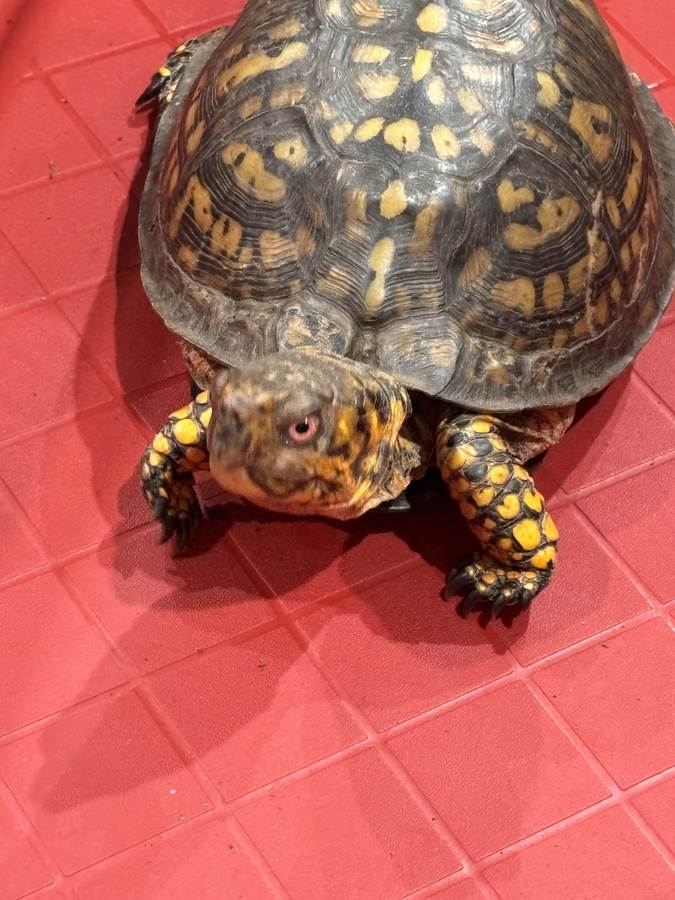
Male eastern box turtle (Terrapene carolina) with a high-domed shell, radiating yellow-orange markings, and a red eye.
Captive-bred box turtles do exist in the hobby in states where keeping them is allowed, but even these are not simple starter turtles. They need humidity, time outdoors, an omnivorous diet, and decades of care. Wild-caught adults often decline in glass tanks because the tank is too dry, the diet is wrong, and the turtle never adjusts to captivity.
Adults commonly reach about 4.5 to 6 inches in length, and their lifespan is measured in decades. This guide covers general husbandry for eastern box turtles as a species group, with T. c. carolina as the nominotypical form. Nothing here replaces veterinary care, and nothing here overrides Georgia law.
Whether they are a good fit
In Georgia, box turtles are simply not a legal pet. Elsewhere, a captive-bred box turtle is a good fit only for someone who can provide a humid outdoor pen and long-term care, and who is willing to treat the animal as a display-and-stewardship project rather than a toy to be handled. They are a poor fit for dry indoor aquariums and for anyone who wants to “save” wild turtles by taking them home.
Enclosure and space
Where keeping is legal, the gold standard is an outdoor pen with escape-proof walls, buried barriers, protection from predators such as dogs and raccoons, a mix of sun and shade, deep leaf litter, a moist hide or burrowing zone, and a shallow water pan. The floor space should allow the turtle to patrol, dig, and thermoregulate, and many keepers use pens of around 4x8 feet or larger for a single adult.
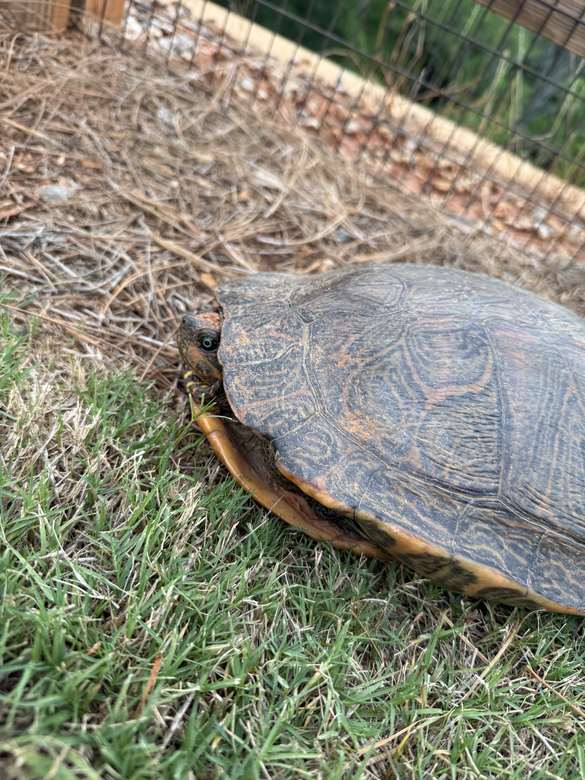
Eastern box turtle in an outdoor pen with grass, pine straw, and mesh fencing — natural substrate husbandry.
Indoor housing should be a backup for bad weather or quarantine, ideally a large open turtle table with UVB, a moist hide, a dry basking spot, and room to walk. Tall glass aquariums with poor airflow are a frequent source of respiratory problems and stress.
Keeping one turtle per enclosure avoids combat between males. Breeding groups are a specialist project that carries both legal and welfare overhead.
Temperature and the gradient
When using artificial heat, provide a dry basking area of around 85 to 90 F, with cooler, moist zones available elsewhere. Outdoor animals regulate their temperature using sun and shade, and nighttime drops are normal in season. Box turtles in suitable climates may brumate, but brumation is a health-screened, species-specific process, never a reason to put a sick turtle in the fridge. Around Cartersville, wild turtles manage the seasons on their own, which is one more reason not to interrupt their lives by bringing them into a house.
Light, UVB, and the daily cycle
Box turtles are diurnal, so outdoor sunshine with access to shade is ideal. Indoors, use a timer and a linear UVB tube suited to its mounting distance, plus a basking lamp if extra heat is needed. Light through window glass does not provide UVB.
Humidity, water, and shedding / shell
These turtles need moisture. Ambient humidity, often in the 60 to 80 percent range, together with a moist hide and leaf litter that holds humidity, helps prevent chronically dry eyes and difficult sheds of the scutes and skin. A shallow water dish large enough for the turtle to soak in should always be clean and available. Keep in mind that chronically filthy, wet newspaper is not the same thing as a humid woodland floor.
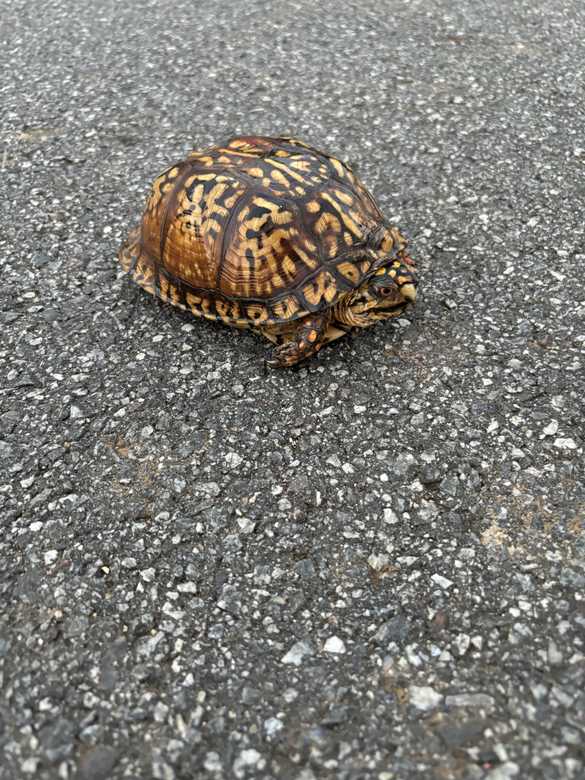
Eastern box turtle showing radiating yellow-orange scute patterns on asphalt — clear species ID shot.
Diet
Box turtles are omnivores. Rotate gut-loaded insects (insects fed a decent diet before they are offered), earthworms from safe sources, dark leafy greens, squash, mushrooms, and limited fruit. Calcium dusting for indoor animals and access to cuttlebone are both helpful. Avoid fruit-only diets, raw meat as a staple, and wild-caught insects from yards that may have been sprayed. A healthy animal should look like a sturdy turtle rather than a shell packed with soft fat.
Substrate
Outdoors, leaf litter over a soil-based mix is the ordinary setup. Indoors, a mix of soil and leaf litter that stays moist in the hide and drier under the basking spot works far better over the long term than bare paper, although paper is fine during quarantine. Cedar should never be used as bedding.
Handling and daily life
Keep handling to a minimum. A closed shell is armor, not an invitation to pry it open, and where keeping is legal, the real reward is watching natural behavior outdoors. Wash your hands after any contact with a turtle as a matter of ordinary hygiene.
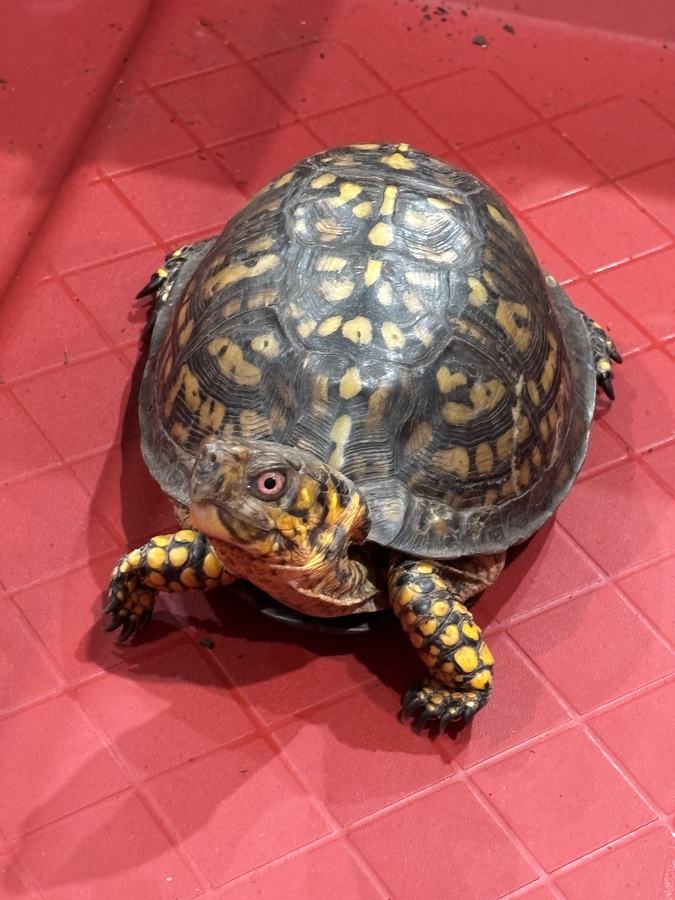
Close-up of a male eastern box turtle with red eye, yellow-spotted forelimbs, and dark claws.
Body language and behavior
Closing up the shell is a defensive response, and pacing along the walls usually points to a problem with the enclosure or the season. Reading human expressions into a turtle that seems to “smile” or “wave” is a form of anthropomorphizing that causes keepers to miss what actually matters, such as swollen eyes, an overgrown beak, and changes in stool.
Signals that are usually ordinary
In healthy animals, foraging after rain, soaking in the water dish, resting half-buried in leaf litter, and seasonal changes in appetite are all ordinary behavior.
What to watch for
- Swollen eyes, thick discharge, or inability to open the eyes.
- Open-mouth breathing, bubbles, or lethargy.
- A soft jaw or soft shell points to metabolic bone disease (soft, poorly mineralized bone from insufficient UVB and/or calcium) until proven otherwise, so check the diet and indoor UVB.
- Soft, foul stool or dramatic weight loss.
- A turtle found on a Georgia road: help it cross the way it was going, or call for guidance if injured — do not convert it into a pet.
Problems that show up often
The problems we see most often begin with illegal collection and failed “rescues,” followed by turtles kept in dry indoor aquariums. Poor diets lead to vitamin A deficiency and eye problems, and cold, dirty setups lead to respiratory disease. Captive turtles are sometimes dumped into wild habitat, and many owners are confused by the gap between pet-trade advice online and Georgia law.
Bringing a new animal home
In Georgia, do not bring one home. Elsewhere, where keeping is legal, quarantine captive-bred arrivals for 30 to 90 days with a fecal check, confirm that the humid hides and UVB are in place, and build the outdoor pen before the turtle outgrows its quarantine enclosure. Never mix a new captive turtle with wild turtles.
If you already have a box turtle in Georgia
People sometimes inherit turtles, discover an enclosure after a relative moves, or were given bad advice years ago. This guide cannot turn an illegal possession into a legal one, so contact the Georgia DNR Law Enforcement / Special Permit Unit for current guidance rather than expecting a care sheet to invent a loophole. Do not dump the animal in the nearest woods “to set it free.” Captive turtles can introduce disease to wild populations, and they do not simply resume a wild home range just because releasing them feels virtuous.
If the turtle is injured, work through a licensed wildlife rehabilitator. If you live outside Georgia in a state where keeping captive-bred turtles is legal, keep the paperwork documenting captive-bred origin, and still never collect from the wild.
Roadway encounters near Cartersville
A box turtle on a road is usually just trying to cross, not auditioning for a bedroom terrarium. If it is safe for you to stop, move the turtle to the far side of the road in the direction it was heading, and leave it there. Do not relocate it miles away, and do not take it home to “rescue” a healthy animal from being wild. If you would like confirmation of what you saw, send us a photo.
Recommended gear
Some of the links below go to Amazon, and if you buy through them we may earn a small commission. This does not change the price you pay.
For Georgia readers, the recommended “gear” is a camera for ID photos and a plan to leave wild turtles wild. For legal keepers elsewhere, these are the items we suggest:
- Hardware cloth and pen materials for a secure outdoor run.
- Etekcity Lasergrip 774 if you run indoor heat
- ThermoPro probe thermometer and hygrometer to track air temperature and humidity
- A forest-strength T5 HO UVB kit for indoor housing; follow the distance chart
- Organic topsoil and leaf litter
- Shallow ceramic water dish
- Zoo Med Reptile Calcium without Vitamin D3 when UVB is in place