


Gray-banded Kingsnake
Lampropeltis alterna
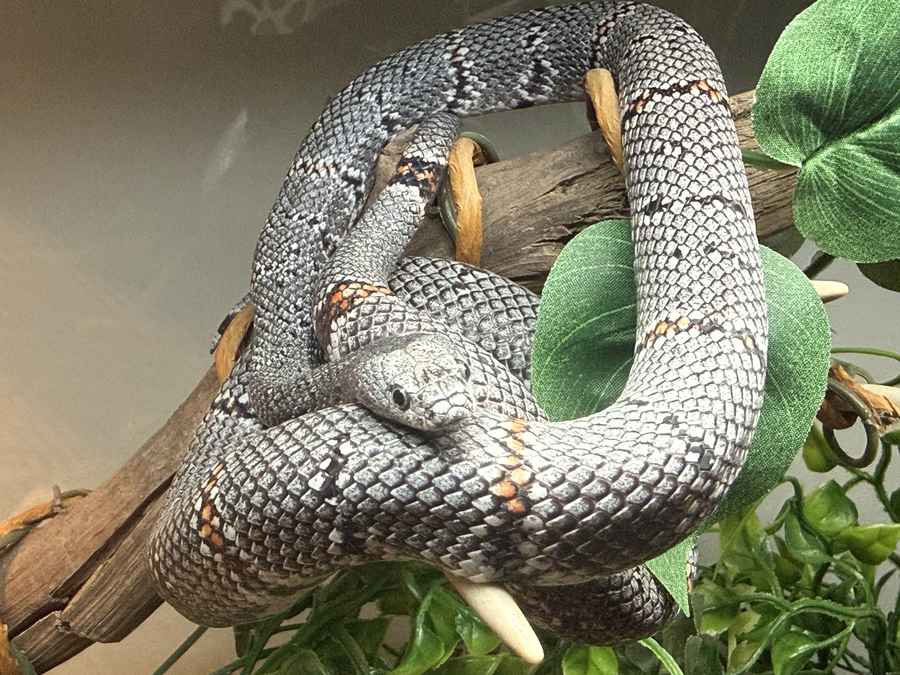
Snake
Key numbers
The figures below are a working snapshot of what a typical gray-banded kingsnake needs, rather than a guarantee that every individual will fit them exactly. The rest of this guide explains the reasoning behind each number, so you can adjust sensibly when your own animal or your own house behaves a little differently.
- Adult size: Adults commonly reach 24 to 36 inches; occasional captives grow past three feet, and records near five feet are rare outliers.
- Lifespan: With consistent care, they often live 15 to 25 years, and some have lived into their late twenties.
- Adult enclosure: An enclosure about 36 inches long by 18 inches deep (a 40-gallon “long” or 36x18) is a practical minimum for one adult, and a larger footprint is welcome.
- Start size: A hatchling can begin in a 10-gallon or an enclosure about 20 to 24 inches long, as long as the temperature gradient (a warm end and a cool end that actually differ) and the lid are right, then move toward the 36x18 as it grows.
- Housing: Keep one snake per enclosure.
- Warm hide / warm surface: The surface the snake actually sits on in the warm hide should read about 85 to 88 F.
- Cool hide: The cool hide should sit at about 70 to 76 F.
- Night: Nighttime temperatures from the mid-60s to the low 70s are usually fine in a typical house.
- Humidity: Keep humidity around 30 to 45 percent most of the time, and provide a humid hide when the snake is in shed.
- Diet: Feed a single appropriately sized rodent, usually frozen-thawed, and buy animals that are already established on mice.
Do’s and don’ts
This list is the short version of the husbandry covered in detail further down the page. If a line here and a paragraph later on ever seem to pull in different directions, trust the longer explanation, because it carries the context that a one-line rule cannot.
Do
- Give an adult an enclosure about 36 inches long by 18 inches deep (a 36x18), or larger, with a warm hide and a cool hide that actually differ and enough loose, dry substrate to burrow and wedge into.
- Measure the temperature of the surface the snake sits on in the warm hide, not a stick-on thermometer on the glass.
- Keep the enclosure on the dry side, and offer a humid hide when the eyes go cloudy (in blue).
- Offer frozen-thawed mice with tongs once the animal is a confirmed rodent feeder.
- Buy from a breeder who can show a feeding history on mice. Hatchlings that still want lizards are a different project than an established animal.
- Learn that individual’s ordinary patterns so a missed meal, a week under cover, or restless glass-climbing can be read against a baseline.
- See a veterinarian who regularly treats reptiles when breathing, body condition, or shed quality leaves that baseline (local herp groups and exotic-vet directories help you find one before you need them).
- Send a picture if you find a banded or blotched snake on a property near Cartersville and want an ID. If you want it moved, we relocate snakes within about an hour of Cartersville at no charge.
Don’t
- Do not leave an adult in a 10-gallon “starter” tank as a finished home because older care sheets said it was enough.
- Do not house two kingsnakes together. Kingsnakes and milksnakes will eat other snakes.
- Do not run the enclosure wet the way you would for a tropical snake.
- Do not use a hot rock or an unregulated heat pad as the main heat.
- Do not handle for a couple of days after a meal, or while the snake is in blue (cloudy eyes before a shed).
- Do not assume a banded snake in a Georgia yard is an escaped gray-band. This species is not native here.
- Do not release a pet gray-banded kingsnake, or any pet snake, into Georgia woods.
- Do not read musking, an S-coil, or a strike at the tongs as a human mood.
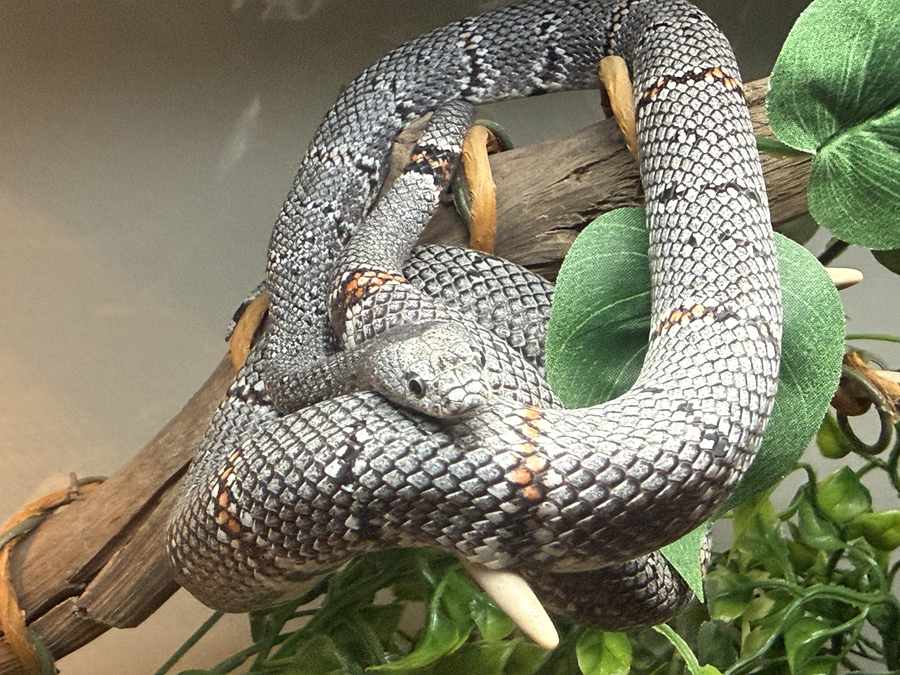
Gray-banded kingsnake pattern detail — orange bands on gray (alterna), not California banding.
A bit of background
The gray-banded kingsnake, Lampropeltis alterna, is a relatively small kingsnake from the rocky canyons and desert country of west Texas, southern New Mexico, and northern Mexico. In the wild, these snakes spend much of their time in crevices, under rocks, and in other tight cover, hunting lizards and small mammals. That preference for a snug hide and a dry floor is what most captive setups are trying to recreate, and a glass box with a flimsy hide on a paper towel is the opposite of it.
Gray-bands became popular because their color and banding vary wildly between localities, with keepers naming forms such as Langtry, Christmas Mountains, and Highway 277, because they stay a manageable size, and because established adults are usually calm rodent feeders. Those traits can make them seem easier than hatchlings sometimes are. A gray-band that refuses a pink mouse is not “being stubborn for fun”; more often it is an animal that still wants the scent of lizard, or one that has not yet settled after shipping.
Adults commonly reach 24 to 36 inches, and with consistent care they often live 15 to 25 years in captivity. This guide covers general husbandry for Lampropeltis alterna; other kingsnakes have their own needs, individual animals vary, and nothing here replaces an examination by a veterinarian who regularly sees reptiles.
Because this is a Chihuahuan Desert animal rather than a Georgia native, two extra points belong up front. First, a pet gray-band that gets loose is not a wild animal and should never be turned out “to be free.” Second, a banded snake that someone finds on their land near Cartersville is far more likely to be a local species, or a lookalike that needs careful identification, than an escaped alterna. If you would like an identification, send us a picture, and if you would like the snake moved, we relocate snakes within about an hour of Cartersville at no charge.
Whether they are a good fit
A gray-banded kingsnake is a long-lived, secretive snake from dry country that needs a generous footprint as an adult, a reliable source of frozen mice, and a keeper who will keep the lid latched. Established adults are often calm, but hatchlings that still prefer lizards make a poorer first snake than a corn snake or a ball python. Gray-bands are a poor fit for anyone who wants a tropical, misted enclosure, or for a household planning to keep two kingsnakes in one enclosure because they seem to “get along.” They are also a poor fit for anyone who wants a snake that is out and visible every evening, since much of a gray-band’s ordinary day is spent under cover.
Enclosure and space
Floor space matters because an adult needs a warm hide and a cool hide with real distance between them, and because this species likes to wedge itself into tight spaces and move beneath the substrate. A practical minimum for a single adult is about 36 inches long, 18 inches deep, and 12 to 18 inches tall; older care sheets that keep adults in a 10-gallon tank for life are undersized by current standards. A hatchling can start in a 10-gallon or an enclosure about 20 to 24 inches long, provided the warm and cool ends genuinely differ and the lid fits properly. Move it toward the 36x18 as it grows, typically as it approaches adult length, rather than leaving a two-foot adult in a shoebox.
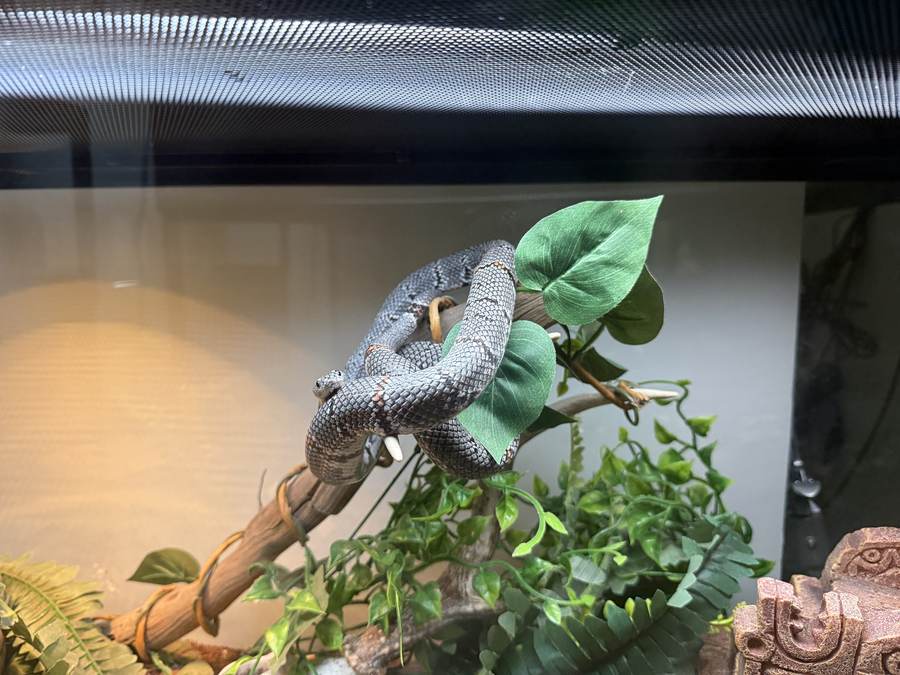
Gray-banded kingsnake in furnished enclosure on wood.
Keeping one snake per enclosure avoids most social problems. Gray-banded kingsnakes do not need a companion, and kingsnakes will eat other snakes, including other kingsnakes. When two animals share one gradient, one usually claims the better hide, and feeding two in the same enclosure is how keepers get bitten by the wrong snake or lose an animal to predation.
A snug hide at each end, a humid hide the snake can enter and leave, and several inches of loose, dry substrate do far more good than a pile of decorations. Support rocks and caves from below so the snake cannot collapse a tunnel on itself. The enclosure also needs a water bowl heavy enough not to tip and a lid that latches, because kingsnakes are patient escape artists that will find any gap you leave them.
Temperature and the gradient
A gray-banded kingsnake’s digestion depends on temperature. The measurement that matters is the floor of the warm hide, or whatever surface the snake actually coils on, taken with an infrared temperature gun. A stick-on thermometer on the glass can show an acceptable air temperature while the hide is too cool for digestion or hot enough to burn.
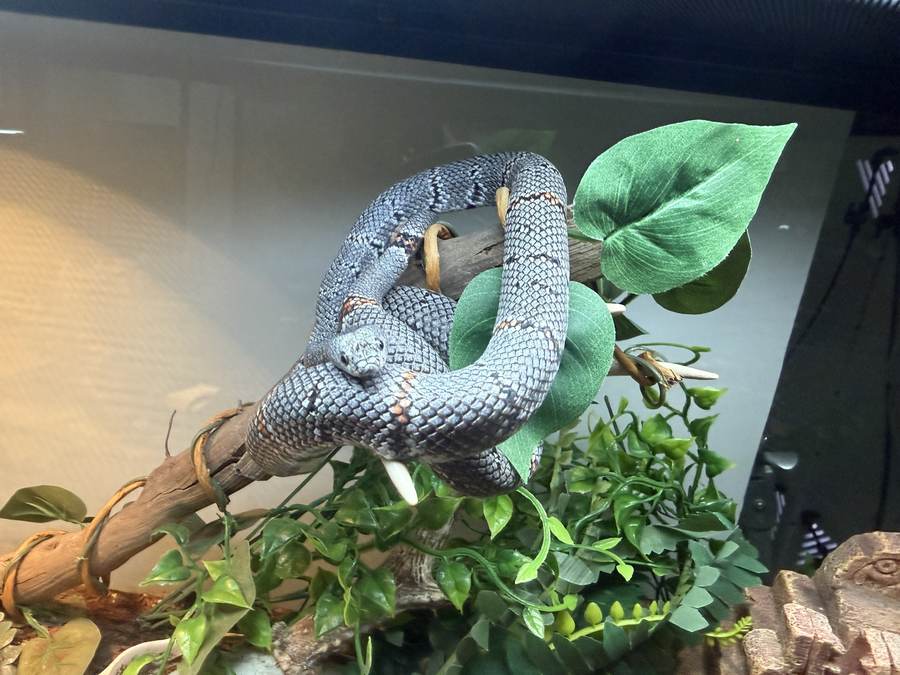
Gray-banded kingsnake utilizing climbing enrichment.
A warm hide or warm surface of around 85 to 88 F supports normal digestion for most adults, while the cool hide in the same enclosure typically sits around 70 to 76 F. The difference between those two ends is what allows the animal to regulate its own temperature; if the whole enclosure sits at one temperature, it has nowhere to go.
Heat is safest when it is controlled by a thermostat, whether the source is an overhead halogen flood lamp or a quality heat pad on the outside of a tub, and unregulated heat mats and hot rocks are a frequent cause of burns. Overnight, a typical house in the mid-60s to low 70s is usually acceptable, and colored night bulbs are unnecessary.
Some keepers cool healthy, well-conditioned adults for a winter brumation, a seasonal slowdown at cooler temperatures once the gut is empty. Brumation is a breeding and seasonal tool rather than a requirement for every pet, and deliberately cooling a thin, parasitized, or recently shipped animal is a reliable way to make it worse. If you do cool your snake, stop feeding well before the temperature drop so that undigested prey is not left sitting in a cold gut.
Light, UVB, and the daily cycle
In the wild, gray-banded kingsnakes are largely crepuscular to nocturnal, meaning they are most active at dawn, at dusk, and after dark, and many captives are most active around dusk and after the lights go down. They do not need a bright array of desert lights the way a bearded dragon does, but they do need a clear day and night. A simple schedule of 12 hours on and 12 hours off, even if the “on” period is just room light plus the heat lamp, is much easier on them than lights that switch at random hours.
Some keepers provide low-level UVB for this species, but it is never a substitute for a correct thermal gradient. A high-output desert tube is the wrong lamp for a snake that spends the day under cover, so keepers who offer UVB generally choose a moderate, forest-strength linear tube and give the snake enough hides and substrate depth to get away from it. If you use a heat lamp, remember that it provides heat only, not UVB.
Humidity, water, and shedding
Gray-bands are snakes of dry country, and ambient humidity of around 30 to 45 percent is typical of a setup that works. When the eyes turn cloudy, a stage keepers call being “in blue,” and the snake is about to shed, a humid hide filled with damp sphagnum or moss that it can enter and leave is usually enough, without wetting the whole enclosure.
In this species, chronically wet substrate, especially on a cool floor, commonly leads to scale rot and respiratory trouble, while chronically bone-dry air with no humid hide commonly leads to stuck eye caps. What you want is a surface that is dry to the touch for the snake to rest on and burrow into, with a humid hide available.
A healthy shed comes off in one piece, including the eye caps, and patchy sheds that keep recurring usually point to a humidity or hydration problem or to an animal that is not in good condition. A shed skin found on a property is not a sign of a nest, because kingsnakes do not stay together after hatching; it simply means that one animal passed through, not that a family is living there.
Diet
In the wild, gray-banded kingsnakes eat a lot of lizards and will also take small mammals. In captivity they are kept on rodents once they make the switch, because that is the diet we can source cleanly and consistently. Hatchlings usually start on mouse pinks, which are newborn mice, and adults typically move up to small adult mice, sized so that the prey is about as wide as the snake at mid-body. Offering frozen-thawed prey that has been warmed all the way through, using tongs, avoids most feeding bites. A live mouse left in the enclosure overnight can chew on a snake that is not hungry.
Reluctant hatchlings are the central husbandry challenge with this species. Breeders commonly scent a mouse with lizard, offer food in a small feeding tub, and show patience after a proper cool-down. If you are not set up to do that work yourself, buy an animal with a documented history of eating rodents.
Young animals are commonly fed every 5 to 7 days during the active season, while adults often go 7 to 14 days between meals, and body condition is a better guide than the calendar. A kingsnake that folds in on itself with fat pads is being fed too often or too much, while one with a sharply triangular body and a visible spine is being fed too little or is ill. Postpone handling for a couple of days after a meal.
Substrate
Aspen shavings are the usual dry, burrowable floor covering for this species, because they stay loose, are easy to spot-clean, and suit the humidity range. Plan on several inches of depth so the snake can genuinely disappear, roughly two to four inches as a working minimum for a typical adult.
A soil-and-sand mix, made mostly of dry organic topsoil with a smaller proportion of play sand, can work in a naturalistic enclosure as long as it stays dry, the snake is warm enough to digest, and rocks are supported from below. That is not the same as a floor of pure sand or calcium sand. Pure sand is a poor default as the main bedding: it is dusty, it does not hold a tunnel the way aspen or a soil mix does, and when a cool or dehydrated snake swallows a lot of it along with a meal, impaction can follow. Offer food with tongs rather than letting it land in the bedding, and keep the warm hide in range. Cypress and coconut substrates kept damp are a better match for a different kind of snake.
Paper works well during quarantine. Whatever you use on the floor needs to stay dry enough that the snake is never lying in wet mulch, and feces should be removed as soon as they appear. Cedar and aromatic pine should never be used as bedding.
Handling and daily life
Most captive gray-banded kingsnakes will rest calmly in a hand once they are used to being picked up, provided they are supported along the body and not grabbed right after a feeding cue. Short, calm sessions once the snake has had a chance to settle go far better than daily wrestling matches. Hold off on handling for a couple of days after a meal and while the snake is in blue.
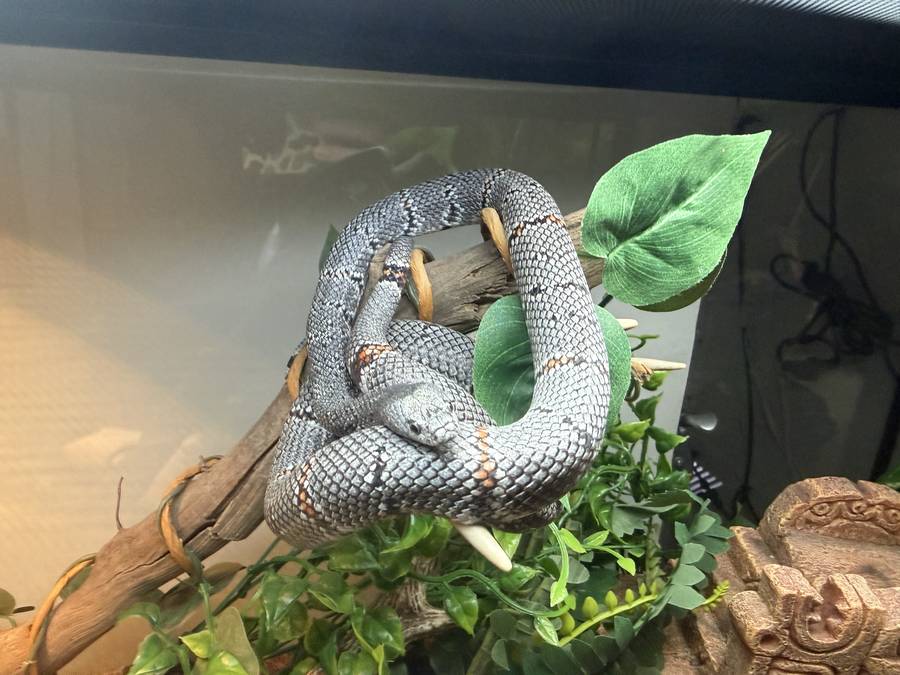
Gray-banded kingsnake coiled on branch in vivarium (same enclosure session — limited pose variety).
A snake that musks, coils into an S shape, or strikes at the tongs is neither greeting you nor “being dramatic for fun”; it is either feeling defensive or focused on food. Give it room, and do not pick it up to show someone the display.
Body language and behavior
Gray-banded kingsnakes are easy to misread because they stay quiet for most of the day and then suddenly become active at the glass, and people tend to attach human stories to that behavior. A snake that stays buried is not depressed, and a snake that glass-surfs for an evening after a cage cleaning is not asking for a roommate. Anthropomorphizing, which means treating the animal as if it had human motives, moods, and social needs, is how keepers miss the information that actually matters: whether this individual is using both hides, eating on its own pattern, shedding cleanly, and breathing with its mouth closed.
The more useful habit is to learn the patterns of the particular animal in front of you, such as how much of the day it spends under cover, whether it usually comes out after dusk, and how it reacts to the lid compared with the tongs. Once you know that baseline, it is a change from it that matters.
Signals that are usually ordinary
Tongue-flicking is simply how the snake samples the air. Spending most of the day in a tight hide is ordinary for a crevice-dwelling desert kingsnake and does not mean the snake is “unhappy.” Mild musking or a quick strike when the snake is first picked up often settles with calm, short handling sessions. Dull, bluish skin and cloudy eyes mean a shed is on the way, and hiding for a few days around that shed is ordinary.
What to watch for
- Open-mouth breathing, wheezing, or bubbles at the mouth or nose point to a respiratory problem.
- Regurgitation, or a snake that strikes and then refuses to finish its meal, is a reason to check the warm-hide temperature and how soon the animal was handled after its last meal.
- Stuck eye caps or ragged sheds that keep recurring usually point to a humidity or hydration problem.
- Belly scales that are brown, pink, or blistered, or a snake lying in wet substrate, suggest scale rot.
- Weight loss during a hunger strike, or a kingsnake that was a reliable eater and has stopped, is a reason to check temperatures first and then see a reptile veterinarian.
- A snake that cannot right itself or that corkscrews is showing neurological signs, which are not something to wait out.
If you notice any of these patterns, check your husbandry first, and then see a reptile veterinarian if the animal does not return to its own normal baseline.
Problems that show up often
Respiratory disease usually follows an enclosure that is too cold, or cold and damp together, and scale rot follows wet, dirty substrate. Stuck shed is less common when a humid hide is available and the water bowl is kept clean. Food refusal in hatchlings is more often a matter of lizard scent and settling in than of a “mean snake.” Obesity is less common than in heavy-feeding colubrids, but it still happens when adults are fed like growing animals all year round.
An escaped pet is a husbandry problem of a different kind: check the lid, then search the house, and never release the animal outside. And again, a banded snake that someone finds on a property here is almost never a gray-band, so send us a picture before deciding it is a loose pet.
Bringing a new animal home
A quarantine period in a separate enclosure, with its own tongs, its own water bowl, and a fecal check, is a much kinder start than placing a new snake into a display vivarium on its first day. A common working window is about 30 to 90 days, or until the snake’s appetite is steady and a fecal test comes back clear, and longer if anything seems off. Before decorating, confirm that both hides reach the right temperatures and that the substrate is dry. Leave the animal alone long enough for it to eat at least a couple of meals before you begin regular handling, and use tongs from the very first feeding. Those first weeks are also the time to start learning its ordinary behavior, including how much of the day it spends under cover.
Recommended gear
Some of the links below go to Amazon, and if you buy through them we may earn a small commission. This does not change the price you pay.
When you are budgeting, remember that a 36x18 footprint, dry aspen for burrowing, a thermostat, and a pair of tongs matter far more than decorations.
- New Age Pet ECOFLEX 36-inch Mojave Reptile Lounge for a typical adult, or the ECOFLEX 48-inch (a 4x2-foot footprint) if you want extra floor space.
- Etekcity Lasergrip 774 for the hide floor the snake sits on
- ThermoPro probe thermometer and hygrometer to track air temperature and humidity
- BN-LINK on/off thermostat for a heat mat. Use a dimming stat if the heat is a bulb
- Aspen snake bedding
- Snug opaque hides for the warm end, the cool end, and a humid hide with damp sphagnum
- Zoo Med stainless steel feeding tongs, 10-inch