


Leopard Gecko
Eublepharis macularius

Lizard
Key numbers
The figures below are a working snapshot of what a typical leopard gecko needs, rather than a guarantee that every individual will fit them exactly. The rest of this guide explains the reasoning behind each number, so you can adjust sensibly when your own animal or your own house behaves a little differently.
- Adult size: Adults commonly reach 7 to 10 inches, including the tail.
- Lifespan: With consistent care, they often live 15 to 20 years, sometimes longer.
- Adult enclosure: An enclosure about 36 inches long by 18 inches deep by 18 inches tall (a 40-gallon “long” or larger) is a practical minimum for one adult; the New Age Pet ECOFLEX 36-inch Mojave we list below has a true 36-by-18-inch footprint (exterior 36 x 18 x 18 inches; interior about 34.6 x 16.4 x 15.8 inches).
- Start size: A 10- or 20-gallon is only a short-term home for a small juvenile; a hatchling can also start in the 36x18 if the hides are snug enough to disappear into, but an adult should never be left in the starter kit.
- Housing: Keep one gecko per enclosure.
- Warm hide: The floor of the warm hide should read about 88 to 92 F; measure the hide floor, not the air or the glass.
- Cool side: The cool side should sit at about 70 to 77 F.
- Humidity: Keep the ambient air on the dry side, often around 30 to 40 percent humidity, with a humid hide available at all times for shedding.
- Diet: Feed insects only, gut-loaded with a decent diet before offering and dusted with calcium, and never wider than the space between the gecko’s eyes.
Do’s and don’ts
This is the short version of the husbandry below. If a line here and a paragraph later seem to pull in different directions, trust the longer explanation.
Do
- Give an adult an enclosure about 36 inches long by 18 inches deep (a 36x18), or larger, with a warm hide, a cool hide, and a humid hide.
- Measure the floor of the warm hide, not the air or the glass.
- Keep a humid hide available so sheds come off the toes and tail tip in one piece.
- Feed the insects a decent diet before offering them (gut-load) and dust them with calcium, especially while the animal is growing. Match the powder to the lighting: calcium without D3 for most dustings if a 5.0 T5 HO is in place; calcium with D3 on a schedule if you skip UVB.
- Quarantine a new animal for at least 60 to 90 days in its own enclosure, with its own dishes, before it shares air or equipment with a collection.
- Learn that individual’s ordinary patterns (appetite, stool, how fat the tail is, how it uses the hides).
- See a veterinarian who regularly treats reptiles when appetite, stool, shed, or the tail’s fat stores leave that baseline (local herp groups and exotic-vet directories help you find one before you need them).
Don’t
- Do not leave an adult in a 10-gallon tank as a finished home.
- Do not house two leopard geckos together because they “get along.”
- Do not run the whole enclosure wet the way you would for a tropical gecko.
- Do not use calcium sand, or any loose sand, as the default floor for a juvenile that lunges at food.
- Do not feed a mealworm-only diet, or insects from the yard.
- Do not grab the tail; it can drop, and the regrown tail is never the same fat store.
- Do not read a waving tail, a vocalization, or sitting on a hand as a human mood.
- Do not ignore stuck shed around the toes. Those bands can cost digits.
- Do not buy an enigma or related neurological morph hoping a better warm hide will erase the circling and star-gazing.
- Do not buy a lemon frost (or a related tumor-linked white morph) hoping the color stays pretty. The white-tumor risk is documented.
- Do not add a new gecko to a room that already has reptiles without isolating it first. Cryptosporidium travels on shared dishes and hands.
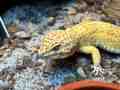
Leopard gecko head and eye detail. Loose mix underfoot is a later naturalistic floor, not the default first setup for juveniles.
A bit of background
The leopard gecko, Eublepharis macularius, is a ground-dwelling gecko from the rocky, arid parts of Afghanistan, Pakistan, India, and Iran (and nearby). Unlike the familiar sticky-toed house geckos, leopard geckos have eyelids and claws. They do not climb glass. They spend the day in crevices and burrows and come out in the evening to hunt insects. That pattern of a warm, snug daytime hide and a cooler night is the thing most captive setups are trying to recreate. A glass box with one thin hide in the middle of an open floor is the opposite of that picture. The gecko is not being “shy” when it wedges under a water dish. It is using the only tight space you gave it.
They became one of the most widely kept pet lizards because they stay small, they tolerate handling better than many geckos, and they come in a long list of colors and patterns. Those traits can make them look like a desk pet. A leopard gecko that sits still on a couch is not evidence that the enclosure is doing its job. Most of the chronic problems we see (thin tail, stuck shed on the toes, metabolic bone disease, regurgitation of sand) come from heat, calcium, space, or diet being a little bit off for a long time. Metabolic bone disease here means soft or deformed bone from a long gap in calcium, vitamin D3, and/or correct heat — not a morph.
Adults commonly reach 7 to 10 inches including the tail and can live 15 to 20 years, which is a real commitment. The person who buys a two-month-old gecko is signing up for a long stretch of consistent heat, a humid hide that actually stays damp, and a reliable insect supply. The hand-tame temperament is what sells the animal, but the hide floors and the calcium schedule are what keep it healthy.
Enigma and some related morphs can carry a neurological syndrome (circling, star-gazing, balance trouble, difficulty striking food). Husbandry does not erase it. A perfect warm hide will not teach an enigma gecko to walk a straight line. That is a purchase decision, not a gradient fix. Lemon frost (and some related white lines) can grow iridophoromas, white skin tumors that are well documented in that morph and can spread. Husbandry does not prevent those either. We come back to morphs later because the sales photos usually do not. This guide is general husbandry for Eublepharis macularius. Other eublepharids have their own needs. Individual animals also vary, and nothing here replaces an exam by a veterinarian who regularly sees reptiles.
Whether they are a good fit
A leopard gecko is a long-lived, heat-dependent insectivore that needs a real footprint as an adult and a reliable source of appropriately sized feeder insects. They do best in a household that can keep a consistent evening feeding routine and a warm hide that actually hits the right temperature. They are a poor fit for anyone hoping the animal will live in a 10-gallon tank forever, or for a home that cannot keep feeder insects on hand.
We like them. We also tell people the sit-still-on-a-hand part is the easy part. The hard part is measuring the hide floor instead of trusting a sticker, keeping three hides that actually differ, and not panicking the first time a healthy adult skips a meal after a shed. If that sounds like more patience than you have, this is the wrong species, and that is a kinder conclusion than a gecko that sits in a 10-gallon for five years because the owner is tired of the project.
They are also a poor fit for anyone who wants a tropical, climbing gecko in a tall planted enclosure. Leopard geckos are ground lizards from arid country; they will use low clutter, but they will not use height the way a crested gecko does, and they will not thank you for a fogger.
Enclosure and space
Because they are ground lizards that hunt by walking, floor space matters more than height. A practical minimum for a single adult is about 36 inches long, 18 inches deep, and 18 inches tall. That footprint is what lets you put a warm hide and a cool hide far enough apart that the floors actually differ. If those two hides sit six inches apart in a 10-gallon, the “gradient” is a wish. Both hides sit in the same air mass. The gecko cannot choose a different temperature because there is no different temperature to choose.
Many animals are still sold in 10- and 20-gallon kits. A 10- or 20-gallon is only short-term for a small juvenile if the heat and hides are correct. The 36 by 18 inch (40-long) footprint is the adult minimum. A hatchling can go straight into that 36x18 if the hides are snug enough that the gecko can disappear completely. That is often the simpler path. What is not fine is leaving an adult in the kit. Upgrade out of a 10-gallon when they are using the space, in months, not years. Those kits are not a finished home. A gecko that can sit in a shoebox is not a gecko that has a gradient.
The adult box we can actually point to on Amazon is the New Age Pet ECOFLEX 36-inch Mojave Reptile Lounge. The exterior is 36 inches long by 18 inches deep by 18 inches tall. The interior is about 34.6 by 16.4 by 15.8 inches. That is a true ~36x18 footprint. The manufacturer’s own size chart still talks about a smaller 24-inch “15 gallon” for leopard geckos. We do not. A 24-inch box does not give an adult two hides with real distance between them. The 36-inch is the size we will stand behind for one adult. Larger is fine. Smaller is a grow-out, not a finished home.
The mesh top and the side vents are the part that needs a plan, though for this species the plan is the opposite of a ball python’s. Leopard geckos want the main enclosure on the dry side. The mesh and vents help you keep ambient air around 30 to 40 percent without turning the floor into mud. You still need a humid hide that stays damp on its own terms. The composite is moisture-resistant, not waterproof. It is the wrong box for standing water. Heat lamps should sit on the mesh and should not touch the ECOFLEX panels. Front-opening sliding doors are easier on many animals than a lid coming off from above. Lock the sliders. A leopard gecko is not a champion escape artist compared with a kingsnake, but a gap at the door and a warm room is still how pets get lost under couches.
Dress the box before the gecko goes in, not after. Put a snug hide at the warm end, under or just beside the heat, and a second snug hide at the far cool end. The humid hide can sit on either end; many keepers put it on the warm side so the gecko can shed in a warm, damp cavity. The water dish belongs where it will not sit on the heat and will not tip when the gecko climbs in. Then turn the heat on, and wait. Measure both hide floors the next day, and again after you add a liner or a thin layer of soil. An empty box and a dressed box do not run the same numbers.
One gecko per enclosure is the arrangement that avoids most social problems, because leopard geckos do not need a companion. When two animals share one gradient, one usually claims the warm hide, and injuries, dropped tails, and chronic stress are common, even in pairs that appeared peaceful for months. A gecko that “gets along” with a tankmate has often simply learned to stay out of the other animal’s way, and that is not enrichment.
Three hides is the working minimum: a warm hide, a cool hide, and a humid hide. A hide that is too large feels like open ground; many leopard geckos will ignore it and wedge themselves under the water dish instead. That is useful information. It means the hide you offered is not snug enough, not that the gecko “likes the water.” The gecko should be able to disappear completely and touch the walls. Low clutter and a couple of pieces of cork or rock give them cover without turning the box into a pile that blocks the heat. A shallow water dish they can enter and leave belongs in the enclosure at all times.
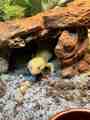
Leopard gecko using a rock hide on a bioactive floor. Loose mix is a later naturalistic floor, not the default first setup for juveniles.
Temperature and the gradient
A leopard gecko’s digestion is tied to the temperature of the belly. The useful measurement is the floor of the warm hide, taken with an infrared temperature gun or a probe sitting on that surface. Air temperature on a glass sticker can look acceptable while the hide is too cool to digest, or hot enough to burn. We have seen plenty of boxes where the sticker said 85 and the hide floor was 78, or 104. The gecko lives on the floor of the hide, not on the glass.
For most adults, that warm-hide surface sits in the neighborhood of 88 to 92 F. The cool side of the same enclosure is typically around 70 to 77 F. The difference between those two ends is what lets the animal self-regulate. If the whole box sits at one temperature, they have nowhere to go. A gecko that spends all day on the cool end is telling you the warm end is too hot, or the hide there is too open. A gecko that never leaves the warm hide may be too cool everywhere else, or may simply prefer that cavity. Measure before you invent a story.
How you measure is as important as the numbers. An infrared gun reads a surface, and it averages a circle, not a magic point under the laser dot. The Etekcity Lasergrip 774 we list is a 12-to-1 distance-to-spot tool: from about a foot away you are reading roughly a one-inch circle. Get closer for a hide floor. Six to eight inches is a more honest working distance than standing across the room and hoping the laser is magic. Do not shoot through glass. Glass reflects infrared; you will read the glass, not the hide behind it. Do not treat a reading off a shiny water bowl as the hide temperature. Dark, matte surfaces (the hide floor, the liner, the gecko’s own belly if you are checking body surface) are the honest targets. Take two or three readings of the same floor and use the middle one. Write the number down with the date. A single glance you forget by Thursday is not a record.
A probe thermometer or hygrometer belongs inside the enclosure, ideally with the sensor in the air or on the floor of a hide, not stuck to the outside of the glass. The thermostat probe, if you are running a heat mat or a ceramic emitter, belongs on the surface being controlled, usually the warm hide floor, so the stat is regulating the place the gecko sits and not the room air. Tape or weigh the probe down so it cannot wander into the lamp or under a pile of moss. A probe hanging in mid-air will shut the heat off before the hide is warm, or leave it on until the floor is dangerous, depending on where the air is that day.
Map the box once it is dressed, not empty. A liner or a thin soil mix insulates an under-tank pad. A humid hide changes the air next to it. Recheck after you add substrate, after you move a hide, and again when the house heat changes in October. We would rather a keeper take five IR readings (warm hide floor, cool hide floor, mid-floor, warm air, cool air) once a week for a month than stare at one sticker and call it husbandry. After that first month you will know what your box does, and you can ease back to a weekly check plus any time you change something.
Heat is safest when it is controlled by a thermostat. Under-tank heat on one end of a glass tank is the older standard. Overhead heat (a small halogen or deep-heat projector aimed at the warm hide) is closer to how a rock warms from the sun, and it is easier to pair with UVB. Hot rocks and unregulated mats are a frequent source of belly burns. Match the thermostat type to the heat: an on/off stat is the right tool for a heat mat or many ceramic emitters; a dimming (proportional) stat is the right tool for a visible bulb, because clicking a halogen full-on and full-off is hard on the lamp and on the gradient. The BN-LINK we list is an on/off controller. The REPTIZOO is a dimming PID unit meant for bulbs. Put the heat on a thermostat before the gecko goes in. A lamp that “seems fine” at midnight is how hide floors hit 110 F.
Overnight, many rooms drop into the mid-60s to low 70s, which is usually acceptable. Extra night heat is for a genuinely cold room, not for the lights going off. Colored night bulbs are unnecessary. The gecko does not need a red lamp to “see at night.” It needs a dark period.
Light, UVB, and the daily cycle
Leopard geckos are crepuscular (most active at dawn and dusk). They do not need a blazing desert ramp. They do need a day and a night. A simple 12 hours on and 12 hours off is easier on them than lights at random hours. A gecko that never gets a dark period is a gecko whose appetite and hiding pattern are harder to read. Put the heat lamp and any room light on a timer so the cycle does not depend on who remembered to flip the switch.
UVB has become a common recommendation for this species. They can use it. A 10.0 desert tube is the wrong lamp. Keepers who offer UVB generally choose a 5.0 T5 HO, a long high-output fluorescent tube at forest strength rather than a bearded-dragon 10.0, and give the gecko enough cover to get out of it. Follow the lamp’s distance chart. The 14-inch 5.0 we list is a zone on a 36-inch box, not a blanket. The gecko should be able to get under it and also step out of it. A heat lamp is still heat, not UVB. Window glass blocks most UVB, so a tank on a sill is still a tank without UVB. If you add UVB later, recheck hide floors. Extra light is extra heat.
The calcium plan and the lighting plan are the same plan. We come back to that in Diet, because stacking D3 from powder and lamp together, or skipping both, is how metabolic bone disease still shows up in a species people call easy.
Humidity, water, and shedding
These are arid-country lizards. The main enclosure stays on the dry side. Ambient air often lands around 30 to 40 percent in a typical household setup, and that is fine. The humid hide is where they go to shed. Running a fogger or a wet substrate through the whole enclosure is a better match for a different gecko and is a regular backdrop for respiratory and skin problems here.
The humid hide is not optional decoration. It is the shed tool. A hide with a tight entrance, packed with damp (not dripping) sphagnum or moss, refreshed as it dries, is the usual tool. Squeeze the moss. It should feel like a wrung-out sponge, not a puddle. If water runs out when you pick it up, it is too wet. If it is crispy, it is too dry, and the gecko will shed against a dry wall and leave skin on the toes. Refresh it when it dries or sours. In a warm room that can be every few days. In a dry winter house it can be every other day. Write it on the calendar if you have to. A humid hide you forgot about in March is how April’s shed bands the toes.
Where you put it matters less than whether it stays useful. Many keepers put it on the warm side so the gecko can shed in a warm, damp cavity, which is closer to a burrow that holds moisture while the rock above it is warm. Mid-enclosure works too if the moss stays damp. A humid hide on a searing hide floor will cook the moss dry in a day. Check it. Do not assume.
A healthy shed comes off in large pieces, including the skin over the toes and the tail tip. You should be able to find a little crumpled ghost of the gecko, toes and all, in or near the hide. Bands of stuck shed on the toes can cut off circulation and cost the digit. That is one of the more preventable injuries in this species. If you see a thread of skin around a toe, do not pick at it dry. Check the humid hide first, offer a shallow warm soak if the animal will sit, and see a veterinarian if the toe is swollen, dark, or thread-thin. Waiting for the next shed to “take it off” is how keepers lose toes.
A shallow water dish they can enter and leave belongs in the enclosure at all times. Change it when it is soiled. A gecko that sits in the water dish for hours, especially on a cool floor, is often too dry in the humid hide, too hot on the warm end, or unwell. Measure before you invent a story about it “liking baths.”
Diet
Leopard geckos are insectivores. They do not eat fruit puree, and they do not become plant-eaters as they age. A jar of crested-gecko diet is the wrong food. Dubia roaches, crickets, and black soldier fly larvae are widely used. Mealworms and superworms can appear in a rotation; a mealworm-only diet is a poor long-term plan. The hard shell and the fat-to-protein picture of a mealworm-only bowl is how keepers end up with a chubby gecko that is still underfed on the nutrients that matter.
Whatever is fed is more nutritious if it has been gut-loaded. That means the insects ate a decent diet — greens, a commercial gut-load, carrot, whatever you actually put in their bin — for at least a day before they go in front of the gecko. An insect that has been sitting in a cup of dry bran since you bought it is an insect that has been emptying itself. Dusting a starved cricket does not make it a meal.
Calcium dust on insects is routine, especially for growing animals. This is the part that still goes wrong in a species people call beginner. The powder and the lighting have to match.
If a 5.0 T5 HO UVB is in place, and the gecko can actually get under it and also get out of it, many keepers use a calcium without D3 for most dustings rather than stacking D3 from powder and lamp together. A reptile multivitamin once or twice a week is a common addition. That is the plan we list first, because it is the plan that matches the UVB on the gear list.
If they skip UVB, they need calcium with D3 on a schedule. The without-D3 powder is not the only plan, and it is not a plan at all if there is no lamp and no D3 in the dust. Growing juveniles are commonly dusted at most feedings. Adults often do well with calcium at most feedings and a multivitamin once or twice a week. More D3 is not always better. Stacking a D3 powder on every meal and a 10.0 desert tube is how keepers overshoot. Pick a lane: UVB plus calcium without D3 for most meals, or no UVB plus calcium with D3 on a schedule. Write it down so you remember which lane you chose.
A calcium dish left in the enclosure is used by some animals and ignored by others. It is not a substitute for dusting. A gecko that never licks the dish is not “getting calcium another way.” It is getting whatever you put on the insect.
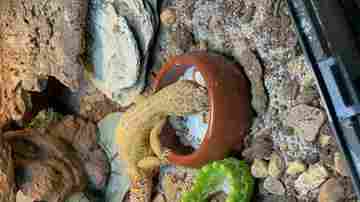 Leopard gecko at a calcium dish — optional use some animals do; not a substitute for dusting insects.
Prey should be no wider than the space between the gecko’s eyes. Juveniles are commonly offered insects daily. Adults often do well on every other day, or on a schedule that keeps the tail thick without turning the animal into a balloon. The tail is a fat store. A thin, wrinkled tail on an adult is a body-condition problem, not a morph. A tail that looks like a sausage and a gecko that can barely lift itself is the other direction. Feed to the animal in front of you, not to a chart you printed in 2014.
Wild-caught insects from a yard or porch light are a poor trade: pesticides, parasites, and hard-bodied wild prey are not worth the convenience. Feeding in a bowl or on a smooth slate keeps a lot of substrate out of the stomach. Tongs help some keepers keep count and keep the gecko from inhaling bedding with the lunge. They are not required. A dish is fine if the gecko will use it.
Substrate
For a typical household, especially with a juvenile that lunges at food, a solid surface (tile, paper towel, or a fitted liner) removes the most common path to impaction. Calcium sand was marketed as digestible and has a poor record in young geckos that swallow it with their food. “Reptile sand” with a calcium label is still sand. The gecko does not read the bag.
A dry, soil-and-stone naturalistic floor can look better and give them something to dig in, and some experienced keepers use it successfully. It asks more of the keeper: the mix has to stay dry, feces have to be removed promptly, and feeding is safer on a plate. It is a reasonable later project, not the default first setup. If you go that way, keep the humid hide as a packed moss cave, not as “the whole floor is a little damp.” The whole floor should stay on the dry side.
Handling and daily life
Most leopard geckos will walk onto a hand once they are used to being picked up, provided they are supported and not lifted by the tail. The tail can drop (autotomy) if it is grabbed or if the animal is badly startled. The gecko survives. The fat store does not grow back the same way, and the new tail is a blunt replacement. Short, calm evening sessions are easier than chasing the animal around the enclosure in the middle of the day.
Leave a newly arrived gecko alone for several days before the first handle, and longer if it has not eaten yet. Handling is not how you make a gecko “tame” in week one. Consistent hides, a correct warm floor, and food that shows up at the same time of evening are how you make a gecko that will walk onto a hand later.
Do not handle the gecko for a couple of days after a large meal, or while it is in heavy shed, which shows as dull skin, cloudy eyes, and extra time in the humid hide. A gecko that is about to shed is not being difficult; it is halfway out of its skin.
Body language and behavior
Leopard geckos do a lot with the tail and the mouth, and people put human stories on both. A gecko that vocalizes when picked up is not “talking.” A gecko that sits still on a palm is often staying put because it has been taken off its heat, not because it is content. Anthropomorphizing is how keepers miss whether this individual is using the warm hide, eating, shedding clean, and keeping a thick tail.
The useful habit is to learn the patterns of the animal in front of you: whether it usually comes out after lights-out, how it reacts to tongs versus a hand, what its stool looks like, and how fat its tail is from month to month. Once that baseline is familiar, a change is what matters. A gecko that has always been a cave-sitter is not “depressed,” but a gecko that has always come out at dusk and suddenly stops is giving you information.
Signals that are usually ordinary
A slow tail wave while stalking an insect is hunting focus. A faster rattle of the tail can appear when the gecko is excited or uncertain. Licking the lips and a slow blink after a meal are ordinary. Digging and rearranging the humid hide happen in animals that are about to shed or that are looking for a temperature they want. Females can lay infertile eggs even without a male in the house; digging and time in a moist hide sometimes go with that cycle.
A chirp, squeak, or bark when first picked up is a protest vocalization, not a conversation. Glass surfing that lasts a few minutes after a change in the room can be ordinary. Glass surfing that does not settle is usually an enclosure or husbandry problem.
What to watch for
- Stuck shed on the toes or tail tip, or toes that look swollen or thread-thin, can cost the gecko a digit.
- A tail that goes from thick to thin over several weeks, especially with a dropped appetite, means the gecko is losing condition, often because of parasites or a husbandry problem.
- A soft jaw, tremors, or a gecko that cannot lift itself normally are signs of metabolic bone disease (soft or deformed bone from a long gap in calcium, vitamin D3, and/or correct heat).
- Open-mouth breathing, bubbles, or sitting with the head up as if working for air can signal a respiratory problem.
- Straining, a closed vent, lethargy, and a loss of appetite together can indicate impaction, especially on loose sand.
- A dropped tail that is not clotting, or that looks infected, needs a veterinarian rather than a wait-and-see approach.
- Closing the eyes and going limp when handled is often an attempt to wait the handling out; if that is new and the animal is also off its food, check the enclosure before deciding it has a new personality.
- Circling, star-gazing, or repeated loss of balance in an enigma or related morph may be that animal’s neurological baseline, but a sudden change, or the same signs in a morph without that history, still needs a veterinarian.
- White lumps or thickening of the skin on a lemon frost or related morph can be iridophoromas (pigment-cell tumors), so see a veterinarian rather than waiting to see whether they stay pretty.
If you notice any of these patterns, check your husbandry first, and then see a reptile veterinarian if the animal does not return to its own normal baseline.
Problems that show up often
Metabolic bone disease still shows up in animals kept without calcium, without a correct warm hide, or without any UVB or D3 plan. Soft jaw, a gecko that cannot lift its body, tremors, and rubbery limbs are the late picture. The early picture is a tail that never filled out and a keeper who was told calcium sand would handle it. Thin tail and chronic parasites are common in animals that have been through pet stores or mixed collections. Impaction tracks loose sand plus a cool gecko. Stuck shed on the toes is almost always a humid-hide problem.
Cryptosporidium (often called crypto in this species) is a contagious parasite. It spreads between reptiles on shared dishes, tongs, substrate scoops, and hands. It is diagnosed by a veterinarian, not treated from a forum protocol. Isolate a new or sick gecko from other reptiles. Do not share water bowls. Handle the isolated animal last, or wash and change shirts in between. A gecko that is losing tail fat, producing odd or recurrent stools, and not gaining on a correct diet is a reason for a fecal and a crypto test, not a new brand of cricket and another two weeks. If you already keep other geckos, isolation is not optional politeness. It is the practical control for a parasite you cannot see on a pretty morph.
Enigma and related neurological morphs belong here as a purchase problem, not a husbandry problem. Circling, star-gazing, and trouble striking food are well-documented in those lines. A better enclosure will make a neurologically affected gecko more comfortable. It will not make the neurology go away. Do not buy one hoping you will be the keeper who “fixes it with heat.”
Lemon frost belongs in the same purchase-problem column. The attractive white color comes from the same pigment-cell overgrowth that becomes tumors in a large share of those animals, and a better humid hide will not stop that.
Bringing a new animal home
A quarantine period of at least 60 to 90 days in its own enclosure, with its own dishes and a fecal check, is a kinder start than introducing a new gecko to an existing collection on day one. Sixty days is the short end of a working quarantine. Ninety is kinder if you already keep other reptiles, because some problems — crypto among them — do not announce themselves in the first month. The point is not to be unfriendly. The point is that parasites do not announce themselves on the drive home, and they travel on shared bowls and hands.
Set quarantine up before the gecko arrives. A simple tub or the adult box, paper towel so feces are visible, a warm hide, a cool hide, a humid hide, a shallow water dish, a thermostat on the heat, and an IR gun you will actually use. Confirm that the warm hide, humid hide, and diet are in range before decorating. Do not share dishes, tongs, or substrate scoops with the rest of a collection. Handle the quarantine animal last, or wash and change shirts in between. A fecal exam at intake, and another before the animal graduates into a display enclosure, is cheap compared with treating a roomful of geckos.
Leave the animal alone long enough to eat at least a couple of meals before regular handling. Those first weeks are also the time to start learning this animal’s ordinary behavior, including what a normal tail looks like on this individual, which hide it chooses after lights-on, and whether it comes out after dusk. Write a weight down if you can. A new leopard gecko that hides and then eats on week two is a common, good start. A new leopard gecko that is still losing tail fat on week six, or that has not shed clean, or that sits open-mouthed, is not a “shy” story. It is a husbandry check and then a veterinarian.
If you already keep other geckos, quarantine is not optional politeness. It is the practical control for crypto and the rest of what travels on a pretty morph.
Recommended gear
Some of the links below go to Amazon, and if you buy through them we may earn a small commission. This does not change the price you pay.
A warm hide, a cool hide, a humid hide, and calcium do more good than any 10-gallon kit. The 36-inch ECOFLEX is the adult footprint we can verify, and the UVB on this list is a 5.0 T5 HO rather than a bearded-dragon 10.0; give the gecko cover and follow the lamp’s distance chart.
- New Age Pet ECOFLEX 36-inch Mojave Reptile Lounge for a single adult (exterior 36 x 18 x 18 inches; interior about 34.6 x 16.4 x 15.8)
- Zoo Med ReptiSun T5 HO 5.0 hood, 14 inch if you want an Amazon-reliable 5.0 T5 HO. Give the gecko cover and follow the lamp’s distance chart; a 10.0 desert tube is the wrong lamp
- Etekcity Lasergrip 774 for the floor of the warm hide
- TempPro TP65 indoor/outdoor thermometer and hygrometer (previously ThermoPro) so a remote sensor can sit inside the enclosure
- BN-LINK on/off heat-mat thermostat for a heat mat or ceramic emitter
- REPTIZOO dimming thermostat if the heat is a bulb
- Exo Terra Gecko Cave, Large as a snug opaque hide for the warm or cool end
- Zoo Med New Zealand Sphagnum Moss packed damp (not dripping) in a third hide that is the humid hide
- Zoo Med Reptile Calcium without Vitamin D3 for most dustings when a 5.0 T5 HO is in place
- Zoo Med Reptile Calcium with Vitamin D3, 8-Ounce if you are not running UVB; that powder is the plan, not an optional extra
- Zoo Med ReptiVite without D3, 8-Ounce once or twice a week
Closing
Leopard geckos reward people who measure hide floors, keep a humid hide that actually stays damp, and treat calcium and lighting as one plan. They punish impulse setups: a 10-gallon forever home, an unregulated pad, a mealworm-only cup, an enigma bought from a photo. If you can keep a 36x18 with three hides and a warm floor in the high 80s, and you can live with a gecko that spends most of the day in a hole, this is a good species. If you want something out and busy on glass all day, it is the wrong one.
If you have questions about an animal you already keep, or you find a spotted gecko on a porch near Cartersville and want a photo ID, reach out. We relocate snakes within about an hour of Cartersville at no charge when that is the right help. A leopard gecko on a porch is a pet, not a native. Nothing in this guide replaces hands-on judgment for a specific animal or an exam by a veterinarian who regularly sees reptiles.