


Reticulated Python
Malayopython reticulatus
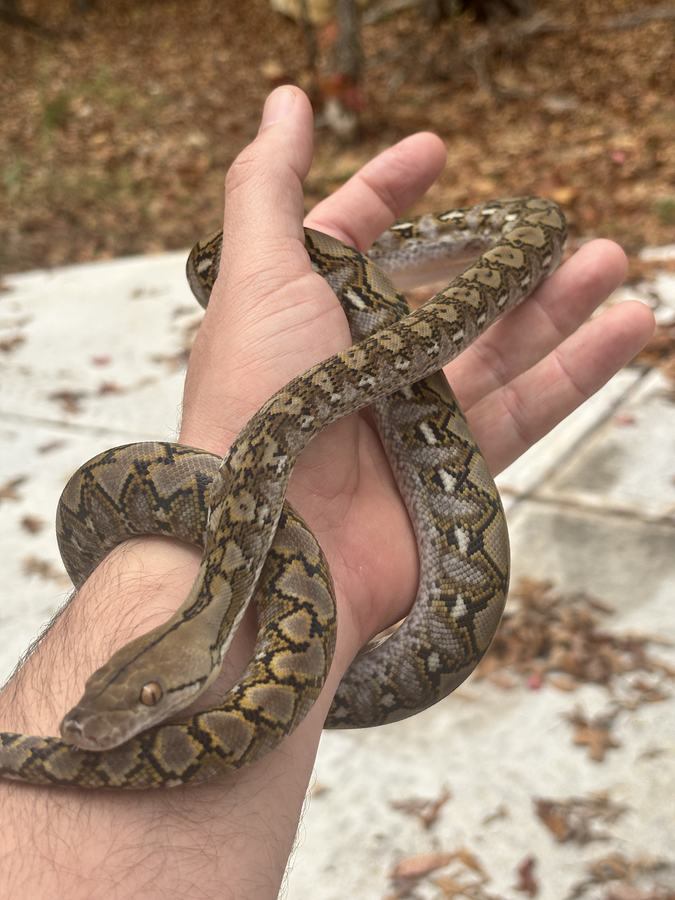
Snake
Key numbers
These figures are a working snapshot for Malayopython reticulatus as a group. Adult size depends heavily on locality and genetics, so treat the ranges below as planning tools, not a guarantee for the animal in front of you. The rest of the guide explains why that planning matters before the hatchling price tag does.
- Adult size (mainland / typical): Mainland and typical trade animals commonly reach about 12 to 20 feet; heavy females often land between the mid-teens and around 20 feet, exceptional animals grow longer, and males are usually shorter and lighter than females from the same stock.
- Adult size (dwarf localities): Animals from dwarf localities commonly reach about 8 to 13 feet, depending on the island line and how they are fed (Jampea, Selayar, and related trade “dwarf” groups).
- Adult size (super-dwarf localities): Animals from super-dwarf localities commonly reach about 5 to 10 feet, depending on the island line (Karompa, Kalaotoa, Madu / Honey Island, Tombolongan, and related trade “super dwarf” groups), and males often stay toward the smaller end.
- Lifespan: With consistent care, they often live 20 to 30 years, and longer is possible.
- Adult enclosure: The adult enclosure must match the expected adult length, not the hatchling; a working rule of thumb is floor space at least as long as the snake and about half as deep, with height for climbing, and while many keepers treat about 8x4x4 feet as a starting point for a manageable dwarf or smaller adult, a large mainland animal needs custom room-scale housing.
- Start size: A hatchling can begin in a secure tub or small enclosure with hides and a real temperature gradient (a warm end and a cool end that actually differ), then step up as it grows, which happens quickly because retics put on length early.
- Housing: Keep one snake per enclosure, use locks that actually hold, and never house an adult in an open-top glass tank.
- Basking / warm surface: The basking or warm surface the snake actually sits on should read about 88 to 95 F, and many keepers target roughly 88 to 92 F.
- Cool end: The cool end should sit at about 76 to 82 F.
- Night: Nighttime temperatures often run about 74 to 78 F, and long cold nights should be avoided.
- Humidity: Keep humidity around 60 to 80 percent most of the time, with strong ventilation so the floor is not permanently soggy, and raise it when the snake is in shed.
- Diet: Feed appropriately sized whole prey, usually frozen-thawed rodents and, for larger animals, rabbits or poultry as needed, on a schedule that matches age and body condition rather than power-feeding for length.
Do’s and don’ts
This is the short version of the husbandry below. If a line here and a paragraph later seem to pull in different directions, trust the longer explanation.
Do
- Buy (or keep) the animal based on its expected adult size from locality and parentage, not the hatchling’s current length or the word “dwarf” on a sale ad.
- Plan the adult enclosure, locks, and prey budget before the animal outgrows a starter setup.
- Give a warm end and a cool end that actually differ, and measure the surface the snake sits on with an infrared thermometer.
- Keep humidity tropical enough for clean sheds while ventilating so the substrate is not a swamp.
- Provide a water vessel large enough for the snake to soak in, heavy or secured so it cannot tip.
- Feed frozen-thawed prey with long tongs, and treat the door opening as a food cue until that animal’s baseline says otherwise.
- Never free-handle a large adult alone. For animals approaching roughly 8 to 10 feet and beyond, a second capable person in the room is ordinary safety, not paranoia.
- Learn that individual’s ordinary patterns so a missed meal, heavy soaking, or a tense posture at the glass can be read against a baseline.
- See a veterinarian who regularly treats large reptiles when breathing, body condition, shed quality, or behavior leaves that baseline (local herp groups and exotic-vet directories help you find one before you need them).
- Send a picture if you find a large patterned python on a property near Cartersville and want an ID. If you want it moved, we relocate snakes within about an hour of Cartersville at no charge.
Don’t
- Do not treat “dwarf” or “super dwarf” as a morph that guarantees a pet-store corn-snake footprint. Those are locality / lineage labels, and sellers use them inconsistently.
- Do not leave a growing retic in a hatchling tub as a finished home, or buy a mainland animal without a plan for room-sized housing.
- Do not house two retics together.
- Do not free-handle a large constrictor alone, around the neck, or with children unsupervised.
- Do not use a hot rock or an unregulated heat source as the main heat.
- Do not keep the enclosure chronically flooded, or bone-dry with no soak option.
- Do not power-feed for maximum length. Fast growth is not the same thing as healthy growth.
- Do not handle for a couple of days after a large meal, or while the snake is in blue (cloudy eyes before a shed).
- Do not release a pet retic, or any pet snake, into Georgia woods.
- Do not read wrapping, soaking, or a hard stare as a human mood.
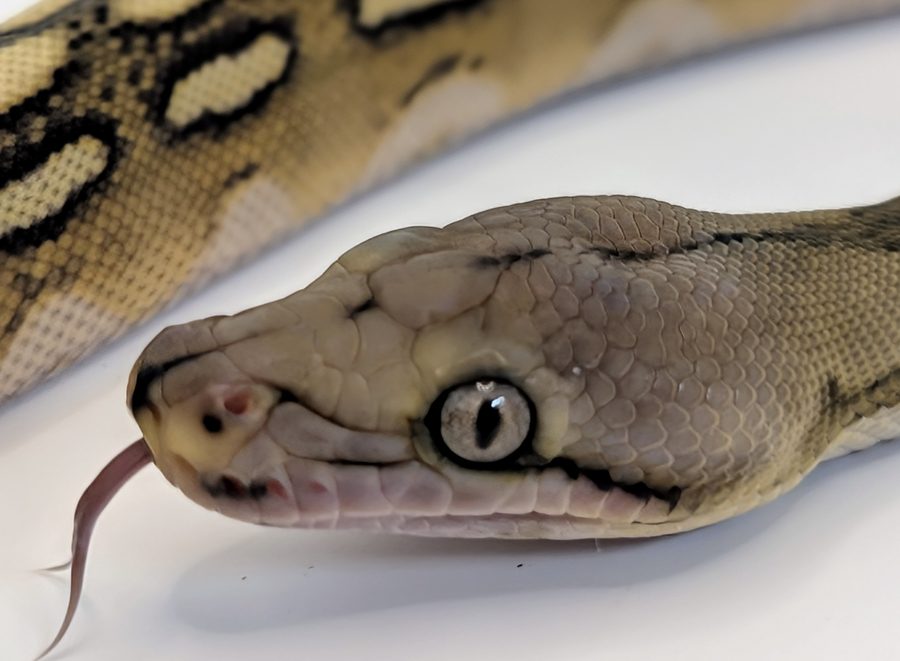
Reticulated python head profile — elongated head vs ball python.
A bit of background
The reticulated python, Malayopython reticulatus (still widely labeled Python reticulatus in older books and ads), is a large Southeast Asian constrictor from tropical forests, edges, farmland, and country near water across much of Indonesia, Malaysia, the Philippines, Thailand, and neighboring range. In the field they climb, swim, and cruise. That mix of floor, water, and height is what a serious captive setup is trying to leave room for. A bare locked box with no soak tub and no cover is easier to clean and harder on the animal.
They are famous for length. Mainland / typical trade animals are the giants: adults commonly in the low teens to around 20 feet, with females the heavier sex and rare record animals longer still. They are also famous for island dwarfism. On certain Indonesian islands, isolated populations mature at shorter adult lengths than mainland stock. In the pet trade those populations are sold as dwarf and super-dwarf retics. Those words are not color morphs. They are shorthand for locality groups and, often, for how much of that island ancestry is in the pedigree.
Commonly referenced dwarf localities in the trade include Jampea and Selayar (often discussed in the roughly 8 to 13 foot adult range, with Selayar frequently toward the larger end of the “dwarf” conversation). Super-dwarf localities commonly discussed include Karompa (often cited toward about 5 to 7 feet), Kalaotoa and Madu / Honey Island (often about 6 to 9 feet), and Tombolongan (often about 6 to 10 feet). Kayuadi appears in both conversations depending on the source and the bloodline. Exact numbers vary by sex, feeding history, and how “pure” the locality line still is after years of captive crossing. Females outgrow males in essentially every size class.
Labels vary by seller. MorphMarket and careful breeders generally treat “dwarf” / “super dwarf” as meaningful only when island locality genetics make up a substantial share of the lineage (a common marketplace rule of thumb is at least about 50 percent combined dwarf or super-dwarf locality blood for those tags). A hatchling sold as “super dwarf” that is mostly mainland with a splash of island ancestry can still become a very large snake. Genetics and documented locality matter more than the adjective on the tote. Housing must match the animal’s expected adult size, not the hatchling price tag.
Even a true super-dwarf adult is still a powerful constrictor measured in many feet, not inches. A mainland female is a different order of animal: room-scale housing, large prey, and handling protocols that treat the snake as stronger than one person. This guide is general husbandry for Malayopython reticulatus across those size classes. Individual animals vary, and nothing here replaces an exam by a veterinarian who regularly sees large reptiles.
Because a big patterned python on land in this part of Georgia is not a native wild species, two extra points belong up front. A pet retic that gets loose is not a wild animal and should not be turned out “to be free.” And a large snake someone finds on their land is not automatically a copperhead story or a zoo escape just because it is patterned. If you want an identification, send us a picture. If you want it moved, we relocate snakes within about an hour of Cartersville at no charge.
Whether they are a good fit
A reticulated python is a long-lived, tropical, space-hungry constrictor that needs secure locking housing sized for the adult it will become, a reliable supply of appropriately large frozen prey, and a keeper who will treat safety as part of ordinary care. Many dwarf and super-dwarf animals are more manageable than mainland giants, and some individuals are calm and curious once they know the household. That is not the same thing as being an easy first snake.
They are a poor fit for anyone who wants a “big impressive snake” without the adult footprint, the prey budget, or a second person for large handling. They are a poor fit for a household that will leave a hatchling in a starter enclosure for years, or that buys on the word “dwarf” without asking for locality percentages and parent sizes. They are also a poor fit for anyone who free-handles large constrictors alone, drapes them around the neck, or treats children as unsupervised keepers. If the plan cannot include locks that hold, a soak tub that will not tip, and adult-sized housing before the animal needs it, this is the wrong species. Large constrictors are also restricted or banned in some cities and counties — check local rules before you buy, not after the animal is already home.
Enclosure and space
Floor space and security matter more here than for almost any other commonly sold snake. An adult needs a warm zone and a cool zone with real distance between them, room to stretch a substantial portion of its body, cover so it is not exposed on an empty floor, and a lid or doors that lock. A practical planning habit is to size length and width to the expected adult (many keepers use “at least as long as the snake, about half as deep,” with as much useful height as the room allows for climbing). For a smaller dwarf or super-dwarf adult, a large custom PVC or sealed-wood enclosure in the neighborhood of 8 feet by 4 feet by 4 feet is often the start of a serious conversation, not a palace. For a mid-teens mainland animal, that same box is closer to a stall than a habitat; room conversions and purpose-built spaces are how responsible keepers house giants.
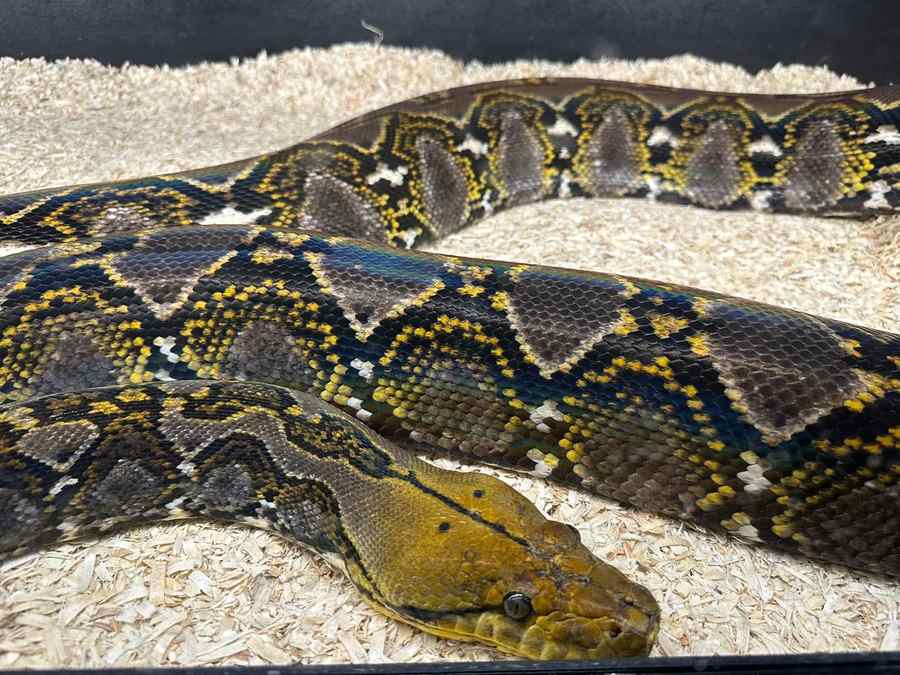
Reticulated python coiled on wood-shaving substrate in a tub/PVC setup (not a finished adult display vivarium).
A hatchling can start smaller if the gradient, hides, and security are right. Retics grow quickly in the first years. Step the enclosure up as length and mass increase. Leaving a six-foot animal in a three-foot tub because “it still fits coiled” is how keepers end up with frustrated snakes and unsafe lid fights.
One snake per enclosure is the arrangement that avoids most social and feeding problems. Retics are not a species that needs a companion. Two animals in one gradient means competition for the better hide and a real risk of feeding the wrong snake — or of one animal injuring the other.
Use front-opening doors with locks rated for a strong animal. Screen lids that a determined adult can bow or pry are not enough. Branches and shelves must be structural, not decorative sticks wedged in place; a heavy python will collapse weak furniture. A water vessel large enough to soak in belongs in the plan from early on, and it must be heavy, recessed, or otherwise secured.
Temperature and the gradient
A retic’s digestion and immune function are tied to temperature. The useful measurement is the basking or warm-hide surface the snake actually coils on, taken with an infrared temperature gun, plus ambient readings at the cool end with a probe. Air temperature on a glass sticker can look acceptable while the warm surface is too cool to digest, or hot enough to burn.
A warm / basking surface in the neighborhood of 88 to 95 F (many working setups land around 88 to 92 F) supports normal digestion for most animals. The cool end in the same enclosure is typically around 76 to 82 F. Night temperatures often sit in the mid-70s. The difference between the warm and cool ends is what lets the animal self-regulate. If the whole room or box sits at one temperature, they have nowhere to go.
Heat is safest when every source is on a thermostat. Overhead halogen or radiant panels work well in large enclosures when bulbs and panels are guarded so the snake cannot press against a hot surface. Unregulated heat mats and hot rocks are a frequent source of burns. Large animals break weak fixtures; build for strength. Colored night bulbs are unnecessary.
Humidity and water
These are tropical snakes with a real relationship to water. Ambient humidity around 60 to 80 percent is a typical working target, with a bump when the eyes go cloudy (in blue) and a shed is coming. Strong ventilation matters as much as misting. Chronically wet, filthy substrate is a regular backdrop for scale rot and respiratory trouble. Chronically bone-dry air with no soak option is a regular backdrop for stuck eye caps and rough sheds.
A water vessel large enough for the snake to coil and soak — for big animals that may mean a stock tub or custom basin — does a lot of the humidity and welfare work. Change soiled water promptly. A healthy shed comes off in one piece, including the eyecaps. Patchy shed that repeats is often a humidity, hydration, or overall condition problem.
A shed skin on a Georgia property is not a nest of retics. Finding a skin means an animal passed through. If the skin looks like a large python rather than a local rat snake or kingsnake, that is a reason to send a photo for ID, not a reason to assume a breeding colony.
Substrate and hides
Substrate has to hold some humidity, cushion a heavy body, and still be practical to spot-clean, because retics are messy. Cypress mulch, coconut products kept appropriately damp (not swampy), reptile soil mixes, or similar tropical bedding are common choices. Plan on several inches of depth. Paper or simple flooring can work for quarantine and for some hospital setups where you need to watch feces closely. Cedar and aromatic pine are not bedding.
Opaque hides on the warm end and the cool end still matter, even for a large snake. Plastic kennels, half-logs, and custom caves sized so the animal can feel covered do more work than an empty showroom floor. Climbing structure should be thick, secured, and rated for the animal’s mass. Leaf litter and cover reduce the “exposed on a stage” feeling that pushes some animals into restless glass-surfing or nose-rubbing.
Whatever substrate you use, spot-clean it whenever waste appears, because a tropical enclosure that is never cleaned becomes a health problem faster than a dry one.
Lighting / UVB
Retics are largely crepuscular (most active at dawn and dusk) and nocturnal in activity, but they live under a real day and night in the wild. A simple 12 hours on and 12 hours off — room light plus any heat lamps on a timer — is easier on them than lights at random hours.
Low to moderate UVB is used by some keepers for this species and is not a substitute for a correct thermal gradient or a clean diet. Keepers who offer UVB generally choose a forest-strength linear tube, mount it so the snake cannot burn itself, and give enough shade and cover that the animal can get out of the light. A heat lamp is still heat, not UVB, if you are using one. Bright full-spectrum lighting helps plants and makes observation easier in a large enclosure; it is optional enrichment layered on top of temperature and humidity done right.
Diet and feeding
In the field, reticulated pythons take a wide range of vertebrate prey as they grow — mammals and birds especially, and for giant adults, impressively large meals. In captivity they are kept on whole prey we can source cleanly: mice and rats for younger animals, then larger rats, rabbits, and poultry as size demands. Frozen-thawed, warmed through, and offered with long tongs (or placed and stepped away) is the method that avoids most feeding injuries to both snake and keeper. A live rodent left with a snake that is not hungry can chew devastating wounds.
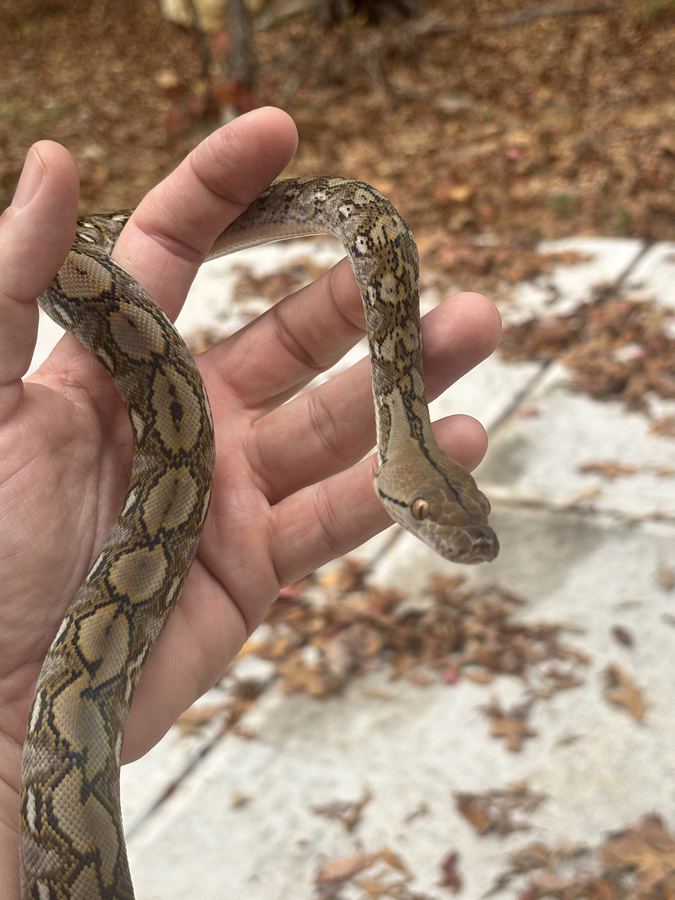
Reticulated python on hand showing reticulated dorsal netting.
Prey width about as wide as the snake at mid-body is a common starting rule; body condition is a better long-term teacher than a single number. Hatchlings are often fed about weekly. As the animal grows, the interval usually lengthens — every 1 to 2 weeks for many juveniles, then every few weeks for subadults, and for many adults every 4 to 6 weeks depending on meal size. A retic that is folding in on itself with fat rolls is being fed too often or too large. A retic with a sharply triangular body and a visible spine is being fed too little, or is ill. Power-feeding for maximum length is how keepers buy a bigger animal and a shorter, less healthy life.
Large constrictors have strong feeding responses, and the door, the tongs, and a hand that smells like prey are all food cues. Feed with a clear routine that is different from your handling routine, and do not free-handle the snake right after offering food. For large animals, having a second person available at feeding time is ordinary prudence. Postpone handling for a couple of days after a substantial meal.
Handling and body language
Many retics become workable to handle if they are supported along the body, moved calmly, and not approached in a way that makes every door opening look like dinner. Short, deliberate sessions after the snake has settled go better than daily wrestling matches, and handling should wait after a large meal and while the snake is in blue.
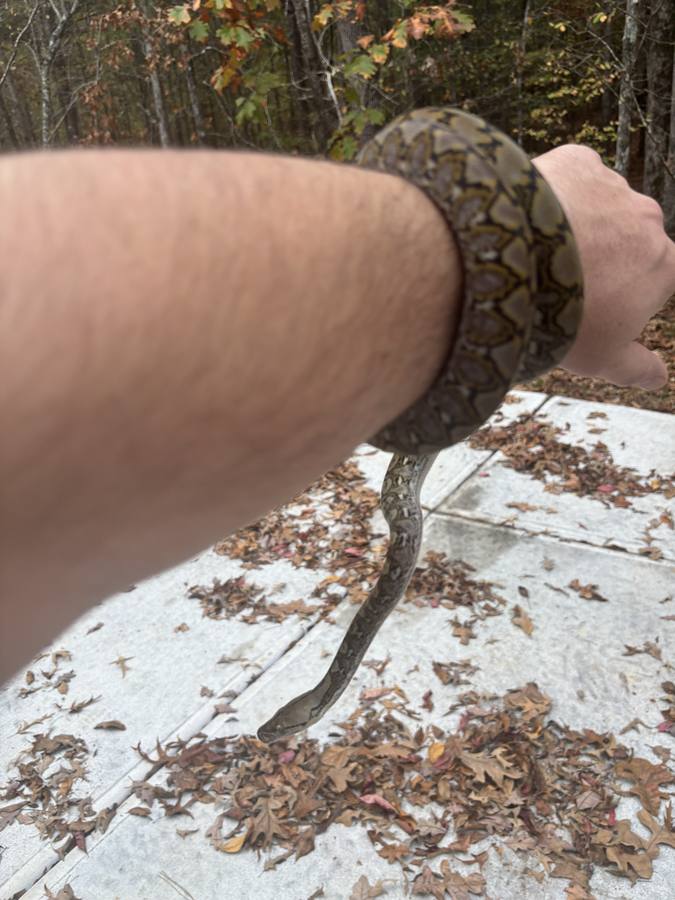
Reticulated python coiled on forearm during handling.
Safety scales with size. A small juvenile is still a constrictor with teeth, and an adult measured in many feet can overpower one person. Never free-handle a large adult alone, never let the snake settle a coil around your neck, and never let children handle a retic unsupervised. Hooks and a second set of hands are tools, not admissions of failure, and a household that cannot commit to those habits is not ready for this species.
Anthropomorphizing — treating the animal as if it has human motives, moods, and social needs — is how keepers miss the actual information. A snake that wraps is often climbing and bracing, not hugging. A snake that soaks may be shedding, too warm, too dry, or simply using water the way this species does. A hard focus and a drawn posture at the glass can be defense or food anticipation depending on context. The useful habit is to learn that individual’s baseline: how it uses hides, how it reacts to the door versus the tongs, how it looks when it is about to shed, how it moves when it is exploring versus when it is tense. Once that baseline is familiar, a change is the thing that matters.
Signals that are usually ordinary
Tongue-flicking is how the snake samples the air. Cruising the enclosure at dusk or overnight is ordinary for an active python with space, and sitting in the water tub for a stretch around a shed is common. A defensive hiss or a withdrawal when the door opens without a feeding cue is information, not a personality diagnosis. Dull, bluish skin and cloudy eyes mean a shed is coming, and hiding more around that time is ordinary.
What to watch for
- Open-mouth breathing, wheezing, or bubbles at the mouth or nose point to a respiratory problem.
- A strike-and-hold feeding response directed at a person, especially when prey scent is on hands or clothes, means the routine needs resetting; never try to “teach it a lesson” by wrestling the head.
- Regurgitation, or a snake that strikes and will not finish, is a reason to check the warm-surface temperature and how soon the animal was disturbed after its last meal.
- Stuck eye caps or ragged sheds that keep recurring usually point to a humidity or hydration problem.
- Belly scales that are brown, pink, or blistered, or a snake lying in wet, filthy substrate, suggest scale rot.
- Rapid weight loss, or a formerly reliable eater that has stopped while temperatures look correct, is a reason to check husbandry first and then see a reptile veterinarian.
- A snake that corkscrews, cannot right itself, or shows a lasting neurological pattern is not something to wait out.
- A successful escape means checking locks, gaps, and screen strength immediately, because a loose retic in a house is an emergency for the animal and for anyone who meets it unprepared.
If you notice any of these patterns, check your husbandry first, and then see a reptile veterinarian if the animal does not return to its own normal baseline.
Health notes worth knowing
Respiratory disease usually follows an enclosure that is too cold, or cold and damp together with poor ventilation. Scale rot follows wet, filthy substrate, and obesity and organ strain follow power-feeding and chronic overfeeding after growth should have slowed. Stuck shed is less common when humidity, a soak tub, and hydration are all in range. Mouth trauma and nose rubs usually follow undersized or barren enclosures and chronic escape attempts against mesh or glass.
Inclusion body disease (IBD) is a serious viral disease of pythons and some boas; it spreads between snakes, and it is diagnosed by a veterinarian, not a forum thread. That risk — along with other infections — is why quarantine, separate tools, and not mixing collections casually matter. Parasite checks on arrival are ordinary good practice for a new retic. A feeding bite or a constriction incident is a handling-and-protocol problem more often than it is a “mean snake.” Large constrictors deserve respect without myth-making: they are not cartoon villains, and they are not lap dogs.
An escaped pet is a husbandry problem of a different kind: check the locks, then search the house, and never release the animal outside.
Bringing a new animal home
A quarantine period in its own enclosure, with its own tongs and water bowl and a fecal check, is a kinder start than dropping a new retic into a display room on day one. A common working window is about 30 to 90 days, or until appetite is steady and a fecal comes back clear — longer if anything looks off. Confirm that the warm and cool ends hit the right temperatures and that humidity and the soak tub work before you invest in elaborate décor. Leave the animal alone long enough to eat at least a couple of meals before regular handling. Establish a feeding cue that is different from a handling approach from the first feeds.
Those first weeks are also the time to verify what you actually bought. Ask for locality percentages and parent sizes in writing if you care about adult footprint — and you should. Plan the next enclosure size before the animal forces the issue. If the snake is already large, arrange help for the first moves and cleans before you need it in a hurry.
Recommended gear
Some of the links below go to Amazon, and if you buy through them we may earn a small commission. This does not change the price you pay.
When you are budgeting, remember that locks, a thermostat, an infrared thermometer, long tongs, and a soak vessel sized for the adult matter more than decoration. For this species, custom PVC or sealed wood built for the expected adult length beats a glass aquarium every time.
- A large locking PVC reptile enclosure for manageable adults; confirm dimensions and lock quality before you buy, and plan custom builds for mainland giants
- Etekcity Lasergrip 774 for the warm surface the snake sits on
- ThermoPro probe thermometer and hygrometer to track air temperature and humidity
- A proportional or quality thermostat for heat sources in a large enclosure
- Cypress mulch or tropical reptile substrate
- Long stainless feeding tongs
- A snake hook for moving and for separating feeding from handling cues
Closing
Reticulated pythons reward keepers who plan for the adult, respect locality and size labels instead of sales adjectives, and treat secure housing and two-person handling for large animals as ordinary care. They punish impulse buys. Mainland animals are giants. Dwarf and super-dwarf island lines are smaller by comparison and still measured in feet of muscle. If you are choosing a retic, choose the enclosure and the safety habits first, then the morph.
If you have questions about an animal you already keep, or you find a large patterned snake on a property near Cartersville and want a photo ID, reach out. We relocate snakes within about an hour of Cartersville at no charge when that is the right help. Nothing in this guide replaces hands-on judgment for a specific animal or an exam by a veterinarian who regularly sees large reptiles.