


Rubber Boa
Charina bottae
Snake
Key numbers
These figures are a working snapshot for a typical rubber boa, not a guarantee for every animal or every locality. The rest of the guide is there to explain why they look this way.
- Adult size: Adults commonly reach about 14 to 30 inches; many captives stay between the mid-teens and the low twenties, and heavy females can feel substantial for their length.
- Lifespan: With consistent care, they often live 20 to 30 years or more, so treat ownership as a multi-decade commitment.
- Adult enclosure: An enclosure about 24 to 36 inches long by 12 to 18 inches deep is a practical range for one adult, and floor space and burrowing depth matter more than height.
- Start size: A neonate can begin in a secure small tub or a 10-gallon, as long as temperatures stay cool and the lid is right.
- Housing: Keeping one snake per enclosure is the predictable arrangement for a pet.
- Warm surface: The warm surface the snake can choose should read about 80 to 85 F at most, and many animals do fine with a mild warm end in the upper 70s.
- Cool side / ambient: A cool side and ambient temperature of about 68 to 75 F is a common working range.
- Humidity: Keep humidity moderate, commonly around 40 to 60 percent, with a humid hide to help with shedding and a floor that never stays swampy.
- Diet: Feed a single appropriately sized rodent, usually frozen-thawed; prey is small compared with what many tropical boas eat.
Do’s and don’ts
This list is the short version of the husbandry covered in detail further down the page. If a line here and a paragraph later on ever seem to pull in different directions, trust the longer explanation, because it carries the context that a one-line rule cannot.
Do
- Keep temperatures cooler than you would for a ball python or a boa imperator. Measure the warm surface and believe the gun.
- Give deep, diggable substrate and at least one truly snug hide. Rubber boas want to disappear.
- Use a thermostat on any heat source, and verify that the warm end never creeps toward the upper 80s or 90s.
- Offer frozen-thawed mice with tongs on a schedule that matches body condition, not tropical-boa appetite myths.
- Learn that individual’s ordinary patterns so a missed meal, a week underground, or unusual daytime roaming can be read against a baseline.
- See a veterinarian who regularly treats reptiles when breathing, body condition, or shed quality leaves that baseline (local herp groups and exotic-vet directories help you find one before you need them).
- Send a picture if you find a small, blunt-tailed brown snake on a property near Cartersville and want an ID. If you want it moved, we relocate snakes within about an hour of Cartersville at no charge.
Don’t
- Do not heat this species like a tropical boa. Sustained temperatures near 90 F are a stress and injury risk.
- Do not leave an adult in a bare, bright tank with one open hide and call it enrichment.
- Do not house rubber boas together as a default “because they ball up in the wild.” Pet keeping is safer one per enclosure.
- Do not use a hot rock or an unregulated heat pad.
- Do not handle for a couple of days after a meal, or while the snake is in blue (cloudy eyes before a shed).
- Do not assume a blunt-tailed snake in a Georgia yard is an escaped rubber boa. This species is not native here.
- Do not release a pet rubber boa, or any pet snake, into Georgia woods.
- Do not read slow movement or a balling response as a human mood.
A bit of background
The rubber boa, Charina bottae, is a small boa from the western United States and southern British Columbia. In the wild, rubber boas live in cool forests, meadows, and rocky or sandy ground, spending much of their time under cover and in burrows. Their skin looks almost rubbery, their tail is blunt enough that people mistake it for a second head, and in captivity their temperament is often remarkably calm. That soft look and gentle reputation are why people keep them. What tends to get missed is temperature: this is a cool-climate snake, and setups built for ball pythons will overheat a rubber boa.
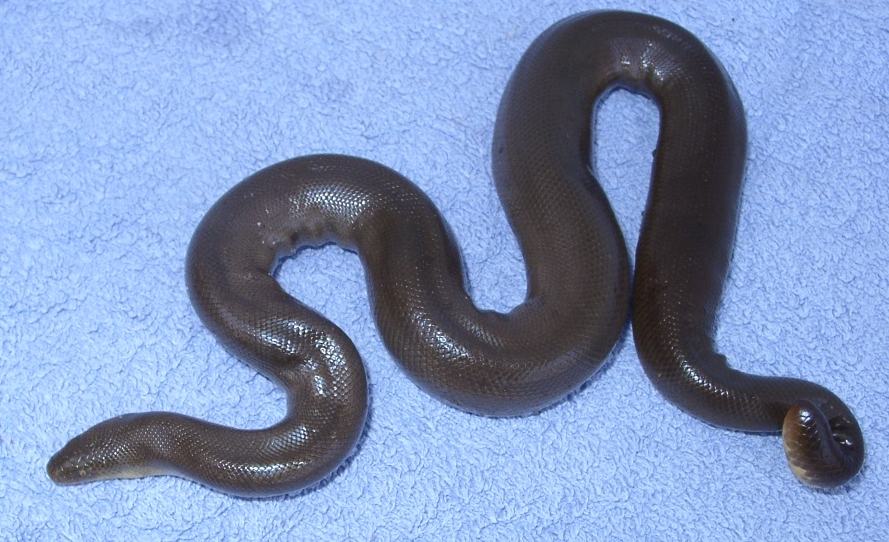
Northern rubber boa (Charina bottae) full body on a towel — uniform olive-brown, tiny smooth scales, and a blunt rounded tail that mimics the head (not a boa imperator or Kenyan sand boa). Stock photo (Wikimedia Commons — 5snake5, CC0).
Rubber boas are not a high-volume pet-store animal in the Southeast, and captive-bred animals from responsible western breeders are the ethical default. Collection pressure on wild populations and the species’ slow reproduction make taking one from the wild a poor idea even where it is native, and in Georgia it is not native at all.
Adults commonly reach about 14 to 30 inches, depending on sex and locality, and when temperatures stay sensible their lifespan in captivity is often measured in decades. This guide covers general husbandry for the northern rubber boa, Charina bottae. The southern rubber boa (Charina umbratica) is a separate, protected California animal with tighter legal and conservation rules, so do not treat a “rubber boa” label as interchangeable. Individual animals vary, and nothing here replaces an examination by a veterinarian who regularly sees reptiles.
Because this is not a Georgia native, two extra points belong up front. First, a pet rubber boa that gets loose is not a wild animal and should never be turned out “to be free.” Second, a small brown snake that someone finds on land near Cartersville is almost never this species; local lookalikes and other burrowing snakes need careful identification. If you would like an identification, send us a picture, and if you would like the snake moved, we relocate snakes within about an hour of Cartersville at no charge.
Whether they are a good fit
A rubber boa is a long-lived burrower from cool country that needs a keeper willing to run lower temperatures than the rest of a typical snake room. Rubber boas are a poor fit for anyone whose only approach to heat is “hot end at 90,” and for anyone who wants a brightly colored display animal sitting out on a branch every evening, since much of a rubber boa’s ordinary day is spent under cover. Calm handling is common once they settle, but that is not the same as needing daily social time.
Enclosure and space
For this species, floor space and burrowing depth matter more than height. A practical range for an adult is about 24 to 36 inches long by 12 to 18 inches deep, with enough substrate depth for the snake to disappear. Neonates can start in something smaller, provided the lid is secure and temperatures stay in range. Older advice that kept adults in tiny tanks for life understates how much secure cover and digging room these snakes actually use.

Rubber boa on diggable earth — floor space and deep substrate matter more than height for this fossorial (burrowing) species. Stock photo (Wikimedia Commons — Ajaykuyiloor, CC BY-SA 3.0).
One snake per enclosure is the predictable arrangement for pets. Some experienced keepers maintain groups under carefully managed cool conditions, but that is a specialist project rather than the default recommendation for a household pet, and feeding several snakes in one enclosure is how keepers lose track of who ate and who got bitten.
A truly snug hide, tight enough that the snake’s body fills the space, along with deep substrate, a humid hide for shedding, and a water bowl that will not tip, does far more good than climbing branches, because rubber boas live on and under the ground. The enclosure also needs a lid that latches, because rubber boas are quiet escape artists.
Temperature and the gradient
Temperature is the make-or-break factor for this species, and the measurement that matters is the surface the snake can choose at the warm end, taken with an infrared temperature gun. Many rubber boas thrive with ambient temperatures from the high 60s to the mid-70s and a mild warm option of around 80 to 85 F. Some keepers in cool houses need little more than a carefully thermostated low-wattage heat source, and others need no heat at all for parts of the year if the room stays in range.
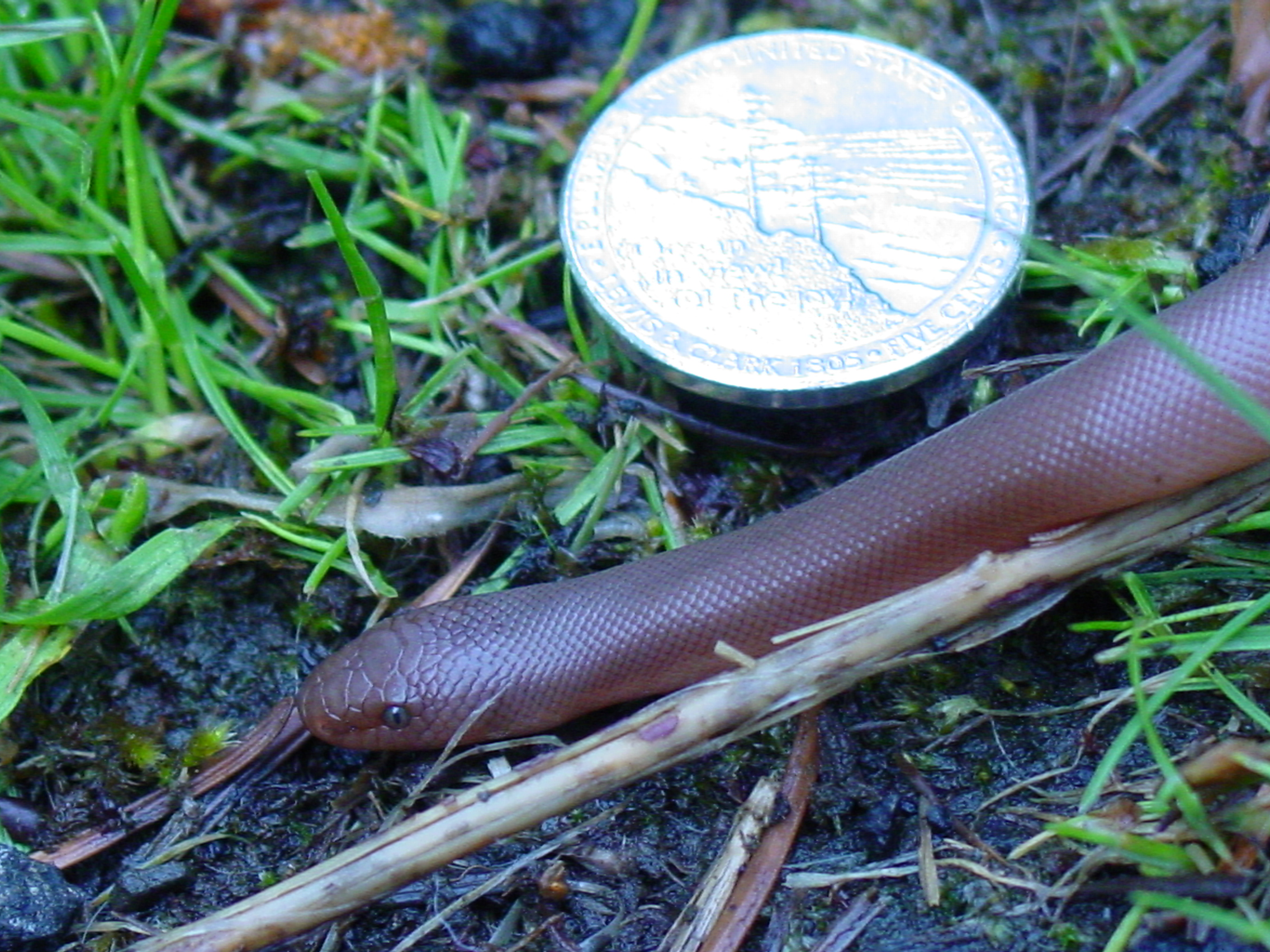
Small rubber boa with a US nickel for scale — cool-climate Charina stay modest in size; do not heat them like a tropical boa. Stock photo (Wikimedia Commons — Dar-Ape, Public domain).
Do not build a 90 to 95 F tropical warm hide and hope the snake “finds the cool side,” because sustained heat that would be normal for a sand boa or a ball python is the wrong tool here. Overnight drops into the 60s are often acceptable, colored night bulbs are unnecessary, and hot rocks and unregulated heat pads are unsafe.
Some keepers cool healthy, well-conditioned adults for a winter brumation once the gut is empty. Brumation is a breeding and seasonal tool rather than a requirement for every pet, and deliberately cooling a thin, parasitized, or recently shipped animal is a reliable way to make it worse.
Light, UVB, and the daily cycle
Rubber boas are largely secretive and are often most active at dusk and at night. A clear day and night matters more to them than bright lighting, and a simple schedule of 12 hours on and 12 hours off using ordinary room light is enough for most pet setups.
Low-level UVB is optional for this species and is never a substitute for correctly cool temperatures. If you offer UVB, choose a low, forest-strength linear tube and provide deep cover and substrate so the snake can get away from it. If you use a heat lamp, remember that it provides heat only, not UVB, and that heat is the one variable you must not overshoot.
Humidity, water, and shedding
The usual target is moderate humidity, with a substrate surface that is dry to the touch and a humid hide for shedding. Chronically soaked substrate on a cool floor commonly leads to scale rot and respiratory problems, while bone-dry air with no humid retreat commonly leads to stuck shed.
A healthy shed comes off in one piece, including the eye caps, and a clean water bowl should always be available. Patchy sheds that keep recurring are a reason to check hydration, the quality of the humid hide, and the snake’s overall condition.
Diet
In the wild, rubber boas eat small mammals, nestling birds, and other small prey, often using the blunt tail as a decoy while the head does the work. In captivity they are kept on rodents. Neonates may start on mouse pinks, which are newborn mice, and adults typically stay on relatively small mice compared with tropical boas of similar weight. The default method is frozen-thawed prey, warmed all the way through and offered with tongs.
Young animals often eat more frequently than adults, and body condition is a better guide than the calendar. A rubber boa that is soft and heavy over the spine is being fed too often, while one with a thin tail and a sharp spine is underfed or ill. Postpone handling for a couple of days after a meal. Appetite commonly slows in cooler seasons, which is not automatically a crisis as long as the snake holds its weight and the cooler temperatures are intentional.
Substrate
Deep, diggable substrate is essential. Aspen, a soil-based mix that stays only lightly moist below the surface, or similar burrowable bedding several inches deep lets the snake go about its ordinary business. Paper works well during quarantine, and cedar and aromatic pine should never be used as bedding. Support rocks and hides from below so a digging snake cannot collapse a cave on itself.
Handling and daily life
Captive rubber boas are famous for handling calmly once they are used to the routine. Support the body, never let the snake dangle, and never pull it out of a tight hide by the neck after a feeding cue. Short sessions work better than long ones. A snake that rolls into a ball is adopting a defensive posture, not asking for a cuddle.
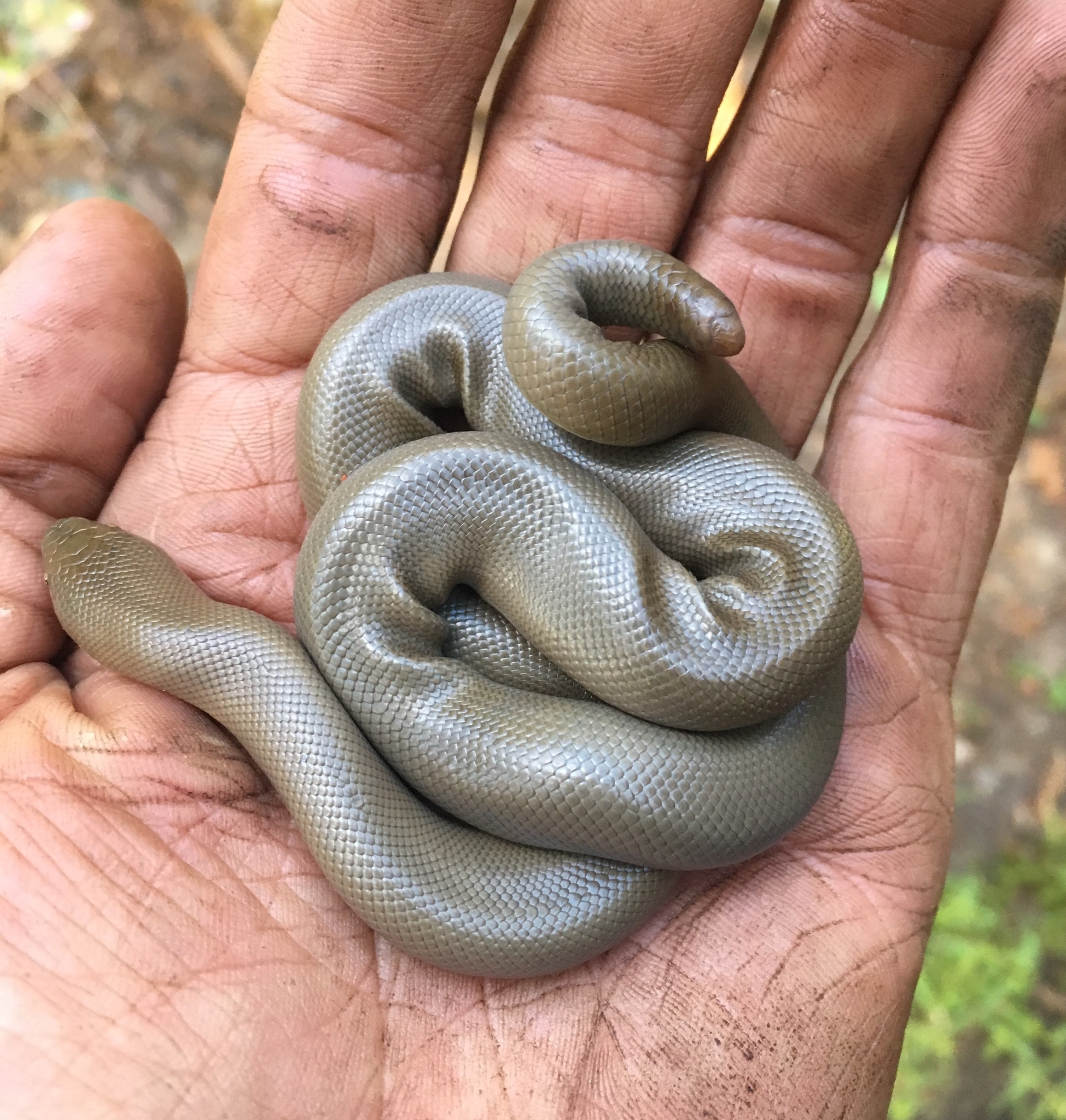
Rubber boa coiled in a palm — calm handling is common once settled; blunt tail and small size are clear in-hand. Stock photo (Wikimedia Commons — Matt Berger (iNaturalist), CC BY 4.0).
Body language and behavior
Slow movement and a blunt tail invite people to tell human stories about rubber boas. A rubber boa that sits still in a hand is usually just warm and well supported, not affectionate in the way a dog is, and one that spends the day buried is simply doing ordinary burrowing work. Anthropomorphizing, which means treating the animal as if it had human motives, moods, and social needs, is how keepers miss the information that actually matters: whether the animal is eating on its own pattern, shedding cleanly, breathing with its mouth closed, and holding a body condition that is neither starved nor overfed.
Signals that are usually ordinary
Tongue-flicking, burrowing out of sight, balling up when first lifted, and resting in a tight hide for most of the day are all ordinary behaviors. Bluish eyes and dull skin mean a shed is on the way.
What to watch for
- Open-mouth breathing, wheezing, or bubbles at the mouth or nose point to a respiratory problem.
- Restless gap-seeking combined with a hot warm end means you should check temperatures before anything else.
- Regurgitation, or repeatedly refused meals while weight drops, needs attention.
- Stuck eye caps or ragged sheds that keep recurring usually point to a humidity or hydration problem.
- Belly scales that are brown, pink, or blistered suggest scale rot.
- Neurological signs, such as an inability to right itself or corkscrewing, are not something to wait out.
If you notice any of these patterns, check your husbandry first, and then see a reptile veterinarian if the animal does not return to its own normal baseline.
Problems that show up often
Overheating is the classic husbandry failure in this species. Respiratory disease usually follows conditions that are cool and damp together, or chronic stress from heat; stuck shed follows a missing humid hide; obesity follows feeding a cool-climate snake on a tropical schedule; and escapes follow underestimating how small a gap a rubber boa needs.
An escaped pet is a husbandry problem: check the lid, then search the house, and never release the animal outside.
Bringing a new animal home
Quarantine a new rubber boa in a separate enclosure, with its own tongs and a fecal check, for about 30 to 90 days or until its appetite is steady and a fecal test comes back clear, and longer if anything seems off. Before decorating, confirm that temperatures are cool to mild and that the substrate is deep. Leave the animal alone long enough for it to eat a couple of meals before you begin regular handling. Those first weeks are also the time to learn how much of the day this individual spends buried.
Why cool rooms beat hot racks
Many snake rooms are built around ball pythons and boas that want warm hides near 90 F, and a rubber boa in such a room needs to be deliberately isolated from shared heat sources. Put the enclosure on a lower shelf away from runs of heat tape, check it with a temperature gun at several points, and accept that in a climate-controlled house this species may use almost no supplemental heat for much of the year. Keepers who “cannot get them to eat” often discover that the warm end had become tropical by accident.
Captive-bred rubber boas from responsible breeders are worth seeking out, because wild collection of a slow-reproducing western species is a poor foundation for the hobby, and Georgia lies entirely outside the native range.
Recommended gear
Some of the links below go to Amazon, and if you buy through them we may earn a small commission. This does not change the price you pay.
When you are budgeting, remember that a secure enclosure, deep bedding, a thermostat you actually trust, and a temperature gun matter far more than decorations. A cool, correct setup beats a warm, pretty one.
- New Age Pet ECOFLEX 36-inch Mojave Reptile Lounge (about 36 x 18 inches); a secure 20- to 40-gallon long with a locking lid also works
- Etekcity Lasergrip 774 for the warm surface
- ThermoPro probe thermometer and hygrometer to track air temperature and humidity
- BN-LINK on/off thermostat if you use a low-output heat mat
- Aspen snake bedding or a diggable soil mix kept from going swampy
- Snug opaque hides and a humid hide with damp sphagnum
- Zoo Med stainless steel feeding tongs, 10-inch