


Russian Tortoise
Testudo horsfieldii
Tortoise
Key numbers
These figures are a working snapshot for a typical Russian tortoise, not a guarantee for every animal. The rest of the guide is there to explain why they look this way.
- Adult size: commonly about 5 to 8 inches (13 to 20 cm) in shell length; some reach closer to 10 inches; females are often the larger of the two
- Lifespan: often 40 to 50 years or more with consistent care; treat ownership as multi-decade
- Adult enclosure: an open tortoise table about 4 feet by 2 feet is a common indoor minimum for one adult; larger is better, and outdoor pens in warm weather are preferred when secure
- Start size: a hatchling can begin in a smaller table if the temperature gradient (warm end and cool end that actually differ) and UVB are right, then move up as it uses the floor
- Housing: one tortoise per enclosure is the predictable arrangement
- Basking surface: about 90 to 95 F on the rock or substrate the tortoise actually sits on
- Cool end: about 70 to 75 F
- Night: mid-60s to low 70s is often acceptable indoors
- Humidity: ambient air often around 40 to 60 percent; a humid hide helps juveniles; the floor stays mostly dry
- Diet: high-fiber weeds, grasses, and leafy browse; almost no fruit; no animal protein
Do’s and don’ts
The short version of the husbandry below. If a line here and a paragraph later seem to pull in different directions, trust the longer explanation.
Do
- Give an adult a real footprint (about 4x2 feet or larger indoors) with a hot basking spot, a cool retreat, and deep substrate to dig
- Measure the basking surface with an infrared gun, not a sticker on the wall of the table
- Offer a long high-output fluorescent UVB tube (T5 HO) indoors on a timer, and outdoor supervised sun when weather and security allow around Cartersville
- Feed fibrous weeds and grasses (dandelion, plantain, sow thistle, mallow, grass hay) as the staple
- Keep a shallow water dish the tortoise can enter and leave, and soak juveniles on a short schedule when your baseline calls for it
- Learn that individual’s ordinary patterns (appetite, stool, how hard it digs, how smooth the new shell growth looks)
- See a veterinarian who regularly treats reptiles when appetite, stool, shell growth, or breathing leaves that baseline (local herp groups and exotic-vet directories help you find one before you need them)
- Send a picture if you find a turtle or tortoise on a property near Cartersville and want an ID. If you want it moved, we relocate within about an hour of Cartersville at no charge
Don’t
- Do not leave an adult in a 20-gallon aquarium as a finished home
- Do not house two Russians together “for company.” They do not need a friend, and males fight
- Do not run a closed, damp glass box the way you would for a tropical turtle
- Do not use hot rocks or unregulated heat pads as the main heat
- Do not feed fruit as a staple, or dog food, cat food, or other animal protein
- Do not force rapid growth with soft supermarket greens and constant rich food. Pyramiding (raised, peaked scutes on new shell growth) and soft bone follow that picture
- Do not release a pet tortoise into Georgia woods, and do not assume a wild turtle on a Cartersville property is a lost Russian
- Do not read a tortoise that sits still on a lap, or one that rams another shell, as a human mood
A bit of background
The Russian tortoise, Testudo horsfieldii, is a small steppe tortoise from Central Asia — dry grasslands and rocky country across parts of Iran, Afghanistan, Pakistan, Kazakhstan, Uzbekistan, and nearby. You will still see Agrionemys horsfieldii on older care sheets and some trade labels. Current taxonomic authorities (including ITIS and the Reptile Database, following the Turtle Taxonomy Working Group) place the species in Testudo, with Agrionemys retained as a subgenus. Husbandry does not change with the label on the invoice. What does change the setup is the animal’s fossorial habit: these tortoises dig. A thin scatter of bedding on a glass floor is the opposite of that picture.
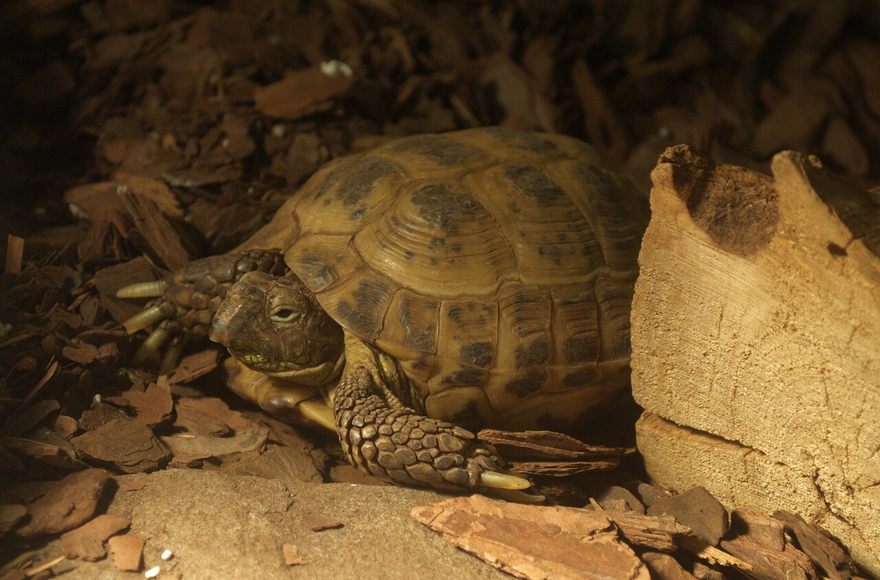
Adult Russian tortoise (Testudo horsfieldii / Horsfield's) on bark substrate — olive-tan shell with dark blotches and four-clawed forelimbs (not a sulcata or box turtle). Stock photo (Wikimedia Commons, CC BY-SA 3.0, Futureman1199).
They became popular because adults stay small compared with sulcatas and many other tortoises, and because they tolerate cooler nights and lower ambient humidity better than tropical species. That reputation can sell them as “easy.” A Russian that lives decades still needs UVB, a real basking surface, room to walk and dig, and a diet built on fiber rather than fruit. Most of the chronic trouble we see (pyramided shells, soft jaws, chronic respiratory pictures, obesity) tracks a closed damp tank, weak UVB, or a soft, rich diet held for years.
Adults commonly reach about 5 to 8 inches, sometimes more. Lifespan in captivity is often 40 to 50 years or longer. This guide is general husbandry for Testudo horsfieldii. Individual animals vary, and nothing here replaces an exam by a veterinarian who regularly sees reptiles. A box turtle or gopher tortoise on land near Cartersville is a different animal and a different legal picture; send a photo if you want an ID before you decide what you are looking at.
Whether they are a good fit
A Russian tortoise is a long-lived, dry-country digger that needs floor space, outdoor access when Georgia weather cooperates, a reliable UVB source indoors, and a keeper who will grow or buy weeds and hay instead of relying on fruit. They are a poor fit for anyone who wants a tiny tank on a desk, a “pair that will cuddle,” or a household that will keep the enclosure tropical and wet. They are also a poor fit for anyone who cannot plan decades ahead. Forty years is not a slogan on this species; it is a common outcome of decent care.
Enclosure and space
Floor space matters because an adult needs a hot end and a cool end with real distance between them, and because this species digs. A practical indoor minimum for a single adult is an open-topped tortoise table about 4 feet long by 2 feet deep. Many keepers go larger. Tall glass aquariums with poor airflow are a frequent respiratory backdrop for this species; an open table or a well-ventilated pen is the better default.
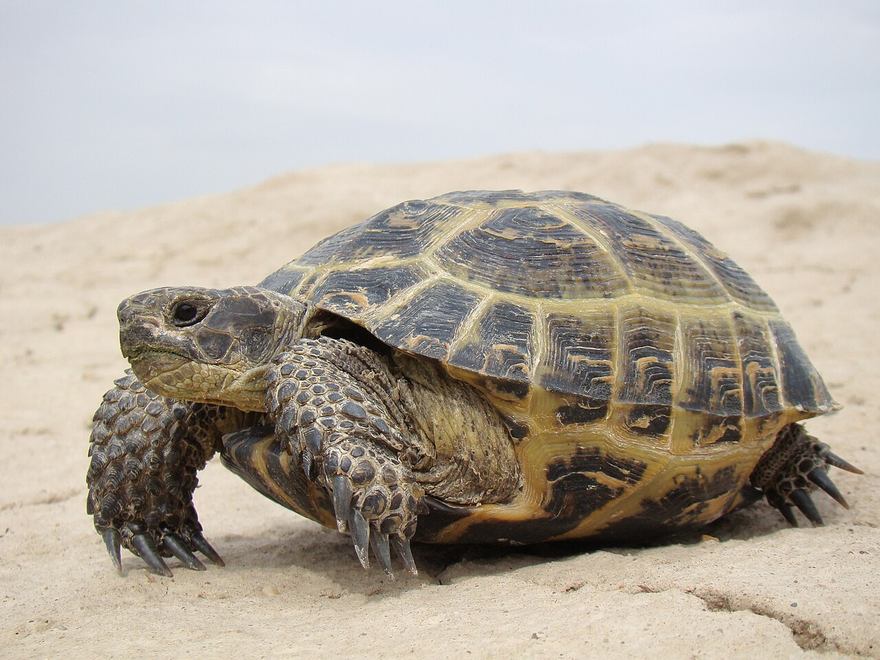
Russian tortoise outdoors on dry cracked earth (Baikonur) — small steppe species built for diggable outdoor space, not a huge spurred sulcata. Stock photo (Wikimedia Commons, CC BY-SA 3.0, Yuriy75).
Outdoors, when daytime highs are appropriate and nights are not a freeze risk, a secure pen with buried or dig-proof edges, shade, and a dry burrow or hide is closer to what the animal is built for. Around Cartersville, that usually means warm-season outdoor time with a plan to bring the animal in overnight when temperatures drop, not a tortoise left out through a cold snap. Predator-proofing (dogs, raccoons, hawks) is part of the pen, not an afterthought.
One tortoise per enclosure avoids most social problems. Males in particular will ram and bite. A hide on the warm side, a cooler retreat, a humid hide for juveniles, deep diggable substrate, and a shallow water dish do more work than a pile of plastic plants. The tortoise should be able to disappear into a burrow or hide. Walls high enough to discourage climbing belong on outdoor pens.
Temperature and the gradient
A Russian tortoise’s digestion and activity are tied to a hot basking surface and a cooler retreat. The useful measurement is the rock or substrate under the basking lamp, taken with an infrared temperature gun. Air temperature on a wall sticker can look fine while the basking surface is too cool to digest, or hot enough to burn.
A basking surface in the neighborhood of 90 to 95 F is the range that supports normal digestion for most adults. Some keepers run the surface a few degrees hotter on a large flat rock; measure what the shell actually sits on. The cool end of the same enclosure is typically around 70 to 75 F. Overnight, mid-60s to low 70s are often acceptable indoors. Heat is safest on a thermostat, whether the source is a halogen flood or another controlled lamp. Hot rocks and unregulated pads are a frequent source of burns. Colored night bulbs are unnecessary.
Light, UVB, and the daily cycle
Russian tortoises are diurnal. They need a day and a night, and indoors they need UVB. A simple 10 to 12 hours on and the rest off, on a timer, is easier on them than lights at random hours. Seasonally shortening and lengthening that photoperiod is useful if you plan brumation with veterinary guidance; it is not required for every pet keeper.
A linear T5 HO UVB tube in the desert-to-high-moderate range, mounted so the basking zone gets a measured UV Index in a working mid range (commonly targeted around 3 to 4 at the shell), is the usual indoor approach. Follow the lamp’s distance chart and replace the tube on the manufacturer’s schedule even if it still looks bright. Window glass blocks most UVB. Outdoor direct sun is excellent when the pen is secure and the animal can reach shade. A heat lamp is still heat, not UVB, if you are using one.
Humidity, water, and shell growth
These are dry-country tortoises. Ambient humidity around 40 to 60 percent is typical of a working indoor table. Juveniles often do better with a humid hide (a hide with slightly damp substrate the tortoise can enter and leave) so new growth does not dehydrate into heavy pyramiding, while the rest of the floor stays dry to the touch. Chronically wet, sealed boxes are a regular backdrop for respiratory disease in this species.
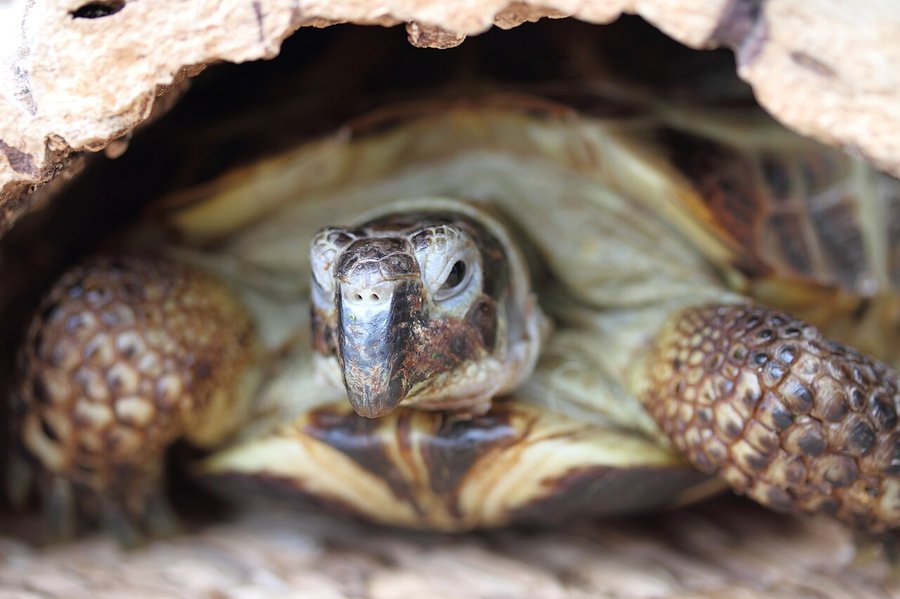
Russian tortoise using a cork-bark hide — retreats and humid hides matter for juveniles; floor stays mostly dry. Stock photo (Wikimedia Commons, CC BY-SA 4.0, Schorle).
A shallow water dish should always be available. Short soaks in lukewarm shallow water help many juveniles stay hydrated; adults usually drink and soak less dramatically but still need clean water. A healthy shell grows with relatively smooth new scutes when diet, UVB, hydration, and temperature are in range. Dramatic pyramiding is a husbandry conversation, not a morph.
Diet
In the field, Russian tortoises browse tough steppe plants. In captivity the staple is high-fiber, low-protein plant matter: dandelion, plantain (the weed), sow thistle, mallow, chicory, endive, mulberry and hibiscus leaves when unsprayed, grasses, and grass hays such as timothy or orchard. Variety across the week matters more than any single “superfood.”
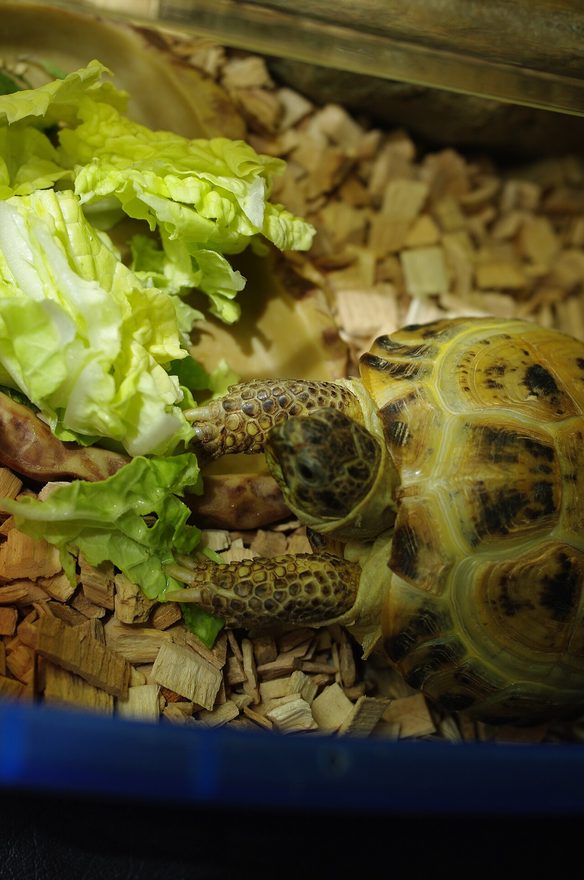
Russian tortoise feeding leafy greens in a captive setup — high-fiber weeds/grasses are the staple; fruit is not. Stock photo (Wikimedia Commons, CC0, Antanana).
Fruit is an occasional fingernail-sized treat at most, not a bowl of melon. Soft supermarket lettuce as the only food is a poor staple. Animal protein, dog or cat food, bread, and processed treats do not belong in this diet. Cuttlebone available free-choice and light calcium dusting for indoor animals (especially growing juveniles and egg-laying females) support shell and bone. Supplements do not replace UVB.
Body condition is a better teacher than a calendar. A tortoise folding fat into the leg pockets is being fed too rich or too often. A tortoise with a sharply sunken look and a soft jaw is underfed, ill, or missing heat and calcium. Outdoor grazing on known safe weeds is ideal when the pen is pesticide-free.
Substrate
A dry, diggable mix of organic topsoil with a smaller fraction of play sand (and optional clay) matches this species better than a bare wood floor. Plan on several inches of depth so the tortoise can excavate, not a thin dusting. The surface should stay mostly dry. Cypress and coconut kept damp are a better match for a different animal.
Paper works for quarantine. Cedar and aromatic pine are not bedding. Rocks and hides need support from below so a digger cannot collapse a cave on itself. Spot-clean feces when they appear.
Handling and daily life
Most Russian tortoises will walk on a hand or sit briefly once they are used to being picked up, provided they are supported under the plastron (the flat underside of the shell) and not dangled by the shell edge. Short, calm sessions are easier than daily wrestling. Handling is postponed when the animal is cold, in the middle of a meal, or showing respiratory signs.
A tortoise that withdraws into the shell is not “sulking.” It is using the armor it has. A tortoise that rams another tortoise is not playing. Give it room. Outdoor time in a secure pen does more for ordinary activity than carrying the animal around the house.
Body language and behavior
Russian tortoises are easy to misread because a still shell looks like contentment and a ram looks like personality. People put human stories on both. A tortoise that sits in a lap is often just warm and supported, not affectionate in a dog sense. A tortoise that digs for hours is doing ordinary fossorial work, not “trying to escape your love.” Anthropomorphizing (treating the animal as if it has human motives, moods, and social needs) is how keepers miss the actual information: whether this individual is using both ends of the gradient, eating fibrous food, passing normal stool, and growing shell without soft jaws.
The useful habit is to learn the patterns of the animal in front of you. How much of the day it spends under cover. Whether it usually basks after the lights come on. How it reacts to the water dish versus a hand. Once that baseline is familiar, a change is the thing that matters.
Signals that are usually ordinary
Walking the fence line of an outdoor pen is ordinary exploration. Digging until only the shell shows is ordinary. Stretching the neck toward a basking lamp is thermoregulation. A closed mouth at rest is normal. Mild head bobbing or circling another tortoise is often a social or territorial display, not a greeting.
What to watch for
- Open-mouth breathing, wheezing, or bubbles at the mouth or nose. That is a respiratory picture.
- Soft jaw, soft shell, or tremors. Those are metabolic bone disease signs (soft, poorly mineralized bone from insufficient UVB and/or calcium) until proven otherwise.
- Rapid, peaked pyramiding on new growth, especially with a soft diet and weak UVB.
- Swollen eyes, thick discharge, or a tortoise that will not open the eyes.
- Weight loss, repeated refusal of favorite weeds, or abnormal stool.
- A tortoise that cannot right itself, or that circles without stopping, is not something to wait out.
Any of those patterns is a reason to check the husbandry first, then to see a reptile veterinarian if the animal does not return to its own baseline.
Problems that show up often
Respiratory disease tracks cold, damp, poorly ventilated boxes. Metabolic bone disease and soft shell track missing UVB, missing calcium, and chronic low heat. Pyramiding tracks fast growth on soft food and inconsistent hydration in juveniles. Obesity is common in animals fed fruit and rich greens after they have finished growing. Escape from outdoor pens tracks shallow fence lines and underestimating how hard a Russian digs.
A pet that escapes is a husbandry problem: check the pen, then the yard, and do not dump the animal outside. A turtle someone finds on a property near Cartersville is often a native species, not a loose Russian. Send a picture before you decide it is a pet.
Bringing a new animal home
A quarantine period in its own enclosure, with its own dishes and a fecal check, is a kinder start than dropping a new tortoise into a shared outdoor pen on day one. A common working window is about 30 to 90 days, or until appetite is steady and a fecal comes back clear — longer if anything looks off. Confirm that the basking surface, cool end, and UVB are in range before decorating. Leave the animal alone long enough to eat and settle before regular handling. Those first weeks are also the time to start learning this animal’s ordinary behavior, including how aggressively it digs.
Recommended gear
Some of these links go to Amazon. If you buy through them, we may earn a small commission. It does not change the price you pay.
Floor space, UVB, a thermostat, and a temperature gun matter more than decoration. A large outdoor pen in season beats a prettier indoor box that is too small.
- A large tortoise table or open pen materials for a typical adult indoor footprint
- Etekcity Lasergrip 774 for the basking surface the tortoise sits on
- ThermoPro probe thermometer and hygrometer
- A dimming thermostat for a basking bulb
- A desert-strength T5 HO UVB kit sized to the table; follow the distance chart
- Organic topsoil for tortoise substrate mixed with a smaller fraction of play sand
- Shallow ceramic water dish
- Timothy or orchard grass hay and a cuttlebone in the enclosure