


Geyr's Uromastyx
Uromastyx geyri
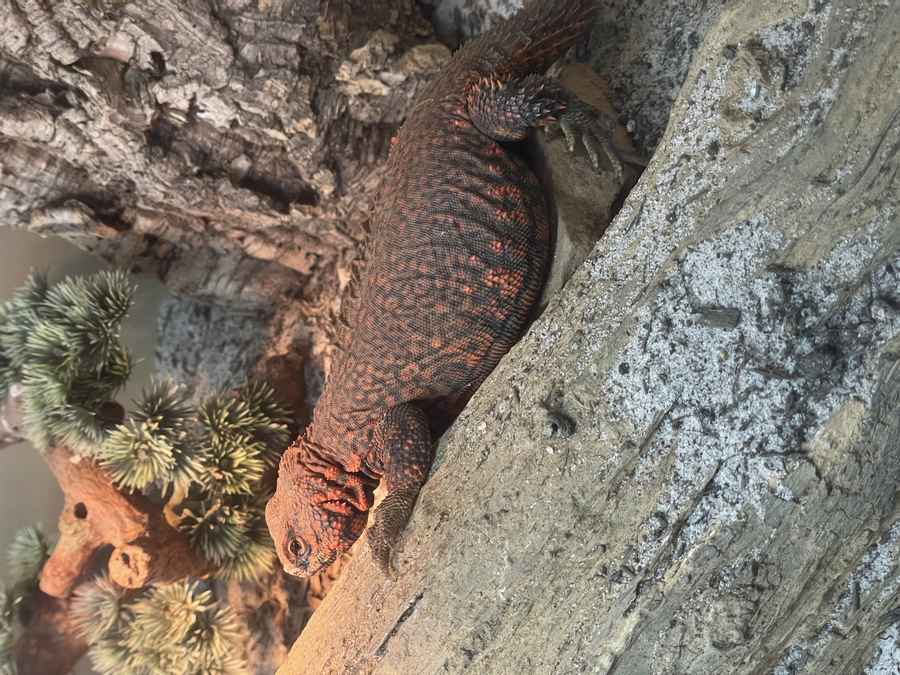
Lizard
Key numbers
These figures are a working snapshot for a typical Geyr’s uromastyx (Uromastyx geyri), not a guarantee for every animal. The rest of the guide is there to explain why they look this way.
- Adult size: commonly 11 to 16 inches including the tail; this is a smaller uromastyx than an Egyptian
- Lifespan: often 15 to 20 years with consistent care, sometimes longer
- Adult enclosure: about 4 feet long by 2 feet deep by 2 feet tall (a 4x2x2) is a practical minimum for one adult
- Start size: a small juvenile can begin in a 40-gallon / about 36 by 18 inches if heat and UVB are already correct; plan on the 4x2x2 as they approach adult size
- Housing: one lizard per enclosure
- Basking surface: about 120 to 130 F, measured on the rock the animal sits on
- Cool side: about 80 to 85 F. That is still warm compared with a gecko
- Overnight: mid-70s is usually acceptable; extra night heat is for a genuinely cold room, not for the lights going off
- UVB: a T5 high-output linear tube in the desert class — roughly 10 to 14 percent / a 10.0 HO tube (or equivalent) — over the basking end, replaced on the manufacturer’s schedule
- Humidity: around 20 to 30 percent ambient. Standing water and a damp enclosure are a common way to make them sick
- Diet: weeds, greens, flowers, and a small amount of seed; insects are a juvenile extra, not the adult staple
Do’s and don’ts
The short version of the husbandry below. If a line here and a paragraph later seem to pull in different directions, trust the longer explanation.
Do
- Give an adult an enclosure about 4 feet long by 2 feet deep by 2 feet tall (a 4x2x2), or larger, with a warm end and a cool end that actually differ
- Measure the temperature of the basking surface the lizard sits on, not a stick-on thermometer on the glass
- Use a long high-output fluorescent UVB tube (T5 HO) in the desert class (about 10 to 14 percent / 10.0 HO) and replace it before it looks burned out
- Keep one Geyr’s uromastyx in the enclosure
- Feed a dry-country plant diet: greens, weeds, flowers, and a modest amount of seed. Dust with calcium, especially while the animal is growing
- Keep the enclosure arid. Moisture should come from the food, not from a tropical mist schedule
- Learn that individual’s ordinary patterns (appetite, stool, color, how long it basks, how it uses the cool end) so a change is visible
- See a veterinarian who regularly treats reptiles when appetite, stool, breathing, or body condition leaves that baseline (local herp groups and exotic-vet directories help you find one before you need them)
Don’t
- Do not leave an adult in a 40-gallon starter kit
- Do not house two uromastyx together because they “get along.” They are not a species that needs a friend
- Do not treat this animal like a bearded dragon that wants 30 to 40 percent humidity and a daily bowl of misted greens
- Do not keep a large standing water bowl in a humid Georgia room. Standing water plus high humidity is a common way these lizards get sick
- Do not use a compact coil UVB or a sunny windowsill as a substitute for a proper T5 HO tube
- Do not use hot rocks or under-tank heat as the main way to warm the animal
- Do not feed an adult as if it were an insectivore. Insects are a small, mostly juvenile item
- Do not confuse this species with Uromastyx aegyptia (Egyptian) or Uromastyx ornata (ornate). Those are different animals with different space and, in the Egyptian’s case, a much larger adult size
- Do not read flattening, a color shift, or the tail being raised as a human mood
- Do not add another powder and wait when the animal is straining, bubbling at the nose, or losing weight
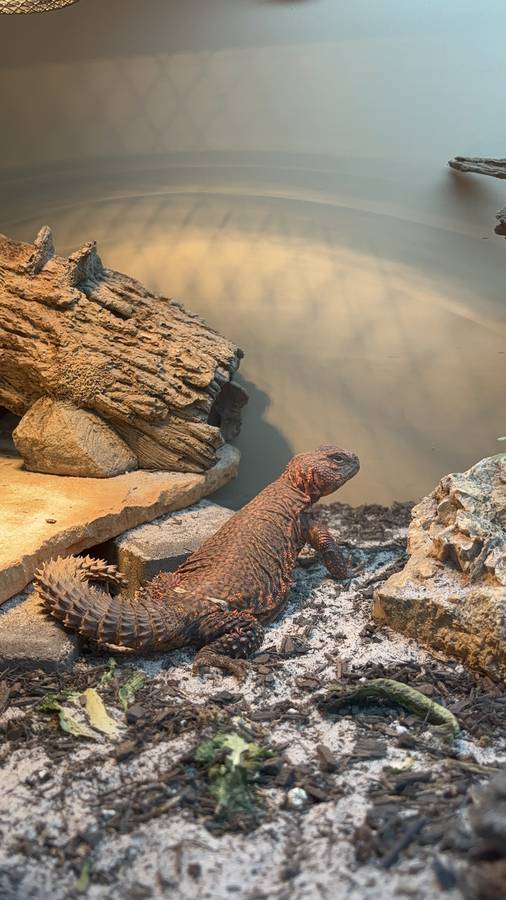 Geyr's uromastyx with full spiny club/whorl tail — classic geyri ID marker.
A bit of background
Geyr’s uromastyx, Uromastyx geyri, is a medium-small spiny-tailed agama from the rocky Sahara of Algeria, Mali, and Niger. In the field they spend the day moving between sun-blasted rock and shade, eating desert plants and seed. That daily pattern of a very hot basking surface and a still-warm retreat is the thing most captive setups are trying to recreate. They are sometimes sold as Saharan, red, or yellow uromastyx. The scientific name is the useful one. This is not Uromastyx aegyptia, the large Egyptian uromastyx, and it is not Uromastyx ornata, the ornate uromastyx from the Red Sea region. Those species are sometimes lumped as “uros” on a care card. They do not share a care card.
They became popular because the colors can be vivid and because they stay smaller than an Egyptian. Those traits can make them look like a colorful bearded dragon. They are not. A beardie is an omnivore that drinks and that tolerates a little more ambient humidity. A Geyr’s uromastyx is a high-heat herbivore from one of the drier corners of the herp hobby. Most of the chronic trouble we see (soft bone, respiratory disease, swollen joints, a lizard that never really starts) comes from a basking surface in the 90s, a weak UVB, a wet floor, or a diet that stayed on insects.
Adults commonly reach 11 to 16 inches including the tail and can live 15 to 20 years. This guide is general husbandry for Uromastyx geyri. Other Uromastyx have their own space and humidity needs. Individual animals also vary, and nothing here replaces an exam by a veterinarian who regularly sees reptiles.
Whether they are a good fit
A Geyr’s uromastyx is a long-lived, heat- and light-dependent herbivore that needs a large footprint, a basking surface in the 120s, and a T5 HO desert-class UVB on a replacement schedule. They do best in a household that can keep that kind of heat safely, keep the enclosure dry through a Georgia summer, and shop for weeds and seed instead of crickets. They are a poor fit for a small bedroom that cannot get warm enough, for anyone hoping the animal will live in a 40-gallon tank as an adult, or for a keeper who wants a beardie-like pet that eats bugs and sits in a water bowl.
Enclosure and space
Because they are ground-basking lizards that also climb rock, floor space matters more than height. A practical minimum for a single adult is about 4 feet long, 2 feet deep, and 2 feet tall. That size gives enough room for a 120 F surface and an 80 to 85 F cool end that actually differ. A small juvenile can start in a 40-gallon / about 36 by 18 inches if the basking surface and the UVB are already correct. Plan on the 4x2x2 as they approach adult size, often within the first year to 18 months, not as a forever tank. Those kits are short-term housing.
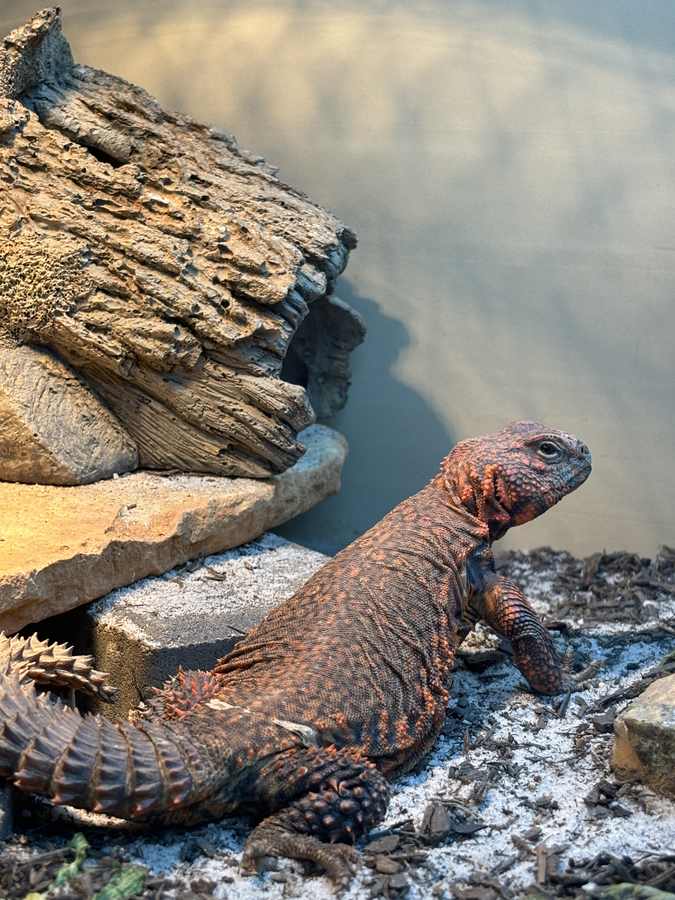 Geyr's uromastyx near cork hide; club/whorl tail clearly visible.
One lizard per enclosure is the arrangement that avoids most social problems. Geyr’s uromastyx are not a species that needs a companion. Two animals in one gradient usually means one claims the basking rock. Injuries and chronic stress are common when they are housed together, even when they appear to “get along” at first.
A screen top helps with ventilation and with mounting lights. The basking furniture (a wide, stable rock or slate) works best when the animal can get its entire body into the hot, bright zone, not just the head. Rocks must be supported so they cannot collapse. A hide or a rock cave on the cool side gives them a place to drop temperature without leaving the enclosure. A pile of clutter that blocks the UVB and heat from reaching the animal is less useful than it looks.
Temperature and the gradient
A Geyr’s uromastyx’s digestion, immune function, and activity are tied to a much hotter surface than most pet lizards use. The useful measurement is the surface they sit on while basking, taken with an infrared temperature gun, not a stick-on thermometer on the glass. Glass and air temperatures can look “warm enough” while the rock is 95 F, which is a basking temperature for a beardie and a cool rock for this species.
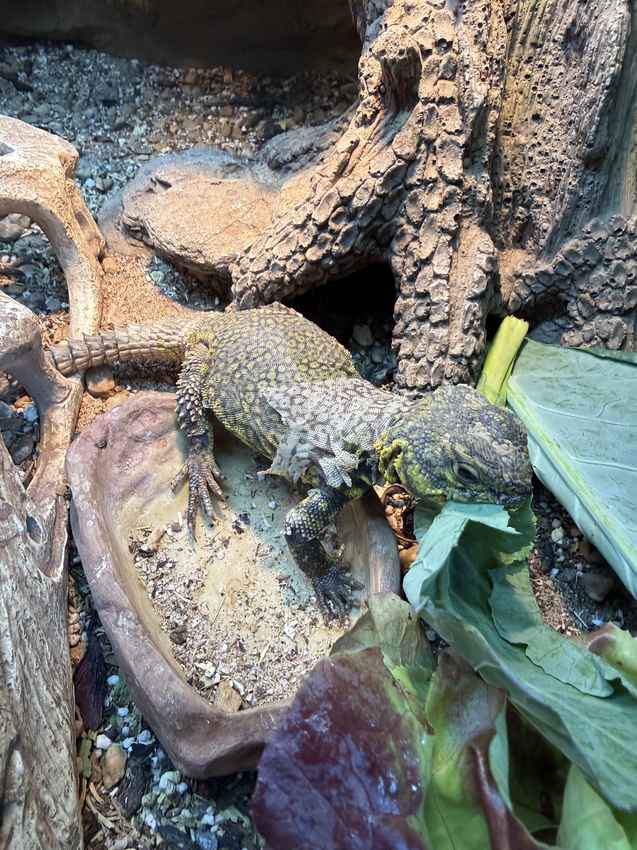 Geyr's uromastyx shedding while feeding; spiny tail and herbivore diet shown.
For most adults, a basking surface in the neighborhood of 120 to 130 F is the range that supports normal behavior and digestion. The cool side of the same enclosure is typically around 80 to 85 F. That cool side is still warm compared with a crested gecko’s whole life. If the whole box sits at one temperature, they have nowhere to go. If the cool side is a gecko-cool 72 F, a Saharan agama has a cold corner, not a retreat.
Overnight, many rooms drop into the mid-70s, which is usually acceptable. Extra night heat is for a genuinely cold room. Colored night bulbs are unnecessary.
A halogen flood on a dimming thermostat, large enough to heat a rock the lizard can lie on fully, is the usual tool. Under-tank heat and hot rocks are a frequent source of ventral burns. Overhead heat plus a surface that behaves like sun-warmed rock is closer to how they warm up in the wild.
Light, UVB, and the daily cycle
Geyr’s uromastyx are diurnal desert lizards. They synthesize vitamin D3 in the skin when they receive ultraviolet B light, and they use that D3 to move calcium into bone. A heat lamp produces warmth and visible light. It does not replace UVB. Ordinary window glass blocks most UVB, so a tank on a sunny windowsill is still a tank without UVB.
The setup that has become standard is a T5 high-output linear UVB tube in the desert class — roughly 10 to 14 percent, or an equivalent 10.0 HO tube — long enough to cover about half to two-thirds of the enclosure, placed over the basking end. Distance matters as much as the lamp name. Follow the manufacturer’s distance chart for that specific lamp. Compact coil UVB bulbs have a much smaller useful field and are a common reason animals look “fine” under a light and still develop metabolic bone disease.
Tubes age. Output drops before the lamp looks burned out. Most keepers replace them on the manufacturer’s schedule, commonly every 6 to 12 months. A simple 12 hours on and 12 hours off matches a lot of indoor keeping. Sudden, irregular lighting is harder on them than a boring timer.
Humidity, water, and shedding
These are Saharan lizards. Ambient humidity around 20 to 30 percent is typical of a working setup. Chronically damp substrate, standing fog, and a 30 to 40 percent “beardie” humidity target are a regular backdrop for respiratory and skin problems here. Misting the enclosure is not part of ordinary care.
They get most of their water from food. Lightly damp greens are not the same thing as a soaked salad, and they are not a daily mist over the whole cage. A large standing water bowl in a humid Georgia room is a common way to push the enclosure out of the range this species tolerates. Some keepers offer a very small, shallow dish on the cool end and watch the hygrometer. If the dish raises ambient humidity, the dish goes away. A thin, wrinkly, or newly imported animal is a different problem and belongs with a veterinarian, not under a fogger.
A healthy shed comes off in pieces over a few days. Rough rock helps them rub. Patchy, stuck shed that repeats is often a hydration or overall-health problem rather than a reason to run the enclosure wet. Soaking does not correct a basking surface that is 40 degrees too cool.
Diet
Adult Geyr’s uromastyx are mostly herbivorous. The working picture is greens, weeds, and flowers as the daily staple, with a small amount of seed (millet, lentils, and similar dry seed) as a regular but limited part of the diet. Seeds carry fat and protein this species uses. Seeds in unlimited bowls are how some animals become overweight. Phil Lietz and other arid-country keepers treat seed as a modest fraction, not a hopper of bird seed left all week.
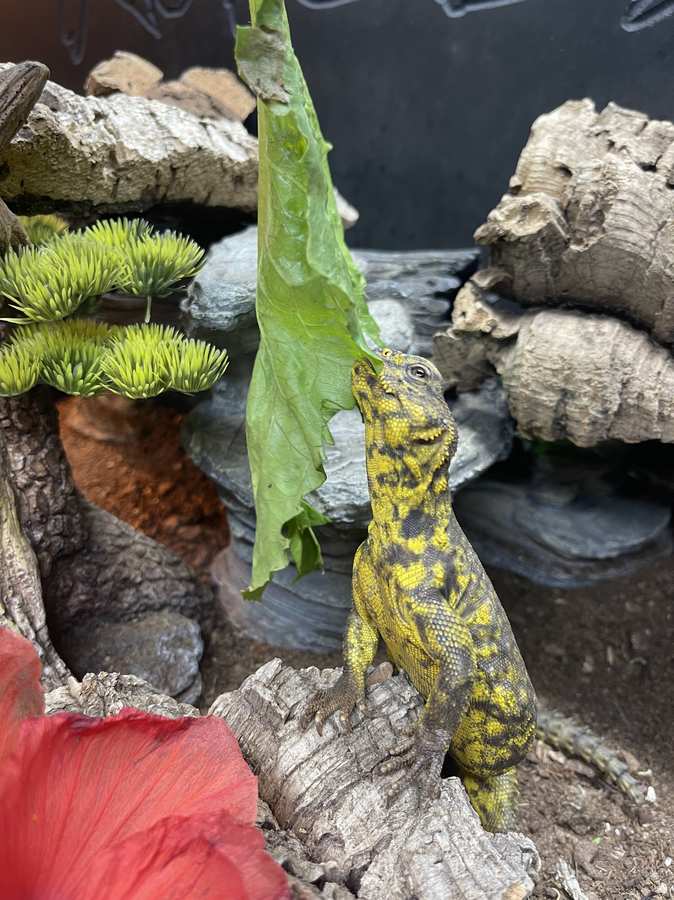 Geyr's uromastyx eating leafy greens; yellow/black morph in cork-and-rock setup.
Collard, mustard greens, dandelion, escarole, endive, hibiscus leaves and flowers, and unsprayed weeds from a clean yard are the kinds of staples that show up in working diets. Iceberg is mostly water. Spinach can appear in a rotation; it is a poor only green because of oxalates (compounds that bind calcium). Fruit is a sweet, occasional item, not a meal. A bearded-dragon schedule of wet chopped salad twice a day is the wrong picture. Offer food on a slate or a shallow bowl so they are not swallowing substrate, and let the greens be fresh, not swimming.
Insects are a small, mostly juvenile item. Hatchlings and young animals may take a few gut-loaded, calcium-dusted insects. Adults that stay on a cricket-heavy diet are being fed like a different lizard, and long-term that is a kidney and gout conversation as much as it is an obesity conversation. Do not gut-load an adult’s whole life with dubia because the lizard will eat them.
Calcium dust on plant food is routine, especially for growing animals. If the UVB is a current T5 HO 10.0-class tube, many keepers use a calcium without D3 for most dustings and a reptile multivitamin once or twice a week. Stacking D3 from high-dose powders on top of strong UVB is how some animals end up with too much vitamin D rather than too little.
Substrate
For a typical household, especially with a juvenile that lunges at food, a solid surface (tile, slate, or a fitted liner) removes the most common path to impaction. Paper works for quarantine.
A dry, arid-mix naturalistic floor can look better and give them something to dig in, and some experienced keepers use it successfully. It asks more of the keeper: the mix has to stay dry, feces have to be removed promptly, and feeding is safer on a plate. It is a reasonable later project, not the default first setup. Calcium sand and damp coconut are the wrong products.
Handling and daily life
Most Geyr’s uromastyx will sit on a hand once they are used to being picked up, provided they are supported along the body and not lifted by the spiny tail. The tail is a fat store and a defensive tool. Short, calm sessions are easier on them than long wandering tours of the house, where they cool off quickly once they leave that 120 F rock.
They are diurnal. The useful handling window is after they have basked, not first thing as they come off a cool night. A lizard that is still dark and flat on the rock is still in the middle of warming up.
Body language and behavior
Uromastyx do a lot with flattening, color, and the tail, and people put human stories on all three. A lizard that flattens on the basking rock is spreading out to take heat, not “pancaking because it is happy.” A lizard that goes darker or lighter through the day is thermoregulating. A tail lifted or swung is often a defensive warning, not a wag. Anthropomorphizing is how keepers miss whether this individual is using the gradient, eating plants, shedding, and behaving like itself.
The useful habit is to learn the patterns of the animal in front of you. How long it usually basks after lights-on. Whether it usually retreats to the cool rock at midday. What its stool looks like (dry, well-formed urates are the ordinary picture). Once that baseline is familiar, a change is the thing that matters.
Signals that are usually ordinary
Flattening (“pancaking”) on the hot rock is usually a way to take in more heat. A slightly open mouth while sitting under the lamp can be the same project: dumping heat after the animal has warmed through. That is different from open-mouth breathing on the cool end, which belongs in the next list.
Color shifts lighter and darker through the day as the animal warms, cools, sheds, or settles. A pale animal under the lamp and a darker one first thing in the morning can both be normal for that individual. Slow movement and a focused stare often mean it has locked onto food. Digging happens in animals that are exploring or looking for a temperature they want. Head bobbing, when it appears, is display, not a greeting.
What to watch for
- Open-mouth breathing away from the basking rock, bubbles or discharge at the nose, or sitting with the head up as if it is working for air. That is a respiratory picture, and humidity is the first thing to check.
- A soft or rubbery jaw, tremors, a body that sags between the limbs, or fractures from ordinary movement. Those are metabolic bone disease signs.
- Swollen joints, lethargy, and a history of insect-heavy feeding can be a gout or kidney picture.
- Weight loss, sunken eyes, or a lizard that has stopped basking are reasons for an exam, not a larger water bowl.
- Stuck shed that repeats on the toes or tail tip can constrict those digits. It is usually a hydration or overall-health problem rather than a reason to mist the cage.
- Glass surfing that does not settle often means the enclosure is too small, the gradient is wrong, or the animal can see another lizard or its own reflection. It is not the animal asking to “play.”
- Closing the eyes and going still when handled is often an attempt to wait the handling out. If that is new, and the animal is also off feed and off the basking rock, check the enclosure.
Any of those patterns is a reason to check the husbandry first (surface temperature, UVB age and distance, humidity, whether the animal can actually use both ends) and then to see a reptile veterinarian if the animal does not return to its own baseline.
Problems that show up often
Metabolic bone disease is still the classic captive problem when the UVB is a coil, a dead tube, or missing, or when the basking surface never reaches the 120s. Soft jaw and a body that sags between the limbs develop over weeks and months.
Respiratory disease tracks humidity and cool, damp air more than it tracks a sudden infection out of nowhere. Gout and kidney trouble track long-term protein (too many insects, too much animal food) in a species that is built as a plant-and-seed eater. Impaction often looks like straining, a closed vent, lethargy, and a loss of appetite, especially in a cool animal on loose sand.
Any of those patterns is a reason to see a reptile veterinarian. Adding another powder to the greens does not replace an exam.
Bringing a new animal home
A quarantine period in its own enclosure, with its own dishes and a fecal check, is a kinder start than introducing a new uro to an existing collection or to a fancy display vivarium on day one. A common working window is about 30 to 90 days, or until appetite is steady and a fecal comes back clear — longer if anything looks off. Confirm that the basking surface actually hits the 120s, that the UVB distance is in range, and that the enclosure is dry before decorating. Do not “help” a new arrival with a large water bowl and a mist. Those first weeks are also the time to start learning this animal’s ordinary behavior, including how long this individual basks and what a normal stool looks like.
Recommended gear
Some of these links go to Amazon. If you buy through them, we may earn a small commission. It does not change the price you pay.
A 4x2x2, a linear T5 HO 10.0-class UVB, a way to measure the basking surface, a dimming thermostat, and calcium without D3 do more work than a kit sold as complete. A water bowl is not on this list on purpose.
- Zen Habitats 4x2x2 3.0 for a single adult
- Zoo Med ReptiSun T5 HO Terrarium Hood with 10.0 bulb, 24 inch over the basking half. Replace the tube on the manufacturer’s schedule
- Etekcity Lasergrip 774 to measure the basking surface, not the glass
- ThermoPro probe thermometer and hygrometer
- A dimming thermostat if the heat is a halogen flood. A simple on/off stat is for mats, not bulbs
- Rep-Cal calcium without D3 for most dustings when the UVB is a current T5
- Zoo Med ReptiVite without D3 once or twice a week