


Veiled Chameleon
Chamaeleo calyptratus
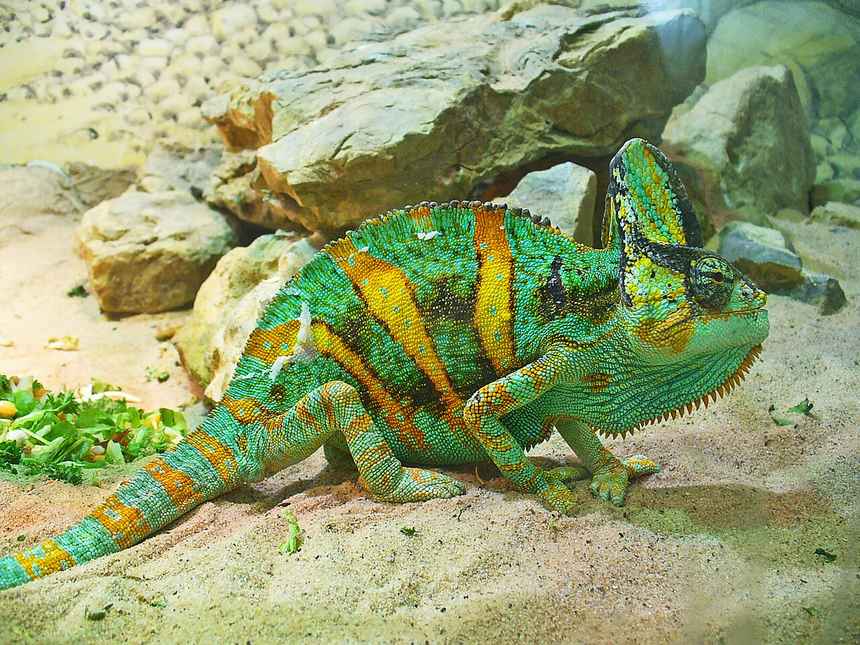
Lizard
Key numbers
These figures are a working snapshot for a typical veiled chameleon, not a guarantee for every animal. The rest of the guide is there to explain why they look this way.
- Adult size: males commonly about 17 to 24 inches including the tail, with a tall casque; females usually smaller
- Lifespan: often about 5 to 8 years for males and sometimes longer for females with consistent care; plan in years, not months
- Adult enclosure: about 24 inches long by 24 inches deep by 48 inches tall is a practical minimum for one adult; larger is better for big males
- Start size: a juvenile can begin in a smaller tall cage if ventilation, UVB, and hydration are right; move up before the animal is crowded
- Housing: one chameleon per enclosure
- Basking surface: about 85 to 95 F on the perch the chameleon actually sits on
- Cool area: about 70 to 75 F lower in the enclosure
- Night: mid-60s to low 70s is often acceptable
- Humidity: roughly 40 to 50 percent ambient by day, rising high at night after misting or fogging
- Diet: gut-loaded insects of appropriate size, with limited plant matter; calcium and UVB are not optional
Do’s and don’ts
The short version of the husbandry below. If a line here and a paragraph later seem to pull in different directions, trust the longer explanation.
Do
- Give an adult a tall, well-ventilated enclosure about 24x24x48 or larger, with live or artificial cover and overlapping branches
- Use a long high-output fluorescent UVB tube (T5 HO) and a separate basking bulb, both on a timer, and measure the basking perch with an infrared gun
- Mist on a schedule that creates a wet night and a drier day, and offer dripping water; veileds often ignore still bowls
- Keep one chameleon in the enclosure
- Feed insects a decent diet before offering them (gut-load) and dust them on a calcium schedule matched to your UVB setup
- Learn that individual’s ordinary colors and perch choices so a dark, glued-to-the-glass animal reads as a problem, not a personality
- See a veterinarian who regularly treats reptiles when appetite, eye health, tongue function, or stool leaves that baseline (local herp groups and exotic-vet directories help you find one before you need them)
- Send a picture if you find an unfamiliar lizard on a property near Cartersville and want an ID. If you want it moved, we relocate within about an hour of Cartersville at no charge
Don’t
- Do not house two veileds together
- Do not keep adults in a stagnant glass cube with weak ventilation
- Do not treat a compact coil UVB or a windowsill as enough light
- Do not handle daily for fun. These are display animals that stress under frequent interaction
- Do not use hot rocks or leave the cage in a sunny closed room
- Do not rely on a water bowl alone for drinking
- Do not read color change as the animal “matching the curtains.” Color tracks mood, health, and temperature
- Do not release a pet chameleon into Georgia woods
A bit of background
The veiled chameleon, Chamaeleo calyptratus, is a large diurnal chameleon from the Arabian Peninsula, mainly Yemen and southwestern Saudi Arabia. The tall casque on the head is a species trademark. Color change is real, but it is not a costume change for furniture. It tracks social signaling, stress, temperature, and health. In captivity they are popular because they look dramatic and because captive-bred animals are widely available. They are also widely kept badly: still air, missing UVB, dry nights, and daily handling are a common path to a thin, shut-down animal.
Adults reach the sizes above. Lifespan is shorter than many pet lizards, especially for males, which is another reason not to treat them as a casual starter. This guide is general husbandry for Chamaeleo calyptratus. Individual animals vary, and nothing here replaces an exam by a veterinarian who regularly sees reptiles. They are not Georgia natives.
Whether they are a good fit
A veiled chameleon is a solitary, height-dependent insectivore that needs correct light, a hydration cycle, and a keeper who will watch rather than constantly handle. They are a poor fit for anyone who wants a cuddly lizard, a pair in one cage, or a setup that can be ignored for a week. They are also a poor fit for rooms that overheat in summer with no ventilation plan.
Enclosure and space
Height and airflow matter. A practical minimum for a single adult is about 24x24x48 inches, preferably with substantial screen or other high ventilation, and with enough solid sides or cover that the animal can feel screened from constant traffic. Larger is better for big males. Branches should overlap so the chameleon can walk a circuit at different heights, including a basking perch at the correct distance under the lamps and cooler, shaded perches lower down.

One chameleon per enclosure is mandatory. Males fight. Females stress. “They got along as babies” is not a husbandry plan.
Live plants help humidity and cover when they are non-toxic and pesticide-free. Fake plants work if cover is dense. Empty screen boxes create chronic stress even when temperatures look fine on paper.
Temperature and the gradient
Measure the basking perch surface with an infrared gun. A basking zone around 85 to 95 F is the usual adult target, with cooler areas in the 70 to 75 F neighborhood lower in the cage. Night drops into the mid-60s to low 70s are often acceptable. Heat should be thermostatically controlled. Hot rocks have no place here. A cage left in a closed car or a hot window bay is an emergency.
Light, UVB, and the daily cycle
Veileds are diurnal high-light animals. They need bright visible light and UVB for about 12 hours a day, then real darkness. A linear T5 HO forest-strength UVB tube (commonly a 5.0 or 6 percent class tube in a reflective fixture) should be mounted so the basking chameleon’s back receives a moderate UV Index (keepers who measure often target around 3). Follow distance charts through screen mesh, and replace bulbs on schedule. Add a separate daylight LED or fluorescent for brightness; UVB alone is not enough white light. A heat bulb is heat, not UVB.
Humidity, water, and shedding
The working picture is a drier day and a wetter night. Ambient humidity around 40 to 50 percent by day, with misting and/or fogging that drives night humidity much higher, matches how many successful keepers run veileds. Stagnant, constantly wet air with no airflow is a respiratory backdrop. Bone-dry air with no night recovery is a dehydration and shed backdrop.

Veiled chameleons often will not drink from a bowl. A dripper, misted leaves, and automated misting systems are the practical drinking methods. Watch for drinking behavior after misting. Healthy sheds should not leave sheaths on toes or the casque edges.
Diet
The staple is varied, gut-loaded insects sized appropriately: gut-loaded crickets, dubia nymphs, hornworms as hydration treats, silkworms, and similar. Some plant matter (hibiscus, other safe greens) is accepted by many veileds and can be offered. Feeder insects should be gut-loaded and dusted — plain calcium without D3 when UVB is correct, with careful D3 use if UVB is absent, plus a multivitamin on a light schedule.

Juveniles eat more often than adults. Body condition shows in the casque fat pads and overall frame. A gaunt chameleon with sunken eyes is a priority case. An obese animal is less common than a thin one in this species but still possible with constant rich feeders.
Substrate
Many keepers use bare floors, paper, or a simple drainage layer under plants because chameleons spend their time in the branches. Loose substrate is optional and should not create a moldy swamp under a wet misting cycle. Whatever is on the floor must be cleanable. Cedar is not bedding.
Handling and daily life
Minimize handling. These animals display best when left to perch, hunt, and watch. When you must move them, let them walk onto a hand or perch rather than grabbing. Frequent handling is a stressor, not enrichment. Children who want a pet they can carry should look at a different species.
Body language and behavior
Color is information, not fashion. Dark, dull coloration with stress postures (mouth gaping without basking purpose, pressed to glass, flattened) is a warning. Bright, relaxed daytime colors on a preferred perch with hunting interest are a better picture. Anthropomorphizing color change as “he’s matching my shirt” is how keepers ignore illness.
Signals that are usually ordinary
Slow cascading walks, independent eye movement, hunting strikes with the tongue, light color shifts through the day, and sleeping on a chosen perch at night are ordinary.
What to watch for
- Sunken eyes, sticky mucus, or a shut-down dark animal that will not hunt.
- Tongue that will not fire or stick properly.
- Open-mouth breathing at rest, wheezing, or bubbles.
- Swollen joints, tremors, or a soft jaw. Metabolic bone disease (soft, poorly mineralized bone from insufficient UVB and/or calcium) until proven otherwise.
- Retained shed on toes or casque.
- Egg-binding signs in females (straining, weakness, anorexia). Females can produce eggs without a male; that is a veterinary emergency picture when they cannot pass them.
Any of those patterns is a reason to check the husbandry first, then to see a reptile veterinarian promptly if the animal does not return to baseline.
Problems that show up often
Metabolic bone disease from missing or expired UVB. Chronic dehydration from bowl-only water and dry nights. Respiratory disease from stagnant wet cages. Stress wasting from cohabitation or constant handling. Mouth and eye problems in dirty, fly-filled feed cups left in the enclosure.
Bringing a new animal home
Quarantine alone for about 30 to 90 days with a fecal check. Confirm UVB distance, basking temperature, misting cycle, and drinking before adding a planted showpiece cage. Minimize handling while the animal learns the new perches. Those first weeks are also the time to learn this individual’s ordinary daytime colors.
Females, eggs, and lifespan
Female veileds can produce eggs without a male in the enclosure. That is not a reason to keep a male “for company.” It is a reason to watch body condition and to have a reptile veterinarian in mind before a female becomes egg-bound. Breeding is a specialist project with incubation, hatchling insect supply, and placement plans — not a casual add-on.
Males often live shorter lives than females even with good care. Buying a veiled as a child’s long-term companion without an adult ready to run misting, UVB replacements, and vet bills is how animals end up neglected when the novelty fades.
Enclosure ventilation versus humidity
The classic failure mode is a sealed glass aquarium that holds humidity but stagnates. The opposite failure mode is an empty screen cage in air conditioning that never recovers moisture at night. Successful setups usually combine high airflow with scheduled misting and night fogging, dense cover so the chameleon can choose microclimates, and surfaces that dry between cycles. Live plants help, but they do not replace measuring humidity and watching whether the animal drinks after misting.
Recommended gear
Some of these links go to Amazon. If you buy through them, we may earn a small commission. It does not change the price you pay.
A tall ventilated cage, linear UVB, a dripper or mister, and a temperature gun matter more than decoration.
- A 24x24x48 chameleon enclosure
- Zoo Med ReptiSun T5 HO 5.0 hood or another forest-strength T5 HO kit sized to the cage; follow the distance chart
- Etekcity Lasergrip 774
- ThermoPro probe thermometer and hygrometer
- A dimming thermostat for the basking bulb
- An automatic mister or a quality hand sprayer plus a dripper
- Rep-Cal calcium without D3 when UVB is in place