Copperhead
Agkistrodon contortrix
copperhead
Snapshot
The copperhead is Georgia’s most commonly encountered venomous snake — a medium, thick-bodied pit viper whose tan-to-brown body carries distinctive hourglass or “Hershey’s Kiss” crossbands. Georgia Department of Natural Resources (DNR) materials describe it across most of the state except the southeastern corner, in forested and rocky habitats, and note that it can persist even in suburban neighborhoods where forest patches remain. It is venomous. Identify from a safe distance and leave it alone.
Photos
Description and identification
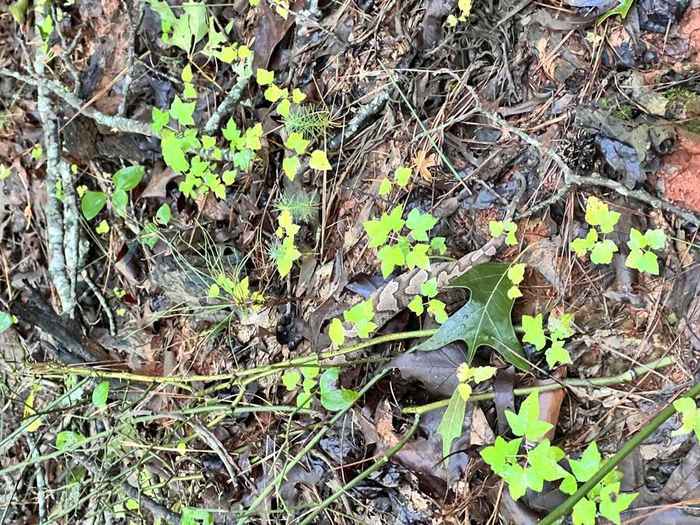
According to Georgia DNR’s copperhead fact sheet and the Venomous Snakes of Georgia brochure, copperheads are medium-sized, thick snakes with keeled scales. Background color is usually light brown or gray, though individuals may be rusty orange, pinkish, or nearly black. The pattern is a series of about 10–21 darker brown hourglass or saddle-shaped crossbands that are widest on the sides and narrowest along the midline of the back. Dark spots may or may not appear inside the hourglasses or in the lighter spaces between them. The head is angular and distinctly wider than the neck, often golden or coppery.
Like other pit vipers, copperheads have a heat-sensing pit on each side of the face between the nostril and the eye. Adults are commonly about 24–30 inches long; the DNR brochure cites a maximum near about 4.5 feet, with most under 3 feet, and the fact sheet notes the largest on record at 52 inches. Newborns resemble adults but may look duller or grayer. Juveniles have a bright yellow-green tail tip for about the first year, used as a caudal lure to attract prey. Mountain snakes in northern Georgia tend to be darker and more richly colored; southern individuals are often paler and softer in tone.
Look-alikes
Harmless snakes are frequently killed when people assume any brown-banded snake is a copperhead. DNR lists several look-alikes worth learning:
- Corn snakes — longer and more slender, with smooth shiny scales, a more elongated head, and square blotches with black outlines; colors often lean red, orange, and yellow on a grayish or brownish background.
- Northern, brown, and banded watersnakes — two-toned brown patterns can suggest copperheads, but watersnake markings are typically more squared and wider on top than on the sides; these snakes are strongly tied to waterways.
- Gray and eastern (yellow-phase) rat snakes and eastern hognose snakes — also noted in the DNR brochure as species often confused with copperheads.
When identification is uncertain, treat the animal as if it might be venomous and give it room. Many “copperhead” reports turn out to be harmless neighbors.
Range in Georgia
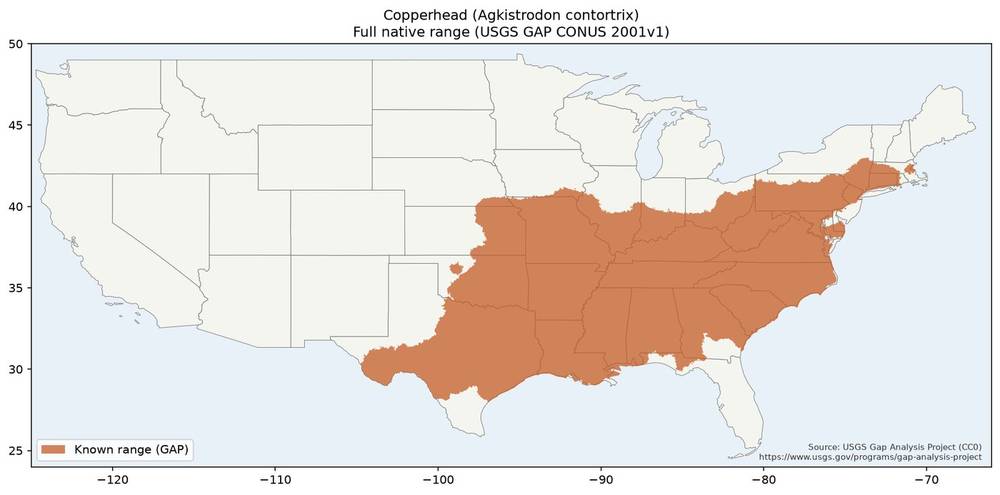
DNR’s copperhead fact sheet states that copperheads occur throughout most of Georgia except the southeastern corner. Across the United States they range widely over much of the eastern seaboard through the central states and into west Texas. The Venomous Snakes of Georgia brochure (range knowledge as of 2018) maps them across a broad swath of the state while reminding readers that range margins are estimated. No single venomous species covers all of Georgia; copperheads are among the most widely distributed of the seven venomous kinds. Bartow County / Cartersville sits well within the documented Georgia footprint.
Full species range map
Habitat preferences
Copperheads favor forested settings, especially mixed hardwoods, and tend to avoid open fields and agricultural expanses. Rocky wooded hillsides in the mountains, and swamp or river edges in the Piedmont and Coastal Plain, are classic places to find them. Habitats with abundant logs, leaf litter, and rocks for cover are preferred. DNR notes copperheads appear more tolerant of urban development than many snakes, often persisting in suburban neighborhoods where forest patches remain.
Natural history
Camouflage plus stillness make copperheads easy to overlook. They are ectothermic (poikilothermic): they depend on the environment to manage body temperature. In cooler weather they enter dormancy, using rock and boulder piles, crevices, hollow logs, or woodpiles; on warm days they may bask. Though they lack rattles, they may vigorously vibrate the tail against dry leaves or grass. Breeding occurs in spring and late summer; young are born live in late summer or early fall, usually in litters of fewer than ten. Captives have lived more than twenty years; wild snakes are known past fifteen. Raccoons, opossums, coyotes, and kingsnakes prey on them. Road mortality and unnecessary killing by people are significant human-related pressures.
Food preferences
Copperheads may sit and wait for prey or actively search. DNR lists frogs, lizards, and small mice among prey, plus large invertebrates. They are also well known for feeding on cicadas as those insects emerge on summer nights. That rodent and invertebrate diet is part of why snakes belong in healthy local ecosystems.
Temperament and encounters
DNR describes copperheads as shy and adaptable — the venomous species Georgians are most likely to meet, including near cities. Common myths (cucumber smell, uncontrolled juvenile venom, always traveling in pairs) are addressed in DNR’s fact sheet; dry bites occur, and DNR states their venom is the weakest among Georgia’s native venomous species, with human death nearly unheard of. Still, any bite deserves prompt medical attention. Most encounters end with the snake remaining still or moving away if given space. Cornering or attempting to kill a snake is when many bites occur.
Conservation and legal notes
DNR characterizes copperhead populations as generally abundant and stable across a wide distribution, though snakes are still frequently killed out of fear and struck on roads. In Georgia, it is illegal (a misdemeanor punishable by up to a $1,000 fine and a year in jail) to possess or kill many of the state’s nongame wildlife species, including non-venomous snakes (O.C.G.A. §27-1-28), per the Venomous Snakes of Georgia brochure. It is also illegal to disturb or destroy dens, holes, or homes of wildlife or to use explosives, chemicals, or other devices to drive wildlife — including venomous snakes — from those homes (O.C.G.A. §27-1-30). DNR materials emphasize the ecological value of both venomous and non-venomous snakes; they do not invite casual killing of either.
If you meet one
Give the snake room. Identify from a distance; do not handle, poke, or try to kill it. If a clearly identified venomous snake is where people or pets cannot safely share space, Georgia DNR points residents to private wildlife-removal specialists rather than do-it-yourself confrontation. Local educators and relocators — including community resources around Cartersville such as Etowah Valley Exotics when appropriate — can help with identification and, when needed, safe relocation and outreach.
If a bite occurs, follow Georgia Poison Center / DNR brochure guidance: stay calm; get medical help immediately (call 911 or the Georgia Poison Center at 1-800-222-1222); identify the snake by sight only; do not try to kill it; keep the patient calm and preferably lying down with the affected limb level with the body; do not give food, drink, or medications such as alcohol or pain pills; do not use a tourniquet; do not cut the wound; do not suck venom; do not pack the wound in ice. Leave the living snake alone and get care.