Florida Cottonmouth
Agkistrodon conanti
florida-cottonmouth
Snapshot
The Florida cottonmouth (Agkistrodon conanti) is one of two cottonmouth / water-moccasin species recognized in Georgia DNR’s Venomous Snakes of Georgia brochure alongside the northern cottonmouth (A. piscivorus). DNR treats them as two species and states that differentiating the species and their geographic distributions is difficult. This separate draft profile mirrors the northern cottonmouth page so the two can be merged later if Josh prefers a single entry. Shared DNR range language covers Coastal Plain waters and the western side of the state; cottonmouths are absent from most of northern Georgia. Venomous. Leave alone; learn watersnake look-alikes before assuming the worst.
Photos
Description and identification
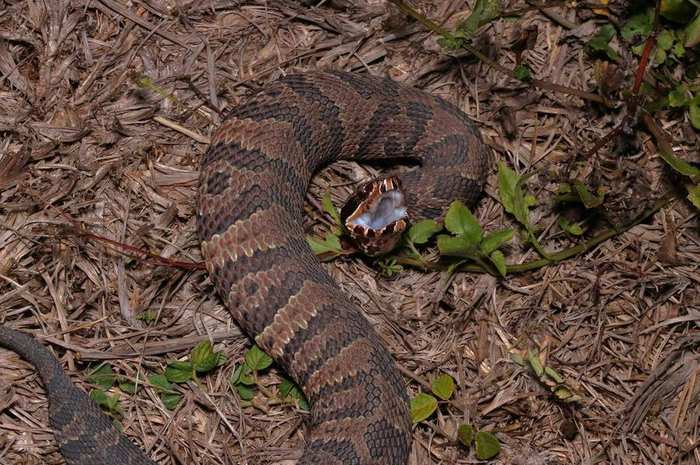
Published Georgia DNR fact-sheet morphology for “cottonmouth” applies to the group: heavy-bodied pit vipers with keeled scales, blocky heads distinct from the neck, a dark postocular stripe to the jaw corner, and facial heat pits. Most adults are under roughly 3 feet 3 inches; common lengths approach four feet; maximum near six feet. Banded brown, olive, or dark-gold patterns often fade as adults darken. Juveniles show brighter banding and a yellow-green tail tip. Defensive gaping reveals the pale mouth lining; tail vibration may accompany the display. Swimming with the head raised and the body high on the surface is characteristic relative to diving watersnakes. Field separation of A. conanti from A. piscivorus is not spelled out in the downloaded DNR PDFs — another reason this profile stays conservative on species-level ID traits beyond the Commons-labeled conanti photos.
Look-alikes
The same harmless Nerodia watersnakes confuse both cottonmouth species. DNR’s water-moccasin brochure highlights habitat and behavior differences, pattern (bands widest on top vs. on sides), pits and elliptical pupils in cottonmouths, and tail-scale rows as technical characters. Head shape alone is unreliable because watersnakes can flatten their heads when threatened. Protecting watersnakes from mistaken identity is a primary education goal.
Range in Georgia
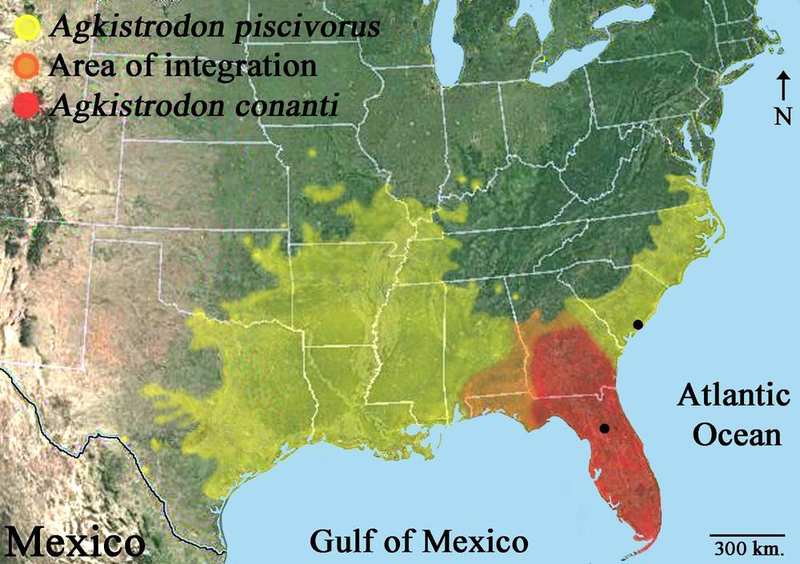
DNR does not publish a clean county-by-county split between northern and Florida cottonmouth in the sources downloaded for this draft. Combined guidance: cottonmouths occupy mostly the Coastal Plain, extend up Georgia’s western side, and are missing from the northeastern quarter and from most of northern Georgia. The full-range map below shows a published two-species interpretation in which A. conanti occupies Florida and adjacent southern Coastal Plain areas, with an integration zone across parts of southern Georgia — useful context, but still subject to DNR’s caution that differentiating distributions is difficult. Expect Florida cottonmouth associations with more southerly Coastal Plain contexts without inventing a hard DNR line.
Full species range map
Habitat preferences
Shared DNR habitat language: swampy, slow-water systems; vegetated lake, pond, and creek edges; occasional overland travel; upland stump-hole hibernation. Open large reservoirs are less typical cottonmouth habitat than backwaters and swamps.
Natural history
Activity can occur nearly any time of day; summer nights may see more movement. Live birth of roughly eight to ten young in late summer, multi-year lifespans in captivity (over fifteen years), and winter basking on mild days match the cottonmouth fact sheet. Cottonmouths climb trees only occasionally and do not regularly drop from branches as watersnakes do.
Food preferences
Fish, amphibians, other snakes, rodents, birds, and opportunistic carrion — cottonmouths are not picky. That broad diet links them tightly to wetland food webs.
Temperament and encounters
DNR repeatedly counters the chase-story reputation: research framing shows rare defensive strikes relative to bluff displays. Gaping is a warning, not a lunge invitation. Give any gape-displaying snake a clear exit and leave.
Conservation and legal notes
DNR calls cottonmouths abundant where found, with stable-seeming populations, while highlighting roadkill and persecution. Legal citations from the venomous-snakes brochure: O.C.G.A. §27-1-28 protects many nongame animals including non-venomous snakes from possession or killing; O.C.G.A. §27-1-30 forbids destroying dens or gassing/driving wildlife — including venomous snakes — from shelters. Do not invent a blanket “it is legal to kill venomous snakes” claim.
If you meet one
Observe from shore or a path; do not prod. Confirm you are not looking at a watersnake before escalating worry. For conflict situations, use experienced removal. Etowah Valley Exotics and similar Cartersville-area educators can support identification and, when suitable, free relocation conversations.
If bitten: calm; 911 or Georgia Poison Center 1-800-222-1222; hospital; sight-only ID; no killing the snake for “proof”; limb level; no tourniquet, cutting, sucking, ice, food, alcohol, or pain medication — per DNR brochure / Poison Center steps.