Northern Cottonmouth
Agkistrodon piscivorus
northern-cottonmouth
Snapshot
The northern cottonmouth (Agkistrodon piscivorus), also called water moccasin, is a heavy-bodied aquatic pit viper. *Georgia DNR treats cottonmouths as two species — northern (A. piscivorus) and Florida (A. conanti) — and notes that differentiating the species and their geographic distributions can be difficult.* Until ranges are clearer, this profile stands alone for easy merging later. Combined DNR range language places cottonmouths mostly in the Coastal Plain and up the western side of Georgia, absent from most of the northeastern quarter and from most of northern Georgia. Venomous — leave alone; identify from a distance. Harmless watersnakes are far more often what people meet in the water.
Photos
Description and identification
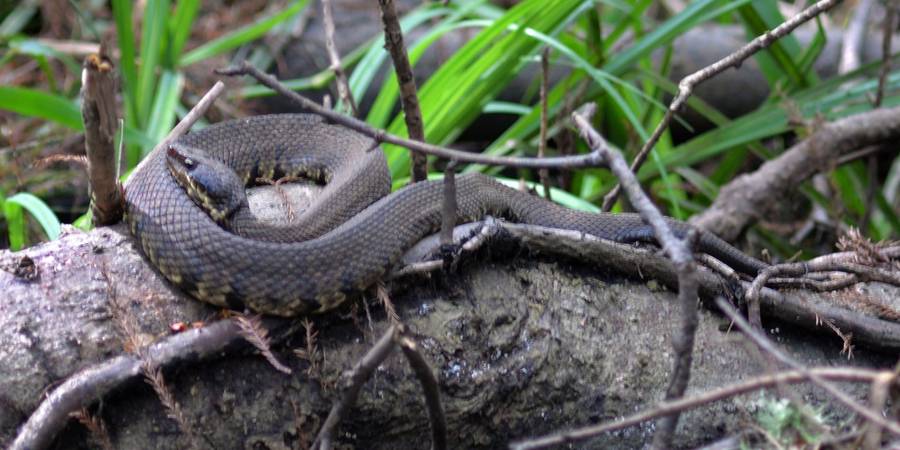
DNR’s cottonmouth fact sheet and Venomous Snakes of Georgia brochure describe relatively large, heavy-bodied pit vipers. Most are under about 3 feet 3 inches; adults commonly reach about four feet; maximum approaches nearly six feet. The head is large and blocky, very distinct from the neck, with a bold dark stripe that obscures the eye and runs to the back corner of the mouth. Heat-sensing pits sit between nostril and eye. The body has keeled scales and wide dark bands on a lighter brown, olive, or dark-gold background; many adults darken so that bands become obscured. Juveniles are lighter and brighter, with a yellow-green caudal lure tip. When threatened, cottonmouths may gape to show the white (“cotton”) mouth lining and may vibrate the tail. They often swim with the head elevated and the body riding high on the water.
Look-alikes
Misidentification drives unnecessary killing. DNR’s water-moccasin brochure emphasizes *nonvenomous watersnakes (Nerodia)* — brown, banded, northern, plain-bellied, and eastern green watersnakes. Watersnakes often bask on overhanging limbs and dive when disturbed; cottonmouths more often bask on land, stumps, or logs near the surface. Watersnake bands (when present) are typically widest on top; juvenile/patterned cottonmouth bands are widest on the sides. Watersnakes have round pupils and lack facial pits; cottonmouths have elliptical pupils and pits (never handle a live uncertain snake to check). Killing a watersnake “just in case” is harmful and, for nonvenomous snakes, illegal under state nongame protections.
Range in Georgia
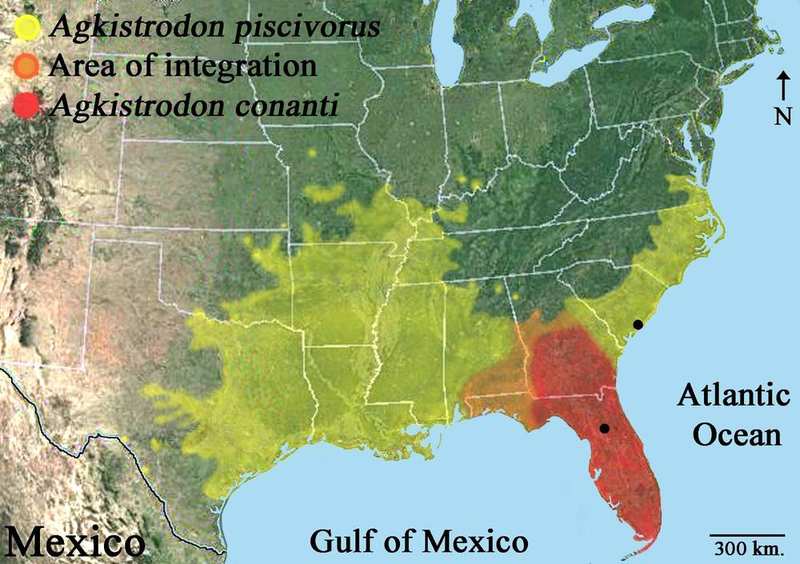
DNR fact sheet: cottonmouths are confined mostly to the Coastal Plain but extend up the western side of the state; they are absent from the northeastern quarter. The water-moccasin brochure stresses they do not occur naturally in most of northern Georgia, unlike watersnakes (statewide). Combined predicted range maps in the venomous-snakes brochure do not cleanly split northern vs. Florida cottonmouth — reflecting DNR’s statement that differentiating species and distributions is difficult. The full-range plate below shows a published two-species interpretation across the Southeast (including an integration zone); treat fine lines as provisional relative to DNR’s caution. Cartersville / Bartow County sits near the northern edge of cottonmouth concern: many local waterside snakes are watersnakes, not moccasins.
Full species range map
Habitat preferences
Semi-aquatic. Cottonmouths prefer swamp-like habitats and can be abundant there; they also use edges of slow-moving rivers, vegetated lakes, farm ponds, and creeks. They may move overland and occasionally appear far from water. They generally hibernate in dry upland areas such as stump holes. They tend to avoid large open reservoirs relative to some watersnake species.
Natural history
Cottonmouths can be active at nearly any time; summer activity may shift more nocturnal. Litters of about eight to ten young are born in late summer. Captives have lived over fifteen years. They bask even on sunny winter days. They are both ambush and active hunters. Myths of nests of moccasins chasing people belong to folklore; DNR framing emphasizes rare defensive strikes relative to bluffing. Snakes that drop from overhanging limbs into boats are nearly always watersnakes.
Food preferences
Diet is broad: fish, frogs, other snakes, rodents, birds, and even discovered carrion. Young may be eaten by opossums, raccoons, birds of prey, and kingsnakes; alligators and feral hogs are among the few serious predators of adults.
Temperament and encounters
DNR’s fact sheet pushes back on the aggressive legend: cottonmouths show measured awareness and curiosity more than unprovoked attack. They may hold their ground and gape, then escape if given a path. Venom is for prey. Most bites happen when people try to capture, harass, or kill snakes. Respect the warning display and walk away.
Conservation and legal notes
Where present, cottonmouths are generally common with seemingly stable populations; cars and human killing are major threats. It is illegal in Georgia to possess or kill many nongame species including non-venomous snakes (O.C.G.A. §27-1-28). It is illegal to disturb dens or use explosives, chemicals, or other devices to drive wildlife — including venomous snakes — from their homes (O.C.G.A. §27-1-30). The water-moccasin brochure was written so people would stop killing harmless watersnakes.
If you meet one
Do not assume every waterside snake is a cottonmouth. Watch from a distance; let it move. If a confirmed venomous snake is in a high-conflict spot, seek qualified removal. Educational relocators in the Etowah Valley / Cartersville community can help with ID and calm next steps when appropriate.
Bite care per DNR / Georgia Poison Center: stay calm; call 911 or 1-800-222-1222; hospital promptly; ID by sight only; do not kill the snake; keep patient calm with limb level; no food/drink/meds; no tourniquet, cutting, sucking, or ice.