Pigmy Rattlesnake
Sistrurus miliarius
pigmy-rattlesnake
Snapshot
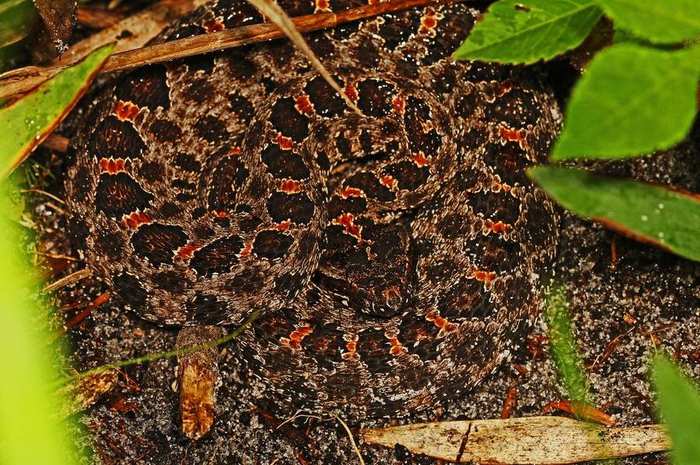
The pigmy (also spelled pygmy) rattlesnake — often called a ground rattler — is Georgia’s smallest rattlesnake: a stout little pit viper usually 16–21 inches long, with a row of dark dorsal spots, side spots, sometimes a reddish middorsal stripe, and a tiny rattle that sounds more like an insect buzz than a classic rattle. Georgia DNR recognizes Carolina (S. m. miliarius) and Dusky (S. m. barbouri) subspecies with different regional footprints and wide gaps in known range. Venomous. Leave alone; identify from a distance. No EVE Animal Pictures species folder yet — photos below are Commons stock with accurate labels.
Photos
Description and identification
DNR’s pigmy rattlesnake fact sheet and brochure: heavy-bodied pit vipers with a blocky head and nine large scales on the crown (unlike the small head scales of Georgia’s other two rattlesnakes). Heat pits sit between nostril and eye. Adults usually 16–21 inches (brochure 16–23); maximum reported 31 inches; newborns about 5 inches. Keeled body scales; slender tail ending in a poorly notched, very small rattle — some individuals reportedly lack a rattle. Pattern: a series of light-edged dark blotches or spots (22–45) on the back plus one to three rows of dark spots on the sides; a reddish stripe may run down the center of the back. Dusky subspecies: ashy gray with dark stippling (dirty/dusty look) and often a third row of dark smudges. Carolina subspecies: brownish, bluish gray, or reddish backgrounds that look cleaner. Juveniles have a bright yellow-green caudal lure tip.
Look-alikes
Often confused with hognose snakes, especially the *southern hognose (Heterodon simus): stout body, blunt head, dark dorsal spots with an orangish stripe. Hognoses have a thick tail without* a rattle and a sharply upturned, pointed snout. Eastern hognose is also listed among brochure look-alikes. Learning that tiny “buzz” and the rattle (when present) matters — but never pick up a snake to check.
Range in Georgia
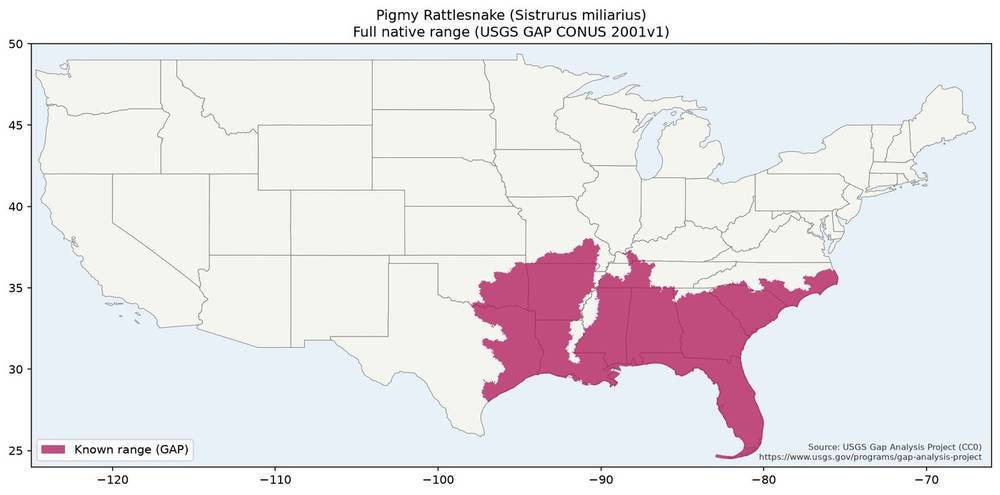
Carolina subspecies: Piedmont and Mountain regions, mainly on the eastern side. Dusky subspecies: lower Coastal Plain. DNR notes wide gaps in known range; U.S. range runs from southeastern North Carolina to eastern Texas and Oklahoma. Brochure status: uncommon overall, though densities can be high locally; small size and cryptic habits mean many individuals are overlooked. Range knowledge margins should be treated cautiously.
Full species range map
Habitat preferences
Found from dry sandhills and longleaf pine forests to wet hammocks and seasonally flooded pine flatwoods, at elevations of 0–1,640 feet. In southern Georgia, DNR notes they specifically thrive in saw palmetto thickets. Also pine-hickory forests, scrub, and hammocks per the fact sheet.
Natural history
Mostly daytime-active; summer evenings and nights may see more movement. Summer into autumn is a high surface-activity period for breeding males; babies are born then from the previous year’s matings, with litters up to about 12. Captives have lived over fifteen years; wild longevity is poorly known. In cooler weather, especially northward, they may enter dormancy, using stump holes, rock piles, crevices, or small animal burrows. Ambush predators that may wait days for prey. The faint rattle is often compared to a small insect buzzing. Raccoons, opossums, foxes, birds of prey, racers, and kingsnakes are predators.
Food preferences
Small frogs, lizards, small mice, and large invertebrates.
Temperament and encounters
Often described as “feisty” because of rapid tail-waving and head-jerking, but DNR says they tend to be slow to strike and rely on camouflage. Venom is largely cytotoxin-based, causing significant local pain, swelling, and bruising; bites are rare and usually involve a hand or foot. Still seek medical care for any bite. Do not handle.
Conservation and legal notes
Localized distribution; populations appear stable where found. Threats: habitat loss, roads, and persecution simply because they are rattlesnakes. Georgia nongame law (O.C.G.A. §27-1-28) protects many species including non-venomous snakes from possession or killing; O.C.G.A. §27-1-30 forbids destroying dens or using chemicals/explosives to drive wildlife — including venomous snakes — from homes.
If you meet one
Step back; the snake is easy to overlook and easy to step near. Identify from a distance. For conflict near homes, use qualified help. Cartersville-area educators such as Etowah Valley Exotics can assist with ID and education when appropriate.
Bite guidance: stay calm; 911 or Georgia Poison Center 1-800-222-1222; hospital; sight-only ID; no killing the snake; limb level; no tourniquet, cutting, sucking, or ice.