Timber Rattlesnake
Crotalus horridus
timber-rattlesnake
Snapshot
The timber rattlesnake — also called canebrake in southern Georgia — is a large, heavy-bodied pit viper with dark chevron or butterfly-shaped crossbands, a solid black “velvet” tail, and a segmented keratin rattle. Georgia DNR reports it across nearly all of the state except a few extreme southwestern locations, favoring wooded, relatively undisturbed country. It is venomous. The DNR brochure notes that timber rattlesnakes (along with eastern diamondbacks and cottonmouths) are among the venomous species that more realistically represent a serious threat to human life if a bite occurs — yet that risk remains remote compared with many everyday hazards. Identify from a distance and leave the snake alone.
Photos
Description and identification
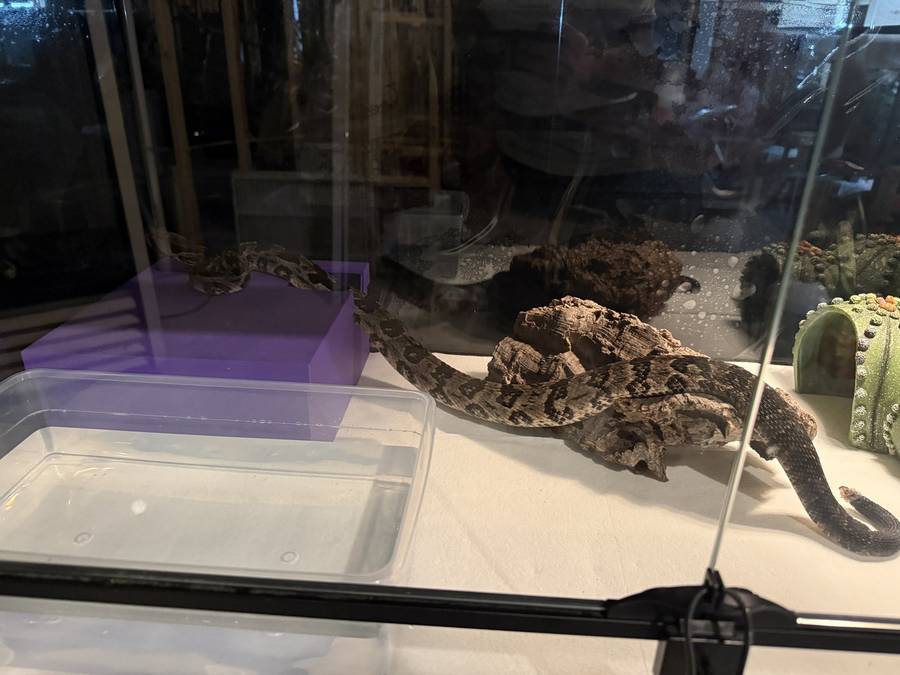
DNR’s timber rattlesnake fact sheet and brochure describe a large, heavy-bodied snake with keeled scales and an undivided anal plate. Background colors range through pink, yellow, tan, gray, brown, olive, and even velvety black. A series of brown to black chevron-shaped crossbands (roughly 15–34) typically crosses the body; some northern animals show more rounded blotches. There may or may not be a stripe from the eye toward the jaw. The head is wide and gracefully angled, distinctly wider than the neck, with heat-sensing pits between eye and nostril. The tail is solid black and tipped with interlocking keratin rattle segments that buzz harshly when shaken.
Young resemble adults but are about a foot long at birth and grayish. Mountain populations (often called “timbers”) tend to be a bit smaller (about 3.5–4 feet) and may den communally in rocky uplands; some individuals are mostly black. Southern “canebrake” animals are often larger (about 4.5–5 feet), with bold chevrons and frequently a reddish-orange middorsal stripe on gray, brown, tan, yellow, orange, or even pink backgrounds. Brochure length notes: maximum nearly 6 feet in the Coastal Plain and about 5 feet in the mountains, with most 3–5 feet.
Look-alikes
People sometimes confuse other large patterned snakes with timber rattlesnakes, especially at a glance in leaf litter. Nonvenomous snakes that share wooded habitats — including various rat snakes — may be misidentified when fear fills in the blanks. Key timber cues from DNR materials include the solid black tail, the rattle, the heavy body, and the chevron pattern. A snake without a rattle is not a timber rattlesnake, though shed skins or broken tail tips can confuse observers. When unsure, do not approach; many harmless snakes are killed because someone “thought it rattled.”
Range in Georgia
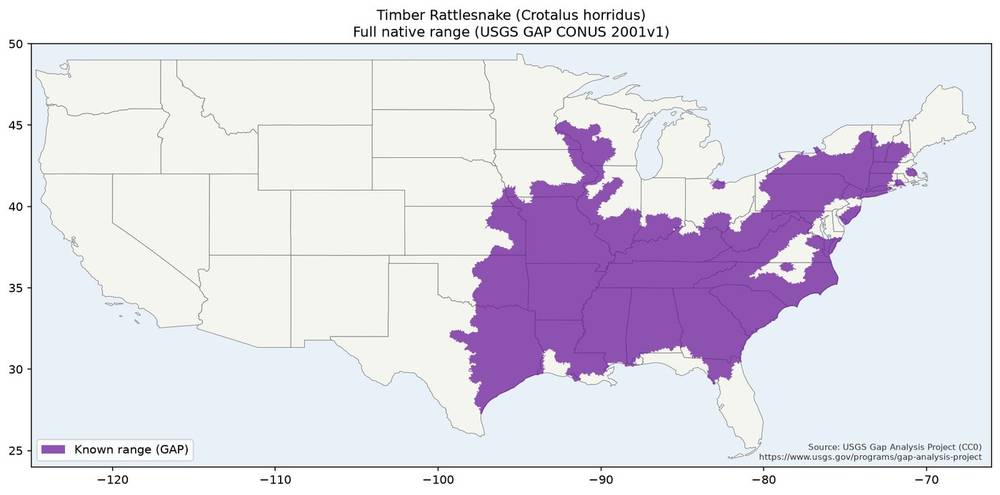
The fact sheet states timber rattlesnakes occur throughout Georgia except a few locations in the extreme southwestern corner. In the U.S. they occupy much of the eastern half of the country. DNR’s brochure describes them as common in much of the heavily wooded Coastal Plain (more limited to wooded stream corridors in open country), with a spotty presence on barrier islands and the immediate coast; highly fragmented in the Piedmont due to habitat loss; and localized around suitable den sites in the mountains. Range depictions in the brochure reflect knowledge as of 2018; margins are estimated.
Full species range map
Habitat preferences
Preferred habitats are wooded and relatively undisturbed — especially mixed pine-hardwood forests. Southern forms favor bottomlands and floodplains; northern forms favor rocky upland slopes and mountains. DNR notes they are often found near old homesites and barns because of cover and prey. Denning and shelter include root and stump holes, mammal burrows, old home sites and debris piles, and — especially in uplands — rock crevices.
Natural history
DNR notes that “timber” and “canebrake” forms differ in size, color, and habits even without genetic variation justifying separate species in that fact sheet’s framing. Courtship and mating occur in late summer and early fall; young are born live the following late August or September. Captives have approached 40 years; wild animals around 30. In northern Georgia they enter dormancy. Ambush hunting may include coiling beside a fallen log with the chin angled to detect prey. Young may be taken by kingsnakes, racers, large raptors, bobcats, and feral hogs; few predators tackle adults.
Food preferences
Timber rattlesnakes eat warm-blooded prey almost exclusively: mice, rats, chipmunks, squirrels, and ground-associated birds such as bobwhite quail and songbirds. By consuming white-footed mice, an individual may inadvertently take in large numbers of ticks annually, which DNR frames as helping reduce tick numbers in the landscape — an ecological service worth remembering when fear is the first reaction.
Temperament and encounters
Despite their size and fame, DNR describes timber rattlesnakes as rather shy and inclined to avoid development and interaction. They often sit motionless and rely on camouflage; rattling is a warning to move along, not a guaranteed prelude to a strike. A surprised snake can strike without rattling first — so the myth that rattlesnakes “always warn” is unsafe. Claims that they hypnotize prey are unfounded. Give them a wide berth on trails and around old structures; do not corner them.
Conservation and legal notes
Populations can be robust in some areas and fragmented or declining in others, especially where habitat is lost. People often kill them on sight. In the mountains they are hunted to some extent and appear to have declined in many areas in recent years, per the brochure. Georgia law (O.C.G.A. §27-1-28) makes it illegal to possess or kill many nongame wildlife species, including non-venomous snakes. O.C.G.A. §27-1-30 prohibits disturbing dens or using explosives, chemicals, or other devices to drive wildlife — including venomous snakes — from their homes. DNR does not frame casual killing as a conservation solution.
If you meet one
Stop, back away, and let the snake choose its path. Identify only from a distance. If a timber rattlesnake is in a place where people or pets cannot safely coexist, use qualified removal help rather than attempting capture. Community educators around Cartersville — including Etowah Valley Exotics in appropriate free-relocation or outreach situations — can support calm identification and learning.
For a bite: stay calm; call 911 or the Georgia Poison Center (1-800-222-1222); get to a hospital promptly; identify by sight only; do not try to kill the snake; keep the patient calm and still with the limb level; do not give food, drink, or medications; do not use a tourniquet, cut the wound, suck venom, or pack the bite in ice — matching DNR / Georgia Poison Center brochure advice.